This blog is based on the analysis titled, Frost Radar™: Digital Trust and eSignature Ecosystem, 2026, authored by Frost & Sullivan’s growth expert, Riana Barnard from the Digital Content Services team.
In a digital-first economy, every business transaction and agreement often comes down to one question: can it be trusted, verified, and completed faster, more securely, and without the hassles of physical signing and long paper trails? Today, thanks to disruptive technologies, previously siloed layers of signature, identity, and integrity are coming together under a unified framework for trusted digital interactions. What was once considered a back-office capability or compliance checkbox for signing documents has become a key component of digital transformation. Every customer onboarding journey, contract approval, account opening, and digital exchange now depends on trust being established instantly and at scale. That need is intensified by new developments in AI and post-quantum cryptography, which necessitate swift change in how organizations approach security.
Build Your Digital Trust Strategy for 2030
Our latest growth podcast highlights transformation drivers, competitive strategies, and best practices from providers like Tinexta InfoCert, Namirial, DocuSign, DigiCert, and more!
to prepare you teams for eIDAS 2.0, digital identity wallets, AI‑enabled fraud mitigation, and cryptographic resilience.
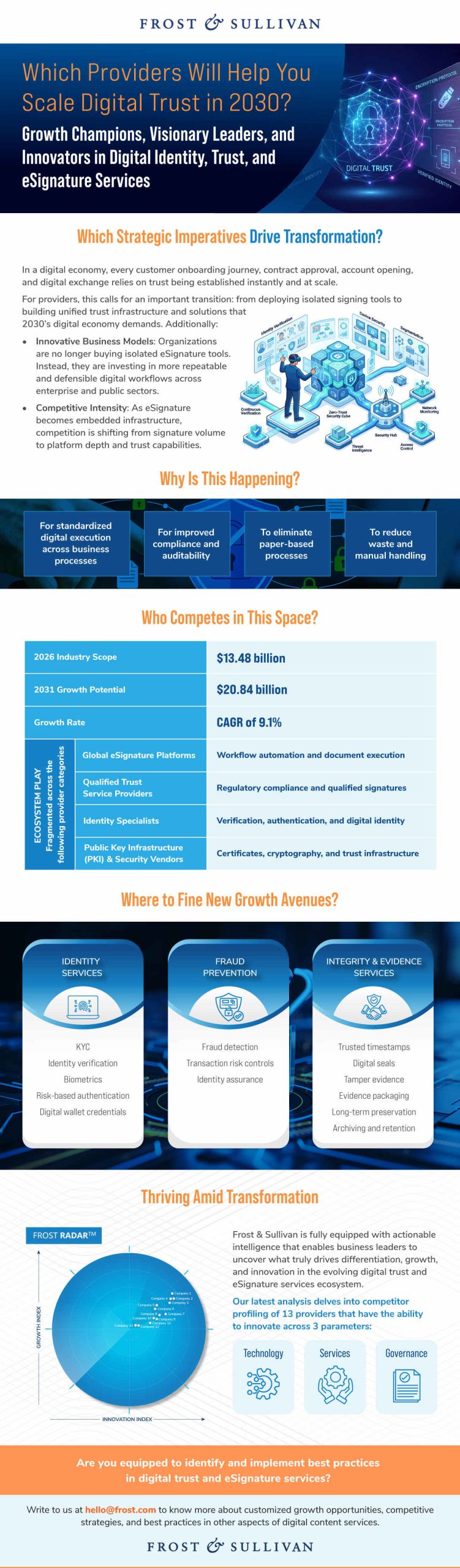
But while eSignatures have achieved widespread adoption, businesses still struggle to extend digital trust beyond the act of signing. Additionally, there’s friction and fragmentation across existing digital workflows. To combat this, a diverse provider ecosystem of over 80 vendors—including eSignature providers, European Qualified Trust Services, identity-first specialists, and Public Key Infrastructure (PKI)-centric security vendors—is coming together and reinvigorating conventional trust/ identity services. This lays the foundation for a future where high-assurance digital transactions become as common as physical handshakes.
Maximize Digital Trust With These Mega Trends
What makes this transformation particularly difficult to track is that it is not being driven by a single technology, but by several interconnected megatrends unfolding in parallel:
- Rising Risk in the Age of AI: Cyber threats are becoming more sophisticated, while AI-generated content is making it increasingly difficult to distinguish authentic information from manipulated content. Consequently, providers feel the pressure of addressing concerns around repudiation risk, regulatory exposure, and AI-enabled fraud.
- Trust Without Borders: The introduction of eIDAS 2.0 and the European Digital Identity (EUDI) Wallet framework has raised the stakes of assurance levels, interoperability, and cross-border recognition. In response, providers must find new ways to navigate regulatory complexity without compromising on legal certainty across jurisdictions.
- The Evolution of Digital Identity: The identity layer has become the fastest-evolving component of the ecosystem, fueled by AI-enabled identity verification, biometric authentication, and reusable digital identity credentials. This is prompting providers to pay closer attention to long-term validation as post-quantum cryptographic (PQC) becomes critical for security.
- From Transactions to Trust Platforms: Existing gaps in point solutions are accelerating the move from transactional signing tools to end-to-end trust service platforms. As a result, providers must strengthen their role in the ecosystem by tying together signature, identity, and integrity with interoperable layouts built on cryptographic assurance.
- The Rise of Machine Identity: With the automation of digital transactions, trust requirements are extending beyond human signers to include applications, devices, and software-driven processes. Because of this, the urgency of expanding trust frameworks to incorporate machine identity, code signing, and software integrity throughout the digital lifecycle is at an all-time high.
Do you have the tools to measure the impact of these megatrends on your organization’s 2030 trust strategy?
Why Trust Services Require a New Approach
🎧 Listen to Our Growth Podcast to Know More! 🎧
Best Practices the Separate Leading Providers from the Rest
Going forward, competitive differentiation increasingly depends on how effectively providers connect assurance, usability, and operational scale, while supporting regional regulatory, security, and business requirements.
- Embedding digital signing into identity and risk: Identity verification, biometric authentication, fraud detection, and auditability can be more tightly connected. Rather than treating signing as a standalone event, providers are extending trust across the broader transaction journey.
- Unifying technology, services, and governance: Technology, services, and governance are becoming harder to separate. Resilient architecture, automation, compliance expertise, and responsible AI are increasingly coming together to support trust at scale.
- Eliminating friction between tools and platforms: Even the most advanced capabilities and tools can struggle to gain traction when implementation is complex. Simpler deployment, clearer legal defensibility, and faster time-to-value continue to shape adoption decisions.
Which growth processes will help your teams implement these best practices in eSignature services?
Competitive Benchmarking
Frost & Sullivan has growth and innovation strategies across the full Digital Content Services value chain. To know more about segment-specific growth champions, visionary leaders, contenders, and innovators, view these analyses:
Digital Trust and eSignature Services: Growth Focus
Much of the ecosystem’s future growth potential sits outside the eSignature itself. As digital transactions gain traction, the following avenues can help providers secure their revenue pipelines:
- Value-add Services: Tomorrow’s expansion promise is increasingly tied to identity services, fraud mitigation, and evidence capabilities. This means that KYC, reusable credentials, timestamps, seals, and long-term preservation are becoming part of a broader trust-based value proposition.
- Automated Compliance: eIDAS 2.0, the EUDI Wallet, and evolving regulatory frameworks are increasing the need for end-to-end trust solutions that simplify compliance, while supporting interoperability across jurisdictions.
- AI, Crypto Agility, and Machine Trust: AI-driven fraud detection, post-quantum readiness, code signing, and machine identity are broadening the role of digital trust. What began with human signers is steadily extending to software, devices, and automated processes.
Do you have the tools to identify, analyze, and act on other growth opportunities in this space?
Ready to Lead the Transformation?
- Book a Growth Dialog:Align your 2026 digital identity and trust strategy with Frost & Sullivan’s Growth Pipeline™ Dialog.
- Engage with Growth Experts:Co-design AI-enabled, data-driven tools that scale commercial impact across industries.
- Share Your Transformation Story: Position your organization as a transformation leader in digital content services through Frost & Sullivan’s Transformational Growth Leadership program.
- Join the Growth Council:Collaborate with global digital content service leaders shaping future ICT ecosystems.
- Nominate for Best Practices Recognition:Be recognized for excellence in growth, technology, innovation, and customer value leadership across the ICT landscape.
- See Industry Positioning on the Frost Radar™:Benchmark your growth performance and innovation strength against other growth champions, visionary leaders, contenders, and innovators.
- Activate Brand & Demand Growth: Accelerate awareness, engagement, and revenue growth through integrated brand and demand generation strategies.
The Digital Trust and eSignature Ecosystem: Frequently Asked Questions (FAQs)
• What is the difference between digital trust and cybersecurity?
While cybersecurity focuses on protecting IT systems and data from threats, digital trust encompasses the broader confidence users have in digital interactions. It includes security, identity verification, privacy, transparency, compliance, and reliability. Organizations can have strong cybersecurity controls yet still struggle with digital trust if customers question the authenticity or integrity of digital transactions.
• How does digital trust impact customer acquisition costs?
Consumers are increasingly cautious about sharing personal information online. Businesses that demonstrate strong digital trust practices often experience higher conversion rates and lower abandonment during onboarding. Trusted digital experiences can reduce customer acquisition costs by minimizing friction, improving confidence, and accelerating approval processes throughout the customer journey.
• How can businesses combat deepfake-related fraud?
Organizations are increasingly investing in behavioral analytics, biometric verification, and multi-factor authentication to combat deepfake attacks. Combining multiple verification methods reduces reliance on a single trust signal and helps organizations identify manipulated content before it impacts customer onboarding, approvals, or financial transactions.
• Which emerging technologies are expected to transform digital trust by 2030?
Several technologies influence the next phase of digital trust, including decentralized identity systems, confidential computing, quantum-resistant cryptography, AI governance frameworks, autonomous agents, and advanced machine identity solutions. These innovations aim to strengthen trust across increasingly automated and interconnected digital ecosystems.