This blog is based on Frost & Sullivan’s analysis, “Growth Opportunities in the Global Combat Cloud for Defense Applications Market,” authored by Wayne Shaw from the Aerospace & Defense Practice Area.
As modern battlefields evolve, so does the need for faster, more integrated, and more secure decision-making. Militaries around the world are embracing combat cloud solutions to drive digital transformation, support multi-domain operations, and ensure strategic superiority. Despite the benefits, the transition poses challenges that include significant investment in secure infrastructure, seamless integration with legacy systems, and complex data migration processes.
To accelerate adoption and modernization, defense agencies are turning to commercial cloud providers. These platforms offer rapid deployment, built-in scalability, and proven architectures tailored for mission-critical applications.
Key Growth Drivers Accelerating Cloud Combat Adoption
- National Cloud Modernization Programs
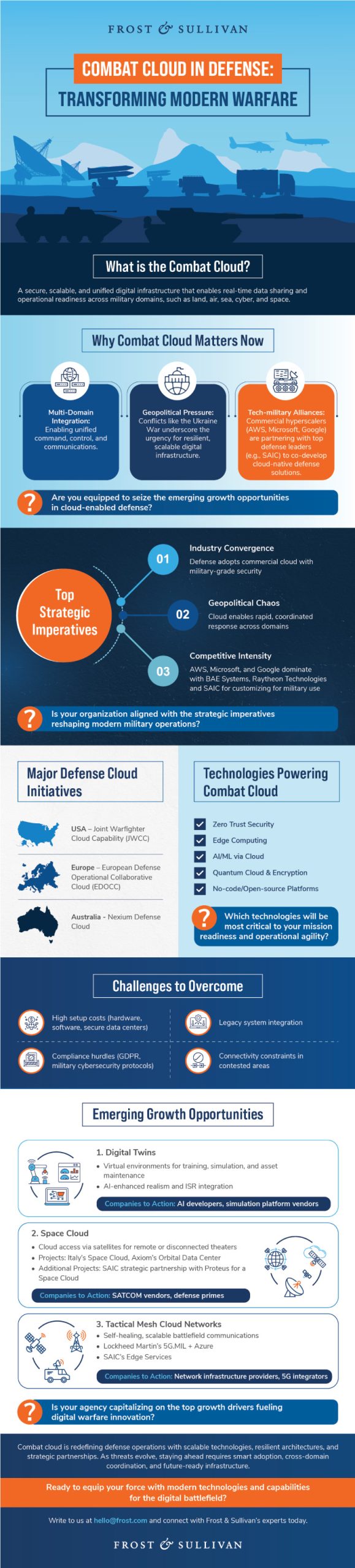
Long-term cloud initiatives are becoming central to defense strategies worldwide. Flagship initiatives include:
- United States Department of Defense (US DoD) – Joint Warfighter Cloud Capability (JWCC)
- Europe – European Defense Operational Collaborative Cloud (EDOCC)
- Australia – Nexium Defense Cloud
- Multi-domain Training & Combat Readiness
Militaries are prioritizing joint force readiness through ever more integrated training scenarios so that all domains and forces fight as one. Combat cloud technologies enable seamless data sharing, command, and control across branches, making them essential for real-world mission success.
- Faster Acquisition & Deployment Timelines
Given the commercial foundation of many combat cloud systems and their proven track record in the commercial space, militaries are turning to OEMs for ready-built solutions instead of developing them in-house. This approach significantly shortens acquisition cycles and accelerates deployment of combat cloud technologies.
Ready to capitalize on the growth opportunities driving global cloud adoption in defense?
Strategic Imperatives Fuelling Combat Cloud Adoption
- Industry Convergence
Defense agencies are embracing commercial IT innovations to support secure, scalable architectures. Technologies such as DevSecOps, advanced encryption, and Military Internet of Things (MIoT) are enabling more agile, interconnected defense ecosystems that are not possible with only “On Prem” storage and computing capability.
- Geopolitical Chaos
Modern conflicts highlight the need for unified situational awareness more than ever before. Combat cloud holds the promise of more real-time, multi-domain operations by giving commanders a shared operational picture across land, air, sea, cyber, and the electromagnetic spectrum.
This is an aspirational goal that the combat cloud is bringing closer to reality with its limitless storage and compute capacity to process the voluminous amount of data created by modern conflict (e.g., the parametric data from electromagnetic spectrum operations).
- Competitive Intensity
Tech giants like Microsoft, Google, and AWS are collaborating with defense leaders such as BAE Systems, Raytheon Technologies, and SAIC to deliver military-grade cloud solutions. Their global infrastructure and trusted reputations give them a clear edge, as militaries increasingly favor one-stop-shop models that combine commercial platforms with defense-specific customization.
Is your defense strategy aligned with today’s innovation drivers, operational risks, and technology partnerships?
Get Full Access to the Latest Analysis
Discover what’s powering the next wave of cloud-enabled military operations
Emerging Growth Opportunities in Combat Cloud Applications
- Digital Twins for Combat Scenarios
Digital twins are revolutionizing how militaries train, plan, and simulate operations. When powered by AI, digital twins can simulate real-world contingencies, predict system failures, and extend the lifespan of expensive physical assets (e.g., jet aircraft, main battle tanks, and submarines) by reducing physical wear and tear. And as it is said in aviation, “A good pilot (or tanker or submariner or fill in the blank military specialty) is always training.”
- Space Cloud for Isolated Theaters
Space cloud architectures, enabled by satellite constellations, bring cloud-based services to regions with limited or no terrestrial infrastructure. Projects like Italy’s Military Space Cloud Architecture and Axiom Space’s Orbital Data Centers signal the growing role of orbital computing. Another example is SAIC’s partnership with Proteus for a Space Cloud solution.
- Tactical Mesh Cloud Networks
In high-threat environments, resilient mesh networks are becoming essential. These decentralized networks rely on multiple interconnected nodes to maintain uninterrupted data flow even if a node (or two) is taken out by enemy action.
Solutions like Lockheed Martin’s 5G.MIL UNS mesh, integrated with Microsoft Azure, highlight the potential of commercial-military partnerships to create agile, combat-ready architectures.
Are you capitalizing on the next wave of cloud-enabled defense technologies to future-proof your military operations?
Key Technologies & Providers Shaping the Industry
Leading vendors such as AWS, Microsoft, Google, and Oracle dominate the global cloud market, with defense incumbents like Thales, Northrop Grumman, SAIC Edge Services and Leonardo emerging as strong challengers.
Emerging technologies driving transformation include:
- Blockchain & Encryption: Secure, tamper-proof data management
- No-code/Open-source Platforms: Agile, cost-efficient development
- Quantum Cloud Computing: Accelerated modeling and analytics
- Zero Trust Architecture: Advanced access control and security
- AI/Machine Learning (ML) via Cloud: Scalable intelligence for threat detection and planning
- Edge Computing: Localized data processing for reduced latency
Is your defense organization leveraging next-gen cloud technologies to enhance security, agility, and mission effectiveness?
The global defense sector is at a critical inflection point. Combat cloud is a transformative enabler of military superiority in the digital age. From virtual training environments and AI-powered decision systems to resilient tactical networks, the future belongs to defense forces that modernize smartly, integrate swiftly, and collaborate globally.
Next Steps: Looking to explore strategic partnerships or cloud solutions tailored to defense?
Schedule a Growth Pipeline Dialog to speak to our Aerospace & Defense experts or reach out to us on [email protected].
To explore the key innovations and leading providers, and opportunities shaping the future of combat cloud systems, download our latest analysis, “Growth Opportunities in the Global Combat Cloud for Defense Applications Market.”