This blog is based on Frost & Sullivan’s recent analysis, NATO Members Defense Market Overview, 2025–2027, authored by growth expert Wayne Shaw from the Aerospace and Defense Practice Area.
NATO defense spending is becoming a stronger indicator of supplier opportunity, industrial positioning, and modernization execution across member-state defense priorities. As members align budgets with readiness, production scale, and technology adoption, growth potential is concentrating around interoperable systems, surge-ready manufacturing, supply resilience, and faster fielding.
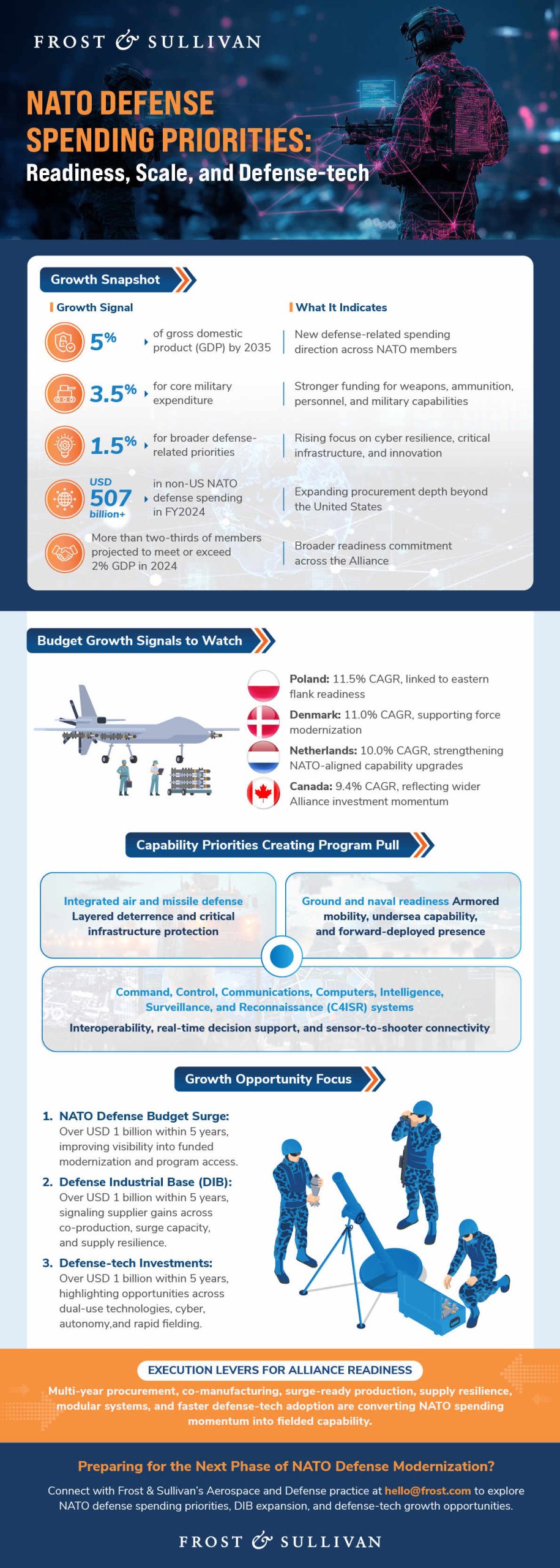
The 2025 NATO Summit in The Hague reinforced this direction, with member states pledging to raise annual defense expenditure to 5% of gross domestic product (GDP) by 2035. Of this, 3.5% is directed toward core military capabilities, while 1.5% is tied to cyber resilience, critical infrastructure, and innovation. NATO’s refreshed Defense Production Action Plan and Industrial Capacity Expansion Pledge further connect spending commitments with collaborative procurement, interoperability, and industrial scale.
Turning NATO Defense Spending into Growth Priorities
Frost & Sullivan’s sample analysis helps defense leaders assess:
- NATO defense budget shifts and the 5% GDP spending direction
- Capability priorities across air and missile defense, ground, naval, and C4ISR clusters
- Defense industrial base (DIB) expansion, surge-capable production, and supply resilience
- Growth Opportunities across budget acceleration, DIB reinforcement, and defense-tech investments
Download the Strategic Analysis
Investment momentum is advancing across air and missile defense, naval and aircraft programs, munitions, unmanned systems, and command, control, communications, computers, intelligence, surveillance, and reconnaissance (C4ISR) systems, linking the NATO defense budget more closely to defense industrial base (DIB) readiness and supplier participation.
Listen to Our Growth Podcast Episode on NATO Defense Spending and Alliance Modernization Priorities
Budget Momentum Is Becoming Capability Delivery
- The 2% GDP benchmark is becoming a readiness baseline, with more than two-thirds of NATO members projected to reach or exceed it in 2024.
- Defense spending by NATO members outside the United States exceeded USD 507 billion in fiscal year 2024, showing broader investment depth beyond a few large contributors.
- Funding momentum is advancing multi-domain modernization across air and missile defense, connected command structures, autonomous capabilities, cyber resilience, and high-readiness ground and naval forces.
- NATO defense spending is gaining commercial relevance where budgets convert into deployable, interoperable, and industrially supported capabilities.
Strategic Imperatives Turning NATO Readiness into Industrial Scale
- Internal Challenges: NATO’s shift from the 2% benchmark toward a 5% GDP defense-related spending direction is raising pressure around readiness, capability gaps, and execution capacity. Funding visibility is becoming commercially relevant where it connects with acquisition speed and deployable capability.
- Geopolitical Chaos: The Russia-Ukraine war is intensifying European defense posture changes, eastern flank reinforcement, rapid mobility, air defense, long-range fires, joint procurement, and stockpile replenishment.
- Industry Convergence: NATO defense industries are advancing toward mass production, localization, co-production, start-up participation, and consolidation. The competitive environment is becoming more closely tied to industrial depth than platform supply alone.
NATO defense spending is creating a more selective growth environment. Strategic value is concentrating where political commitment converts into scalable production, interoperability, and resilient DIB capacity across Alliance modernization priorities.
How will NATO’s defense surge reshape supplier relevance across the next phase of Alliance modernization?
Growth Forces Converting NATO Spending into Execution Pressure
- Demand Signals Accelerating Growth
NATO defense spending is advancing from budget commitment into multi-domain defense modernization. Spending pressure, military modernization, and DIB reinforcement are directing investment toward integrated air and missile defense, C4ISR systems, autonomous capabilities, munitions, cyber resilience, and high-readiness ground and naval forces. - Execution Pressures Affecting Scale
Industrial bottlenecks, inflation, supply chain disruption, limited national stockpiles, just-in-time production models, fragmented procurement, and regulatory and export hurdles are affecting contract timelines and cross-border cooperation. These pressures are making delivery capacity as important as budget expansion.
Capability Segments Defining NATO Procurement Priorities
- Integrated Air and Missile Defense
Integrated air and missile defense is gaining stronger procurement relevance as NATO members reinforce deterrence, protect critical infrastructure, and strengthen eastern flank readiness. Demand is moving toward layered sensing, intercept, and command architectures that support faster response across contested environments. - Ground and Naval Readiness
Ground modernization is advancing around high-readiness land forces, armored mobility, long-range fires, and NATO-standard platforms. Naval priorities are expanding across undersea capability, maritime missile defense, uncrewed systems, and forward-deployed readiness. - Connected and Autonomous Defense Capabilities
C4ISR systems, cyber-electromagnetic capability, unmanned systems, and digital command structures are becoming central to multi-domain coordination. Their value is tied to interoperability, real-time decision support, and faster sensor-to-shooter connectivity.
Growth Opportunities Advancing NATO Industrial Scale and Defense-tech Adoption
Three growth opportunities are emerging where NATO defense spending connects with procurement momentum, DIB expansion, and faster defense-tech adoption. Each opportunity is valued at over USD 1 billion within five years, with a 3-to-5-year window.
- NATO Defense Budget Surge: Budget expansion is strengthening growth pathways across modernization programs, interoperable capability delivery, production capacity, and long-term Alliance readiness.
- NATO Defense Industrial Base: DIB reinforcement is creating stronger relevance for multi-year contracting, co-manufacturing, mass-producible defense systems, resilient supply chains, workforce capacity, and localized production.
- Defense-tech Investments: Innovation programs of the North Atlantic Treaty Organization (NATO) are accelerating opportunities across dual-use technologies, modular systems, autonomous and intelligent defense capabilities, cyber resilience, and operational software. The NATO Innovation Fund (NIF), Defense Innovation Accelerator for the North Atlantic, and Rapid Adoption Action Plan are strengthening the bridge between technology development and fielded capability.
Turning NATO Defense Growth into Alliance Readiness
NATO defense spending is creating a growth environment where budget ambition, industrial capacity, and operational readiness are becoming inseparable. The next phase of Alliance modernization will be shaped by how quickly spending commitments translate into interoperable systems, resilient supply networks, and scalable production across priority capability areas.
Commercial relevance is concentrating around defense modernization programs that connect procurement acceleration with DIB reinforcement, integrated air and missile defense, C4ISR systems, autonomous capabilities, and defense-tech adoption.
Where is NATO’s defense surge creating the strongest growth opportunities across industrial scale, capability delivery, and technology adoption?
Ready to Lead the Transformation?
- Schedule a Growth Strategy Dialog: Align your growth roadmap with Frost & Sullivan’s Visionary Growth Pipeline™ Dialog.
- Engage with Growth Experts: Co-design AI-enabled, data-driven operating models that scale industry-specific and commercial impact.
- Showcase Your Transformational Leadership: Position your organization as a transformation leader through Frost & Sullivan’s Transformational Growth Leadership platform.
- Join the Growth Council: Collaborate with industry leaders shaping the future of your ecosystem.
- Explore Best Practices Recognition: Be recognized for excellence in growth strategy, execution, and customer impact.
- Benchmark Your Industry Positioning on the Frost Radar™: Benchmark your growth performance and innovation strength against industry competitors.
- Tell Your Story: Accelerate awareness, engagement, and revenue growth through integrated brand and demand generation strategies.
Connect with our growth experts at [email protected].
FAQs
1. Why is NATO defense spending becoming a growth priority?
NATO defense spending is rising as member states respond to readiness gaps, geopolitical risk, and capability modernization needs. The 5% GDP direction is shifting focus toward procurement speed, industrial capacity, and interoperable defense systems.
2. How is the NATO defense budget shaping defense modernization?
The NATO defense budget is increasingly tied to deployable capability across munitions, autonomous systems, cyber resilience, high-readiness forces, and multi-domain command structures.
3. Why does European defense spending matter for NATO growth?
European defense spending is strengthening Alliance readiness by expanding domestic production, reinforcing eastern flank capabilities, and supporting long-term procurement across priority defense programs.
4. What role does the defense industrial base play?
The defense industrial base is central to production scale, stockpile replenishment, co-manufacturing, supply resilience, and faster delivery across NATO modernization programs.
5. What does NATO Members Defense Market Overview, 2025–2027 highlight?
NATO Members Defense Market Overview, 2025–2027 highlights how the NATO defense market is being shaped by defense spending commitments, military spending market expansion, procurement shifts, and defense-tech investments.
6. How are integrated air and missile defense and C4ISR systems shaping NATO priorities?
Integrated air and missile defense and C4ISR systems are becoming critical to deterrence, real-time decision support, sensor-to-shooter connectivity, and interoperable Alliance operations.