This blog is based on Frost & Sullivan’s recent analysis, Consumption Pattern Transformations, Global, 2026–2040, authored by growth expert Prerna Mohan and lead analyst Neha Anna Thomas from the Economic Analytics Practice Area.
Executive Summary
Consumer behavior trends are redefining growth priorities as demand shifts across regions, age groups, values, and buying priorities. Through 2040, businesses will need sharper visibility into emerging consumption economies, Gen Z consumer behavior, AI in consumer products, personalized shopping experience models, and sustainable consumer behavior. These global consumer trends are creating new opportunities for portfolio localization, digital engagement, trust-led categories, and age-inclusive growth strategies.
Evolving consumer preferences are gaining strategic relevance for portfolio planning, regional expansion, digital engagement, and capital allocation. Through 2040, growth will depend on how effectively businesses identify new consumption hotbeds, adapt products for younger and older consumer groups, and convert digital engagement into stronger customer relevance.
Commercial relevance is expanding beyond traditional demand planning.
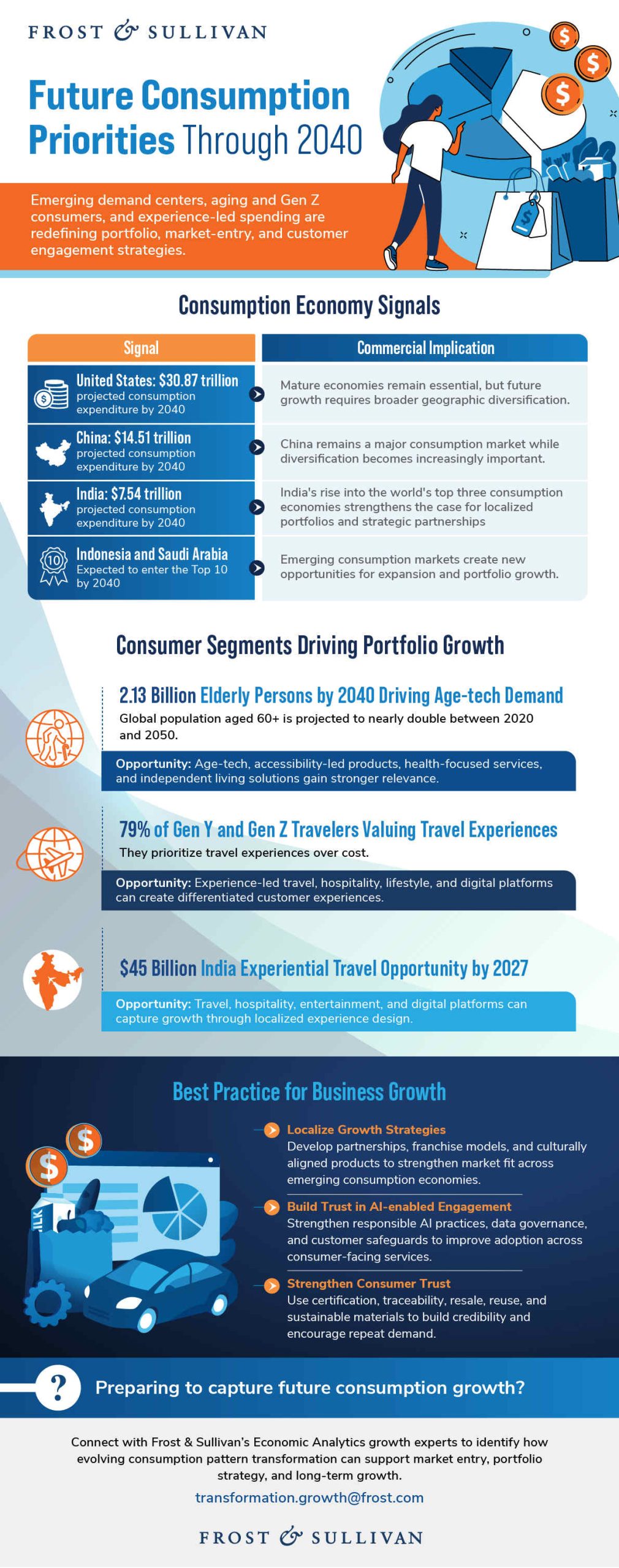
- India’s rise into the top 3 consumption economies by 2040 is strengthening the case for geographic and portfolio diversification
- Gen Z consumer behavior is raising expectations for personalized shopping experience, digital access, sustainability, and experience-led engagement
- AI-integrated solutions are creating new routes for product discovery, price comparison, and customer journey personalization
- Aging populations and value-led purchasing are boosting demand for age-tech, vegan, halal, sustainable, and experiential categories
These global consumer trends give businesses a clearer basis for aligning investment, product design, and market entry before consumer expectations consolidate.
Consumption Growth Signals for Strategic Action
Frost & Sullivan’s sample analysis helps leaders identify
- Where top consumption economies will be located by 2040
- How Gen Z consumer behavior is influencing product, channel, and engagement strategies
- Why AI in consumer products and personalized shopping experience models are becoming commercially relevant
- Where sustainable consumer behavior, age-tech, vegan, halal, and experience-led categories can support portfolio expansion
Strategic Imperatives Advancing Consumption Growth Priorities
Growth priorities are forming around demand-side diversification, AI-enabled engagement, and age-inclusive product design.
- Transformative Megatrends: Demand diversification beyond China and mature economies, combined with India’s expanding consumer base, is widening the case for regional expansion. This can support reduced exposure to slower-growth consumer markets while strengthening portfolio localization and prioritization across high-growth consumption economies.
- Innovative Business Models: Gen Z, Gen Alpha, and Gen Beta are demanding for AI-integrated products and services which prioritize personalization and digital convenience. This raises the commercial value of data-driven engagement, customer journey design, and technology partnerships.
- Disruptive Technologies: Aging populations are increasing the relevance of age-tech solutions designed around health, accessibility, independent living, and senior-focused services. Businesses that adapt products and service models for older consumers can widen addressable demand while improving customer inclusion.
How will these Strategic Imperatives influence regional investment, portfolio adaptation, and customer engagement priorities through 2040?
Growth Drivers and Risk Signals Shaping Consumption Investment
Consumption growth is being shaped by newer demand conditions and value-based consumption. Clearer investment relevance is forming where purchasing power, trust, and demand resilience can support sustained revenue growth.
Growth Drivers
- Emerging economies are widening demand potential: India, Saudi Arabia, and Vietnam are creating new consumption-led growth routes. This raises the value of market prioritization, local partnerships, and product adaptation before competitive intensity rises.
- Supportive macroeconomic conditions are supporting spending recovery: Lower inflation and interest rates are improving spending prospects. Pricing, channel, and portfolio timing gain importance as demand visibility improves.
Risk Signals
- Trust gaps can limit niche category adoption: Vegan and halal-focused consumption can face authenticity, certification, and transparency concerns. Traceability, labeling, and trusted validation will be critical to converting interest into repeat demand.
- Tariff and supply chain risks can weaken purchasing power: Trade policy volatility and geopolitical shocks risk affecting both supply and demand-side dynamics. Scenario-based sales planning and diversified geographic exposure gain importance as volatility persists.
Growth Opportunities Turning Consumption Change into Commercial Action
Consumption change is creating three business priorities for companies planning growth through 2040. Regional diversification, digital engagement, and value alignment will matter as much as product availability.
Geographic and Portfolio Diversification
- Where value is forming: Emerging consumption economies such as India and Vietnam are creating new demand routes as growth in mature economies becomes more selective.
- What will matter commercially: Local partnerships, franchise models, culturally aligned products, and category diversification can improve market entry while reducing dependence on slower-growth demand centers.
Digital and AI-Integrated Products and Services
- Where value is forming: Gen Z, Gen Alpha, and Gen Beta are raising expectations for AI-enabled discovery, immersive engagement, digital convenience, and personalized shopping experience models.
- What will matter commercially: Technology partnerships, responsible AI safeguards, and customer journey models will become stronger differentiators as convenience and engagement expectations rise.
Value-driven Consumption
- Where value is forming: Younger consumers are placing greater weight on products and brands linked to sustainability, health, social value, cultural relevance, and responsible consumption.
- What will matter commercially: Vegan, halal, experiential, and sustainable consumer behavior are strengthening trust-led portfolio expansion, Halal-certified inputs, sustainable materials, and experience-led services can improve brand relevance where values influence buying decisions.
Charting the Next Phase of Consumption-led Growth
Consumption growth through 2040 will be shaped by how well businesses connect geography, generation, technology, and values. Demand is expanding across newer consumption economies, while younger and older consumer groups are creating distinct expectations around access, personalization, trust, affordability, and experience.
The strongest positions will come from portfolios that are localized, digitally enabled, and aligned with consumer values. Businesses that act early on these global consumption trends can improve market entry decisions, strengthen customer relevance, and build more resilient growth pipelines.
Ready to Lead the Transformation?
- Schedule a Growth Strategy Dialog: Align your growth roadmap with Frost & Sullivan’s Visionary Growth Pipeline™ Dialog.
- Engage with Growth Experts: Co-design AI-enabled, data-driven operating models that scale industry-specific and commercial impact.
- Showcase Your Transformational Leadership: Position your organization as a transformation leader through Frost & Sullivan’s Transformational Growth Leadership platform.
- Join the Growth Council: Collaborate with industry leaders shaping the future of your ecosystem.
- Explore Best Practices Recognition: Be recognized for excellence in growth strategy, execution, and customer impact.
- Benchmark Your Industry Positioning on the Frost Radar™: Benchmark your growth performance and innovation strength against industry competitors.
- Tell Your Story: Accelerate awareness, engagement, and revenue growth through integrated brand and demand generation strategies.
Connect with our growth experts at [email protected].
FAQs
1. What is shaping consumer behavior trends through 2040?
Consumer behavior trends are being shaped by emerging consumption economies, younger digital-first consumers, aging populations, and value-led purchasing. Frost & Sullivan’s Consumption Pattern Transformations, Global, 2026–2040 highlights how these forces are influencing regional expansion, portfolio design, and customer engagement strategies.
2. Why do global consumption trends 2040 matter for business growth?
Global consumption trends 2040 matter because demand growth is becoming more selective across regions, generations, and consumer values. Businesses that track these changes can prioritize high-growth markets, adapt portfolios earlier, and strengthen customer relevance before demand patterns mature.
3. How is consumer behavior transformation affecting portfolio strategy?
Consumer behavior transformation is increasing the need for localized products, AI-enabled engagement, age-inclusive design, and value-led categories. Product development will increasingly depend on alignment with generational preferences, cultural fit, sustainability expectations, and digital buying behavior.
4. What should businesses include in future consumption patterns analysis?
Future consumption patterns analysis should assess emerging consumption economies, Gen Z consumer behavior, aging populations, AI in consumer products, personalized shopping experience models, and sustainable consumer behavior. These factors can help businesses identify where demand is forming and where portfolio adaptation is required.
5. Which consumption categories are creating new growth routes?
Growth routes are forming across age-tech, vegan products, halal-focused offerings, experiential consumption, AI-integrated services, and value-driven consumption. Commercial success will depend on affordability, trust, certification, personalization, and local market relevance.