This blog is based on the analysis titled, “Disruptive Trends in AI Computing and Data Centers, 2025–2027,” authored by Frost & Sullivan’s growth expert, Varun Babu, and lead analyst, Yogesh Ravichandran from the TechVision—Megatrends team.
Executive Summary
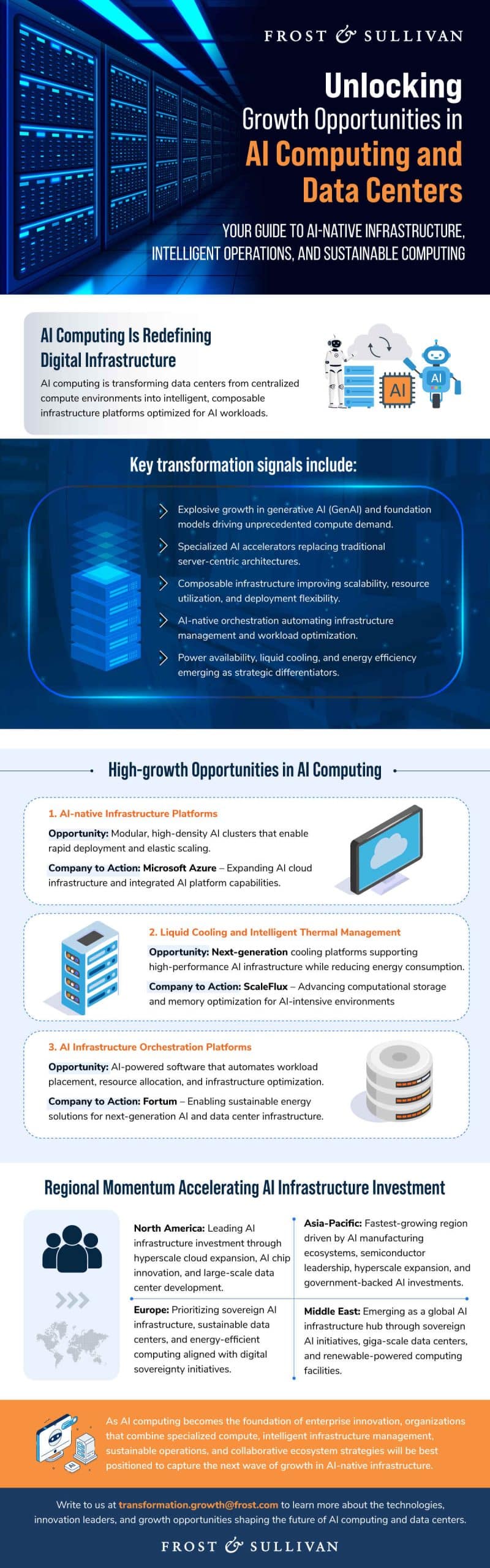
AI computing is reshaping data center infrastructure as organizations scale increasingly complex AI workloads. AI infrastructure unbundling, heterogeneous computing, composable architectures, and AI-native operations are transforming how compute resources are designed, deployed, and managed. These shifts are creating new growth opportunities across infrastructure platforms, intelligent cooling, and AI service models. For hyperscalers, cloud providers, enterprises, technology vendors, and policymakers, AI-native infrastructure represents a strategic opportunity to accelerate AI adoption while building scalable, resilient, and future-ready computing ecosystems.
What is AI Computing?
AI computing refers to the infrastructure, hardware, and software technologies that enable the training, deployment, and execution of artificial intelligence (AI) workloads. It combines specialized processors, high-speed memory, advanced networking, storage, and intelligent orchestration to support compute-intensive applications such as generative AI (GenAI), large language models (LLMs), and real-time inference. AI computing requires compute, memory, networking, storage, power, and cooling to be designed as an integrated system to deliver the performance and scalability demanded by modern AI workloads.
Growth Opportunities Shaping Next-generation AI Infrastructure
Access:
- Emerging AI infrastructure trends transforming next-generation data centers
- Growth opportunities driving the future of AI computing and intelligent data center ecosystems
Download the Complimentary Sample Analysis
According to Frost & Sullivan, AI computing is evolving from a technology enabler into a strategic growth ecosystem, driven by advances in AI infrastructure, composable architectures, sustainable data center design, and increasing enterprise investment in AI-native applications.
🎧Listen to the Growth Podcast for expert knowledge on the future of AI computing and data centers.
How Frost & Sullivan Identifies AI Infrastructure Megatrends
Frost & Sullivan’s Megatrend Universe evaluates more than 70 global trends across technology, economics, society, geopolitics, and business to identify the forces with the greatest long-term impact on industries. These trends are grouped into interconnected megatrends and analyzed through innovation maturity, market readiness, strategic impact, and commercial potential to uncover emerging growth opportunities. For AI computing and data centers, this approach highlights the technologies and business shifts that will redefine infrastructure design, deployment, and investment over the next five years.
Key Takeaways:
- AI Infrastructure Unbundling Will Redefine Data Center Design
AI workloads are accelerating the shift from server-centric architectures to composable infrastructure, where compute, memory, networking, and accelerators are dynamically allocated to maximize performance and scalability. - Power and Cooling Are Becoming Strategic Constraints
As AI clusters become increasingly power-intensive, liquid cooling, energy-efficient infrastructure, and intelligent power management will become critical enablers of future AI data center expansion. - AI-native Operations Will Drive Competitive Advantage
AI-powered orchestration, autonomous infrastructure management, and intelligent resource optimization are transforming data centers into self-optimizing environments that improve utilization, resilience, and operational efficiency.
Which developments are redefining AI infrastructure over the next five years?
Three Transformational Themes Defining the Future of AI Infrastructure
The rapid growth of Gen AI, large language models (LLMs), and AI-native applications is fundamentally changing how computing infrastructure is designed and managed. Three transformational themes are emerging as the foundation of next-generation AI infrastructure, enabling organizations to deliver greater performance, scalability, and operational efficiency.
- Specialized AI Compute and Composable Infrastructure: Organizations are replacing traditional server-centric architectures with composable infrastructure built around Graphics Processing Units (GPUs), AI accelerators, high-bandwidth memory, and high-speed interconnects. This modular approach enables infrastructure to dynamically scale based on workload requirements while improving resource utilization and reducing infrastructure complexity.
- AI-native Operations and Intelligent Resource Orchestration: AI infrastructure is becoming increasingly autonomous. AI-driven orchestration platforms optimize compute, memory, networking, and storage resources in real time, improving workload scheduling, infrastructure utilization, and operational resilience while reducing manual intervention.
- Sustainable AI Infrastructure by Design: As AI workloads increase power density and cooling requirements, sustainability is becoming a core infrastructure priority. Organizations are investing in liquid cooling, energy-efficient architectures, renewable energy integration, and heat reuse technologies to improve operational efficiency while supporting long-term AI expansion.
| Frost & Sullivan Perspective Frost & Sullivan believes that the next phase of AI infrastructure transformation will be driven not only by advances in compute performance but also by collaboration across chip manufacturers, cloud providers, data center operators, energy providers, and AI software ecosystems. Organizations that build integrated, AI-native infrastructure today will be better positioned to capture long-term growth opportunities. |
Emerging Business Models Enabled by AI Infrastructure
As AI infrastructure evolves, organizations are adopting new business models that shift from capital-intensive ownership to flexible, service-based delivery. These models enable scalable AI deployment, improve infrastructure utilization, and create new revenue opportunities across the AI computing value chain.
| Business Model | Primary Beneficiaries | Growth Potential |
|
Accelerator Pods-as-a-Service |
Enterprises, AI startups, research organizations | Expands AI access through flexible, consumption-based infrastructure. |
|
Cooling-as-a-Service
|
Data center operators, hyperscalers, colocation providers | Supports high-density AI workloads while improving energy efficiency and sustainability. |
|
AI Infrastructure Management Platforms
|
Cloud providers, enterprises, managed service providers | Enables autonomous operations, lower operating costs, and higher infrastructure utilization. |
Key Takeaway
The next generation of AI infrastructure leaders will compete not only on computing power but also on their ability to integrate AI-native operations, sustainable infrastructure, flexible business models, and ecosystem collaboration.
Companies to Action: Innovators Shaping the Future of AI Infrastructure
The AI infrastructure ecosystem is being shaped by organizations that are advancing next-generation compute, storage, and sustainable data center operations. These innovators are accelerating the transition to AI-native infrastructure through technology leadership and ecosystem collaboration.
Companies to Watch
- Microsoft Azure: Expanding AI hyperscale infrastructure through integrated cloud platforms, AI supercomputing, and strategic partnerships.
- ScaleFlux: Enhancing AI infrastructure performance with computational storage and intelligent data acceleration technologies.
- Fortum: Advancing sustainable AI data centers through renewable energy integration, heat reuse, and energy-efficient infrastructure solutions.
Which technology partners will help your organization accelerate AI infrastructure transformation?
Growth Opportunities: Where the Next Wave of AI Infrastructure Investment Will Emerge
The rapid adoption of AI is creating new investment opportunities across infrastructure platforms, data center design, and intelligent operations. Organizations that align with these emerging growth areas will be better positioned to scale AI, improve operational efficiency, and strengthen long-term competitiveness.
Growth Opportunity 1: AI Pods and Composable Infrastructure Campuses
Traditional server-centric architectures are giving way to AI Pods—modular, high-density computing environments that integrate GPUs, high-bandandwidth memory, networking, storage, and power into scalable infrastructure blocks. Combined with composable architectures, AI Pods enable organizations to dynamically allocate resources, accelerate AI workloads, and reduce deployment complexity across hyperscale and enterprise environments.
Why It Matters: AI Pods provide the flexibility and scalability needed to support rapidly evolving AI workloads while improving infrastructure utilization and reducing time to deployment.
Growth Opportunity 2: Liquid-first Cooling and Heat Reuse Platforms
Rising rack densities and power consumption are making conventional air cooling increasingly unsustainable for AI data centers. Liquid-first cooling, immersion technologies, and heat reuse systems are emerging as critical solutions for improving energy efficiency, supporting higher compute densities, and reducing environmental impact.
Why It Matters: Organizations that invest in advanced cooling technologies will be better positioned to expand AI capacity while meeting sustainability and operational efficiency goals.
Future Outlook
The future of AI computing will be defined by composable architectures, autonomous infrastructure management, sustainable data center design, and increasingly specialized computing platforms. As AI workloads continue to grow in scale and complexity, these technologies will redefine how organizations build, operate, and monetize AI infrastructure.
According to Frost & Sullivan, organizations that invest early in scalable AI infrastructure, intelligent operations, and strategic ecosystem partnerships will be best positioned to capitalize on emerging growth opportunities, optimize infrastructure performance, and establish long-term leadership in the AI computing ecosystem.
Which AI infrastructure investments will position your organization for the next generation of intelligent computing?
Ready to Lead the Transformation?
- Schedule a Growth Strategy Dialog: Align your growth roadmap with Frost & Sullivan’s Visionary Growth Pipeline™ Dialog.
- Engage with Growth Experts: Co-design AI-enabled, data-driven operating models that scale industry-specific and commercial impact.
- Showcase Your Transformational Leadership: Position your organization as a transformation leader through Frost & Sullivan’s Transformational Growth Leadership platform.
- Join the Growth Council: Collaborate with industry leaders shaping the future of your ecosystem.
- Explore Best Practices Recognition: Be recognized for excellence in growth strategy, execution, and customer impact.
- Benchmark Your Industry Positioning on the Frost Radar™: Benchmark your growth performance and innovation strength against industry competitors.
- Tell Your Story: Accelerate awareness, engagement, and revenue growth through integrated brand and demand generation strategies.
Frequently Asked Questions (FAQs)
1. What is AI computing, and how is it different from traditional computing?
AI computing is a specialized computing environment designed to support AI workloads such as large language models (LLMs), GenAI, machine learning, and real-time inference. Unlike traditional enterprise computing, AI computing integrates specialized processors, high-bandwidth memory, advanced networking, and intelligent orchestration to deliver the performance and scalability required for AI applications.
2. What is AI infrastructure unbundling?
AI infrastructure unbundling is the transition from traditional server-centric architectures to composable infrastructure, where compute, memory, networking, storage, and accelerators are deployed as independent, scalable resource pools. This approach improves flexibility, resource utilization, and infrastructure efficiency while enabling organizations to support increasingly complex AI workloads.
3. Why are composable AI infrastructures becoming important?
Composable AI infrastructure allows organizations to dynamically allocate computing resources based on workload requirements instead of relying on fixed hardware configurations. This improves scalability, accelerates AI deployment, optimizes infrastructure utilization, and reduces operational costs, making it a critical foundation for AI-native data centers.
4. How is AI transforming data center infrastructure?
AI is driving the adoption of specialized accelerators, intelligent orchestration, high-speed interconnects, liquid cooling, and energy-efficient infrastructure designs. These technologies enable data centers to manage higher compute densities, improve operational efficiency, and support the growing demands of GenAI and advanced analytics.
5. What are the emerging business models in AI infrastructure?
AI infrastructure is enabling new service-based business models, including Accelerator Pods-as-a-Service, Cooling-as-a-Service, and AI infrastructure management platforms. These models reduce capital investment requirements, improve infrastructure flexibility, and create recurring revenue opportunities for infrastructure providers and technology vendors.
6. Which industries will benefit most from AI-native infrastructure?
AI-native infrastructure will benefit industries with high-performance computing requirements, including cloud services, financial services, healthcare, manufacturing, telecommunications, automotive, life sciences, and research organizations. These sectors require scalable infrastructure to support AI-driven analytics, automation, and intelligent decision-making.
7. What are the biggest growth opportunities in AI computing and data centers?
Key growth opportunities include AI Pods and composable infrastructure campuses, liquid-first cooling technologies, AI-driven infrastructure management, sustainable data center solutions, and high-performance AI cloud services. These areas are expected to attract significant investment as organizations scale AI capabilities.
8. How can organizations prepare for the future of AI computing?
Organizations should adopt AI-native infrastructure strategies that combine composable architectures, specialized AI accelerators, intelligent orchestration, sustainable cooling technologies, and ecosystem partnerships. Investing early in scalable, energy-efficient infrastructure will help improve AI readiness, optimize operational performance, and support long-term business growth.