Engine oils go from commodity input to strategic vulnerability
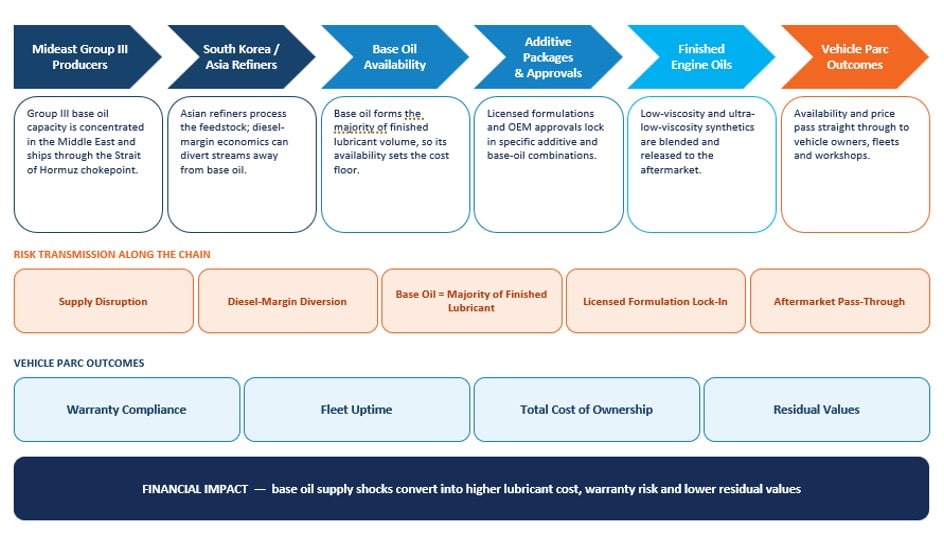
The global shortage of Group III base oils is emerging as one of the most unforeseen risks facing the automotive industry. Unlike semiconductor shortages, which disrupted vehicle production, lubricant shortages threaten the operation and maintenance of the existing global vehicle parc. For passenger and light vehicles, the issue extends beyond the availability of engine oil. It affects warranty compliance, dealer service operations, fleet uptime, ownership costs, and even powertrain competitiveness. As modern engines increasingly rely on low-viscosity synthetic lubricants, OEMs are discovering that lubricant resilience has become a strategic capability rather than just a procurement concern.
Why the Lubricant Crisis Matters Now
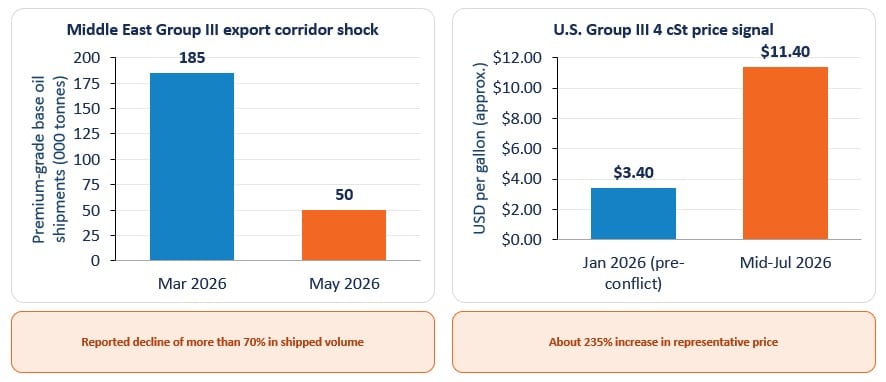
- Group III base oil prices in Europe and North America have risen to approximately $4,000 per ton, nearly 3 times pre-crisis levels.
- Middle East exports of premium Group III base oils reportedly fell from more than 185,000 tons in March 2026 to below 50,000 tons by May 2026, representing a decline of over 70%.
- The U.S. lubricant market derives approximately 74% of its imported Group III supply from regions directly impacted by Middle East disruptions.
- Global engine oil demand remains around 18 billion Liters annually, despite rapid EV adoption.
Where the Shortages are Heading
The Strait of Hormuz remains central to the macro risk. The IEA states that about 20 million barrels per day of crude oil and oil products moved through the Strait in 2025, representing around 25% of global seaborne oil trade, with roughly 80% destined for Asia. EIA similarly estimated 2024 Hormuz flows at 20 million barrels per day, equivalent to about 20% of global petroleum liquids consumption, with limited alternative routes.
- Roughly 25% of global seaborne oil trade moves through the Strait of Hormuz.
- About 80% of those shipments are destined for Asian markets.
- A single disruption to Group III production removed more than 70% of export availability in just two months.
This level of concentration would be considered unacceptable in semiconductors or batteries.
Which Regions are Most Exposed?
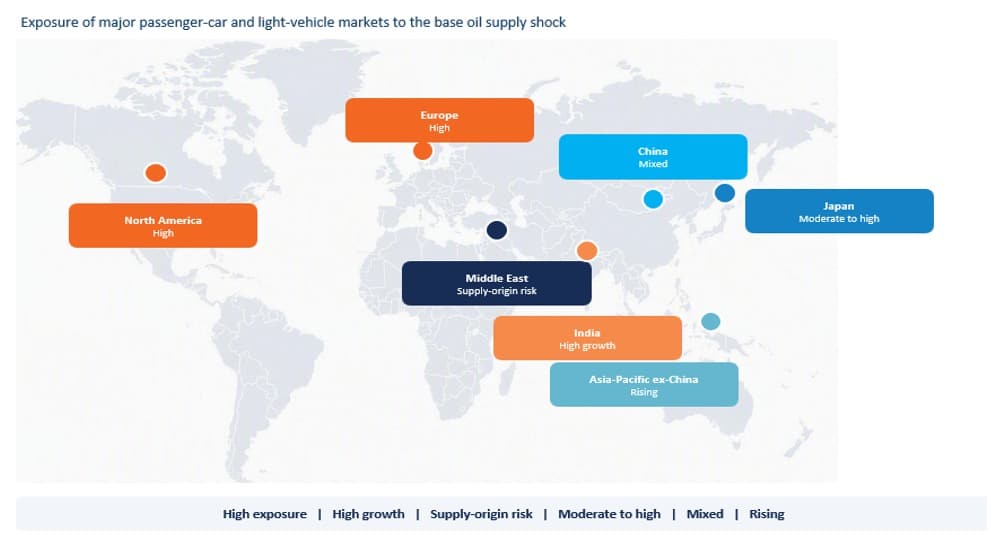
U.S. Group III import exposure is concentrated in Middle East and Korean supply routes. The 289 million vehicles in the U.S. vehicle parc and the rising average vehicle age create a large, recurring lubricant demand base, even if new vehicle sales soften. The supply-side risk is concentrated. The U.S. market reportedly sources about 44% of its Group III imports from Persian Gulf producers and another 30% from South Korea, putting roughly 74% of imported Group III supply under direct or indirect stress when Middle East production, shipping, or Korean crude feedstock flows are disrupted.
China is rapidly electrifying with more than 13 million electric cars sold in 2025, accounting for nearly 55% of new car sales. By year-end, about 44 million EVs were on Chinese roads. However, China’s overall passenger car and light vehicle base remains enormous. China Passenger Car Association (CPCA) linked reporting estimated China’s NEV retail sales at 12.81 million in 2025, meaning ICE and hybrid service demand remains material during the transition.
Europe’s vulnerability is amplified by its strict OEM lubricant specifications. Modern European engines are highly dependent on low-viscosity synthetic lubricants that require approved Group III base-oil formulations. This is why the shortage is not simply a commodity issue; it is also a certification and warranty issue. OEM behavior confirms the seriousness of the risk. Volkswagen has secured necessary lubricant supplies for now and is evaluating additional sourcing options that comply with its technical specifications. Stellantis has evaluated reformulated lubricants and secured alternative products that meet applicable industry standards.
Japan is one of the most important early-warning markets because the shortage has already moved beyond private procurement into government-directed supply stabilization. On April 9, Japan’s Ministry of Economy, Trade and Industry (METI) requested oil sellers to bypass wholesalers and sell fuels such as heavy and light oils directly to critical facilities in medical, welfare, transportation, public services, and essential goods sectors.
Our Perspective
The lubricant shortage underscores a critical reality for the automotive industry: products once considered commodities can rapidly become strategic vulnerabilities. While attention remains focused on batteries, semiconductors, and critical minerals, the disruption highlights how essential consumables are lynchpins for more than 1.6 billion vehicles in operation globally. The real lesson is that supply chain resilience extends beyond vehicle production. It increasingly depends on securing the materials that keep vehicles operating, profitable, compliant, and on the road every day.