This blog is based on Frost & Sullivan’s recent analysis, UAV Navigation Systems and Solutions, Global, 2025–2035, authored by growth expert Wayne Shaw and lead expert Aarthi Kannadoss from the Aerospace & Defense Practice Area.
Executive Summary
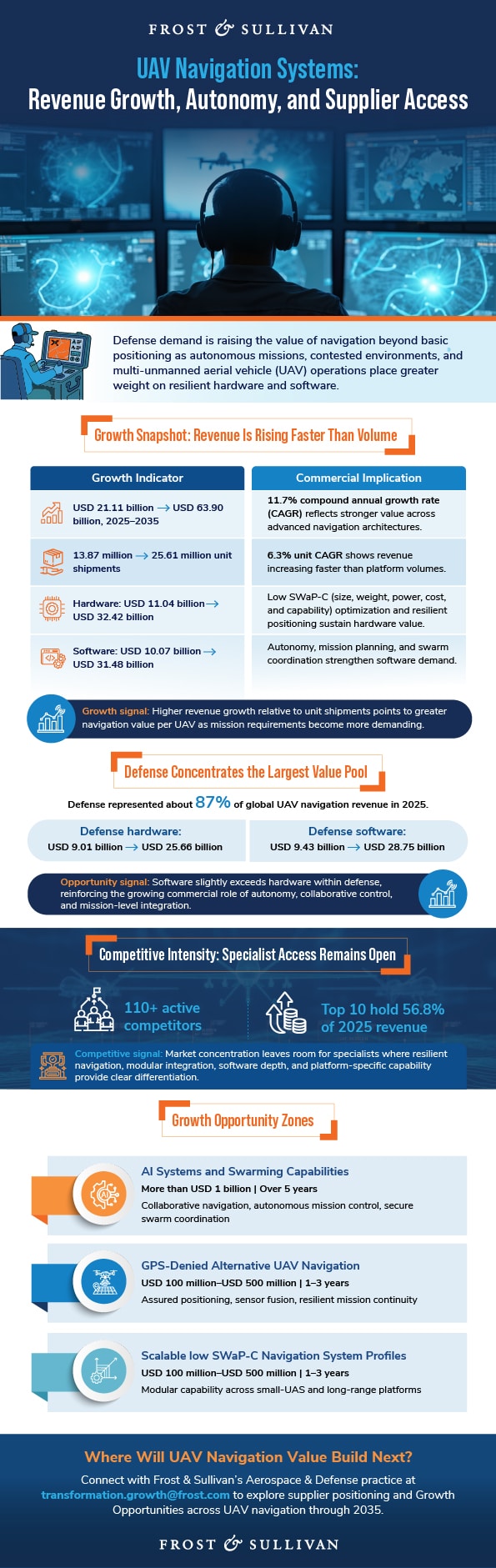
Unmanned aerial vehicle (UAV) navigation systems are taking on a larger role in defense as contested operating environments increase demand for resilient positioning, autonomous mission control, and swarm coordination. Global revenue is projected to rise from $21.1 billion in 2025 to $63.9 billion by 2035, with defense remaining the dominant application. Low SWaP-C optimization and software-led autonomy are increasing navigation value across UAV classes, while sovereign procurement and faster development cycles are widening supplier access for mid-tier and innovation-led providers alongside established defense primes.
Key Takeaways:
- Global positioning system (GPS)-denied resilience is strengthening supplier differentiation: Demand for assured navigation under jamming and spoofing is increasing the importance of inertial navigation, sensor fusion, and anti-jam capabilities greater weight in defense supplier positioning.
- Drone swarm technology is increasing software value: As multi-UAV operations scale, autonomy software, interoperability, and coordinated mission control carry greater commercial relevance across collaborative navigation environments.
- Low SWaP-C optimization is shaping distinct supplier positions: Size, weight, power, cost, and capability (SWaP-C) requirements vary across expendable, attritable, and survivable UAVs, separating opportunities between cost-efficient navigation and higher-integrity resilient systems.
- Sovereign procurement is broadening market access: Domestic capability programs and faster procurement pathways give mid-tier and innovation-led providers clearer entry routes where modular architectures and rapid development matter in defense acquisition.
What Are UAV Navigation Systems?
Unmanned aerial vehicle (UAV) navigation systems combine positioning and sensing hardware with flight-control and mission software to guide aircraft, maintain stability, and support autonomous operation. The navigation stack can include Global Navigation Satellite System (GNSS) modules, inertial navigation systems (INS), perception sensors, obstacle avoidance, mission planning, and fleet or swarm control capabilities.
Defense accounted for about 87% of global UAV navigation revenue in 2025, reflecting the higher value and technical complexity of navigation in mission-critical applications. Hardware and software contributed at similar levels, showing that value extends across the complete navigation stack rather than positioning components alone.
Why Are UAV Navigation Systems Gaining Strategic Importance Across Defense Programs?
Defense procurement is creating two distinct navigation markets. Attritable and expendable UAVs favor lower-cost, scalable solutions that can be fielded in volume, while survivable and long-endurance platforms retain demand for higher-integrity navigation built around redundancy and mission continuity. This split is changing where suppliers compete and how programs balance cost, integration, and performance.
Where Is Your Next Competitive Advantage in UAV Navigation?
Assess how GPS-denied operations, autonomous navigation, and Low SWaP-C requirements are reshaping supplier positioning across defense UAV programs through 2035.
[Download the Strategic Analysis]
Market access is also broadening. Faster procurement pathways, sovereign capability programs, and co-development models are giving mid-tier and innovation-led providers clearer routes into programs traditionally led by established defense primes. For defense agencies, integrators, and navigation suppliers, commercial relevance increasingly depends on fit across platform class, acquisition model, and deployment scale.
Top 3 Strategic Imperatives Shaping UAV Navigation Growth and Supplier Positioning
- Competitive Intensity: Faster defense procurement and modular architectures are widening access for start-ups and mid-tier providers alongside established primes. In small-UAV programs, shorter development cycles and integration flexibility give innovation-led suppliers clearer positions, while incumbents retain stronger roles in complex, high-end systems.
- Transformative Megatrends: Sovereign capability priorities are directing procurement toward trusted domestic and regional ecosystems. Indigenous navigation programs and supply-chain requirements are strengthening the commercial relevance of regional providers, local integration, and co-development models across defense markets.
- Disruptive Technologies: AI-enabled autonomy and swarming are shifting navigation beyond individual platform control toward coordinated mission execution. Shared situational awareness, collaborative flight control, and interoperable software are gaining commercial relevance as multi-UAV operations expand.
Frost & Sullivan Perspective
According to Frost & Sullivan, supplier positioning in UAV navigation will depend on more than standalone technology performance. Procurement speed, sovereign capability requirements, and software-led mission needs are separating supplier positions across integration-led, sovereign, and software-defined programs. Established primes retain advantages in complex programs, while innovation-led providers gain relevance where modular integration, rapid development, and scalable autonomy influence program selection.
Defense Demand and Open Architectures Are Reshaping Supplier Positions
Defense UAV navigation spans two distinct demand profiles. High-volume attritable and expendable platforms, including loitering munitions, favor scalable, cost-efficient navigation, while survivable systems support higher-value requirements around redundancy and mission continuity.
| Growth Factor | Evidence | Business Implication |
| Structural defense demand | Attritable warfare and long-endurance surveillance are sustaining demand across different UAV classes. | Platform economics create separate positions for scalable navigation and higher-integrity mission systems. |
| Policy-driven adoption | Sovereign procurement and indigenous capability programs are strengthening domestic UAV ecosystems. | Trusted supply requirements widen market access for regional navigation, software, and integration providers. |
| Swarm-enabled scaling | Coordinated UAV operations require collaborative flight planning, shared decision-making, and mission control. | Autonomy software and interoperability gain greater commercial relevance as multi-UAV deployments expand. |
| Open architecture and counter-UAV pressure | Modular Open Systems Architecture (MOSA) makes component substitution easier, while jamming and spoofing increase navigation complexity. | Integration depth, resilient performance, and software capability carry more weight as proprietary hardware becomes easier to replace. |
More than 110 competitors were active in 2025, while the top 10 accounted for 56.8% of revenue, leaving space for differentiated specialist positions. Collins Aerospace illustrates the hardware opportunity through compact UAV navigation and low SWaP-C-focused systems. Honeywell Aerospace is strengthening production capacity across navigation and related defense technologies, while Lockheed Martin is extending open-architecture command-and-control across multiple unmanned systems. These positions show how value is being captured through compact hardware, supply-chain scale, and interoperable software.
Business Implication: A moderately concentrated supplier base leaves room for specialist participation, but differentiation increasingly rests on resilient navigation, integration credibility, and software depth rather than component supply alone.
How well is your organization positioned to capture emerging opportunities across UAV navigation systems?
Top Three Growth Opportunities Expanding UAV Navigation Value
- Swarm Autonomy Is Expanding the Software Opportunity
Multi-UAV operations require more than independent flight control. Shared positioning, coordinated routing, task allocation, and real-time mission changes all depend on software that can manage several aircraft as one operational unit. Frost & Sullivan estimates the five-year opportunity for AI systems and swarming capabilities at more than USD 1 billion.
Business implication: Commercial value is concentrating around interoperable autonomy software, mission control, and secure coordination, giving software specialists a stronger position within swarm-enabled programs.
- GPS-denied Navigation Is Strengthening Demand for Resilient Positioning
Electronic warfare is making satellite-dependent navigation less reliable in contested environments. Vision-based sensing, inertial navigation, and sensor fusion allow UAVs to maintain positioning when GPS signals are jammed, spoofed, or unavailable. The five-year opportunity is estimated at USD 100 million to USD 500 million, with a 1-to-3-year horizon.
Business implication: Mission continuity is becoming a stronger differentiator, increasing the commercial relevance of assured navigation, sensor fusion, and electronic protection capabilities.
- Low SWaP-C Architectures Are Broadening Program Reach Across UAV Classes
Small and attritable UAVs operate under tight size, weight, power, and cost limits, while long-range platforms can support more complex and redundant navigation systems. Scalable SWaP-C architectures allow core navigation capabilities to serve different platform classes without relying on completely separate system designs. The five-year opportunity is estimated at USD 100 million to USD 500 million.
Business implication: A common, modular architecture supports access across a broader program base while preserving different cost and performance requirements for each UAV class.
Future Outlook: UAV Navigation Is Entering a More Segmented Growth Phase
Through 2035, navigation requirements will diverge further across UAV classes. Attritable and expendable platforms will favor modular, cost-efficient systems built for scale, while survivable platforms will continue to support higher-value architectures focused on redundancy and mission continuity. Software will take on a larger role as autonomy, swarm coordination, and capability upgrades become more closely integrated with flight operations.
According to Frost & Sullivan, competitive strength will come from matching navigation capability with mission profile, procurement model, and platform economics. Sovereign sourcing will reinforce regional supply ecosystems, while open architectures leave room for specialist providers to participate alongside established defense primes.
Ready to Lead the Transformation?
- Schedule a Growth Strategy Dialog: Align your growth roadmap with Frost & Sullivan’s Visionary Growth Pipeline™ Dialog.
- Engage with Growth Experts: Co-design AI-enabled, data-driven operating models that scale industry-specific and commercial impact.
- Showcase Your Transformational Leadership: Position your organization as a transformation leader through Frost & Sullivan’s Transformational Growth Leadership platform.
- Join the Growth Council: Collaborate with industry leaders shaping the future of your ecosystem.
- Explore Best Practices Recognition: Be recognized for excellence in growth strategy, execution, and customer impact.
- Benchmark Your Industry Positioning on the Frost Radar™: Benchmark your growth performance and innovation strength against industry competitors.
- Tell Your Story: Accelerate awareness, engagement, and revenue growth through integrated brand and demand generation strategies.
Connect with our growth experts at [email protected].
FAQs
1. What are UAV navigation systems and how do they work?
Unmanned aerial vehicle (UAV) navigation systems combine positioning, sensing, flight control, and mission software to guide unmanned aircraft. Depending on the mission, they can integrate satellite positioning, inertial navigation, perception sensors, obstacle avoidance, and autonomous control.
2. What is autonomous drone navigation?
Autonomous drone navigation allows an unmanned aerial vehicle (UAV) to plan routes, avoid obstacles, adjust its flight path, and execute mission tasks with reduced operator intervention. Defense applications increasingly combine onboard processing, sensor fusion, and AI-enabled decision-making to support more complex operations.
3. Why is GPS denied navigation important for military drones?
GPS denied navigation allows unmanned aerial vehicles (UAVs) to continue operating when satellite signals are jammed, spoofed, degraded, or unavailable. Resilient navigation can combine inertial and vision-based capabilities with other sensor inputs to preserve positioning and mission continuity.
4. How does an inertial navigation system support autonomous drones?
An inertial navigation system uses motion and orientation data to estimate position without depending continuously on satellite signals. For autonomous drones, this provides an important navigation layer when Global Navigation Satellite System connectivity is disrupted or unreliable.
5. How is drone swarm technology changing defense UAV operations?
Drone swarm technology allows multiple unmanned aerial vehicles (UAVs) to coordinate positioning, routes, tasks, and mission responses rather than operate independently. This increases the value of collaborative navigation, interoperable software, and distributed decision-making across multi-UAV operations.
6. What is driving growth in drone autonomy?
Drone autonomy is advancing as defense programs place greater emphasis on independent navigation, real-time decision-making, swarm coordination, and operations in contested environments. Software capability and onboard processing are therefore taking on a larger role within drone navigation systems.
7. Why is “low SWaP-C” important for drone navigation systems?
Size, weight, power, cost, and capability (SWaP-C) influence how navigation technologies fit different unmanned aerial vehicle (UAV) classes. Attritable and expendable systems favor compact, cost-efficient solutions, while survivable and long-endurance platforms can support more advanced and redundant navigation architectures.
8. What does “UAV Navigation Systems and Solutions, Global, 2025–2035” examine?
UAV Navigation Systems and Solutions, Global, 2025–2035, examines navigation hardware and software across defense, public safety, agriculture, commercial, and consumer unmanned aerial vehicle (UAV) applications. It also assesses regional supply capabilities, competitive dynamics, and Growth Opportunities in autonomous navigation, swarming, GPS-denied operation, and scalable low SWaP-C (size, weight, power, cost, and capability) architectures.