This blog is based on the analysis titled, “Frost Radar™: Perovskite-silicon Tandem Solar Cells, 2026,” authored by Frost & Sullivan’s growth expert, Pankaj Gaur, and lead analyst, Nikhil Thakur from the TechVision—Energy & Utilities team.
Executive Summary
The global solar photovoltaic industry is entering a new phase of innovation as perovskite-silicon tandem solar cells are emerging as a promising technology capable of surpassing the practical efficiency limits of conventional crystalline silicon cells. Advances in tandem architectures, materials engineering, and scalable manufacturing are creating opportunities to increase energy yields, improve power output per unit area, and strengthen the commercial competitiveness of solar installations.
For solar manufacturers, technology providers, investors, and energy companies, the business opportunity lies in identifying innovations that can deliver higher energy output, reduce electricity generation costs, and support commercially viable deployment at scale.
Frost & Sullivan’s Frost Radar™: Perovskite-silicon Tandem Solar Cells, 2026 benchmarks leading innovators across Growth and Innovation criteria, helping industry stakeholders evaluate competitive positioning, commercialization readiness, strategic partnerships, and emerging investment opportunities.
Top 3 Key Takeaways
- Higher Conversion Efficiency Is Redefining Solar Technology: Perovskite-silicon tandem solar cells are enabling greater energy yields by capturing a broader range of the solar spectrum, creating opportunities to improve photovoltaic performance beyond conventional silicon technologies.
- Commercialization Is Gaining Momentum: Advances in deposition processes, interface engineering, and module encapsulation are supporting scalable manufacturing, while long-term stability, production costs, and product bankability remain critical challenges.
- Competitive Differentiation Is Shifting Toward Manufacturing and Reliability: Increasing collaboration among photovoltaic manufacturers, materials suppliers, equipment vendors, and research institutions is accelerating innovation, with scalable production, field performance, and reliable product warranties emerging as key competitive priorities.
What Are Perovskite-silicon Tandem Solar Cells?
Perovskite-silicon tandem solar cells are next-generation photovoltaic devices that combine perovskite and crystalline silicon absorber layers to capture a broader range of sunlight and achieve higher power conversion efficiencies than conventional single-junction silicon cells. By utilizing complementary materials to absorb different portions of the solar spectrum, these cells are enabling greater electricity generation from the same surface area, improving the potential energy yield and cost competitiveness of solar installations.
According to Frost & Sullivan, the technology’s commercial potential is being shaped by its ability to deliver higher efficiency alongside manufacturing scalability, long-term reliability, and cost-effective production, positioning it as a promising advancement in high-performance solar photovoltaics.
Why Perovskite-silicon Tandem Solar Cells Are Gaining Market Momentum
The global push toward net-zero emissions and higher solar energy yields is accelerating investment in perovskite-silicon tandem photovoltaics.
Several developments are shaping the industry’s growth:
- Higher Energy Efficiency: Tandem architectures are enabling greater power conversion efficiencies beyond the practical limits of conventional crystalline silicon cells.
Discover the Next Wave of High-efficiency Solar Innovation
Explore the companies, technological advancements, and competitive strategies accelerating the commercialization of perovskite-silicon tandem solar cells.
Download the Complimentary Sample Analysis.
- Advancing Commercialization: Innovations in materials engineering, deposition processes, and module encapsulation are supporting the transition from laboratory research to scalable manufacturing.
- Growing Investments and Partnerships: Government incentives, capital investments, and collaboration across the photovoltaic value chain are accelerating technology development.
- Expanding Application Opportunities: Building-integrated photovoltaics (BIPV), vehicle-integrated photovoltaics (VIPV), and aerospace applications are creating demand for high-efficiency solar solutions.
- Increasing Focus on Reliability: Long-term stability, manufacturing consistency, and bankable product warranties are emerging as critical factors influencing commercial adoption.
As competition intensifies, Frost & Sullivan’s Frost Radar™ is benchmarking leading innovators based on their growth strategies, technological capabilities, and commercial positioning.
Which companies are best positioned to translate perovskite-silicon tandem innovation into scalable commercial growth?
Top 3 Strategic Imperatives Shaping Perovskite-silicon Tandem Solar Cell Commercialization
The transition toward high-efficiency solar photovoltaics is being shaped by three strategic imperatives influencing technology innovation, manufacturing scalability, and competitive differentiation across the perovskite-silicon tandem solar cell market.
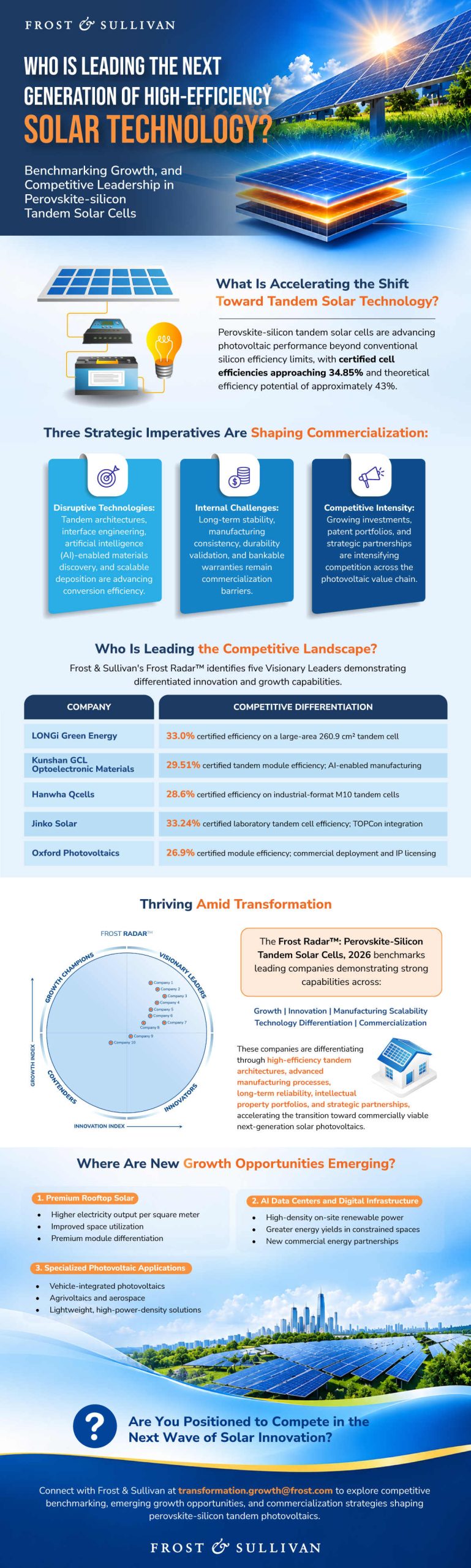
- Disruptive Technologies: Advances in tandem cell architectures, interface engineering, artificial intelligence (AI)-driven materials discovery, and scalable deposition technologies are pushing certified conversion efficiencies beyond 34%. These innovations are improving energy yields, accelerating development cycles, and supporting the transition toward commercially viable, high-performance solar modules.
- Internal Challenges: Scaling perovskite-silicon tandem solar cells from laboratory prototypes to gigawatt-scale manufacturing requires overcoming long-term stability, production consistency, and cost competitiveness challenges. Achieving industry-standard 25-year warranties, improving encapsulation, and controlling material degradation are becoming critical to commercial adoption and investor confidence.
- Competitive Intensity: Increasing investments, patent activity, and strategic partnerships are intensifying competition among solar cell manufacturers, advanced materials suppliers, and technology innovators. Companies demonstrating higher conversion efficiencies, scalable production, and competitive levelized costs of electricity (LCOE) are strengthening their positioning in the emerging tandem solar market.
Frost & Sullivan Perspective
Competitive leadership in perovskite-silicon tandem photovoltaics will increasingly depend on the ability to translate laboratory efficiency breakthroughs into reliable, scalable, and commercially competitive solar solutions. Companies combining technological innovation with manufacturing readiness, long-term performance, and strategic ecosystem partnerships are positioning themselves to capture emerging growth opportunities.
Companies to Action: Leaders in Perovskite-silicon Tandem Solar Cell Innovation
Five companies are emerging on the Frost Radar™, demonstrating differentiated strengths in photovoltaic efficiency, tandem cell architectures, manufacturing scalability, and commercialization readiness. Their competitive positioning highlights the technologies and strategies shaping the next generation of high-efficiency solar photovoltaics.
| Companies |
Strategic Differentiation
|
| LONGi Green Energy Technology, China | Setting New Benchmarks in Tandem Solar Cell Efficiency: Achieving a certified 33.0% efficiency on a large-area 260.9 cm² tandem cell in 2025, while leveraging established silicon manufacturing expertise to advance high-efficiency photovoltaic technologies toward commercial-scale production. |
| Kunshan GCL Optoelectronic Materials, China | Scaling Large-area Tandem Modules Through Advanced Manufacturing: Developing four-terminal tandem architectures and AI-powered manufacturing processes, supported by a certified 29.51% module efficiency and gigawatt-scale production capabilities to accelerate commercialization. |
| Hanwha Qcells, South Korea | Integrating Tandem Innovation with Established Silicon Manufacturing: Achieving 28.6% certified efficiency on a full-area M10 tandem cell while combining perovskite innovation with its Q.ANTUM silicon platform, interface engineering, and industrial-scale manufacturing expertise. |
| Jinko Solar Holding, China | Advancing Tandem Technology Through TOPCon Integration: Developing perovskite-silicon tandem architectures compatible with its n-type TOPCon technology, supported by a certified 33.24% laboratory-scale cell efficiency and established global manufacturing capabilities. |
| Oxford Photovoltaics Limited, United Kingdom | Commercializing High-efficiency Tandem Modules and Intellectual Property: Demonstrating 26.9% certified module efficiency, introducing commercial tandem products, and building an intellectual property portfolio of more than 400 granted patents to strengthen technology licensing and market expansion. |
Across the Frost Radar™, competitive differentiation is increasingly being shaped by certified conversion efficiency, manufacturing scalability, long-term durability, intellectual property strength, and commercial readiness. Companies demonstrating the ability to translate technological advances into reliable, cost-competitive photovoltaic solutions are positioning themselves to capture emerging growth opportunities.
How does your organization benchmark against the companies leading perovskite-silicon tandem solar cell innovation and commercialization?
Top 3 Growth Opportunities in Perovskite-silicon Tandem Solar Cells
As perovskite-silicon tandem solar cell technology advances toward commercialization, higher energy yields, improved power density, and expanding application markets are creating new revenue and investment opportunities across the photovoltaic value chain.
- Expanding Opportunities in Premium Residential and Commercial Rooftop Solar: Demand for high-efficiency solar modules is growing across space-constrained residential and commercial rooftop installations, where maximizing electricity generation per square meter is becoming increasingly important. Perovskite-silicon tandem modules are offering higher energy yield potential and improved roof utilization, strengthening their value proposition in premium solar markets.
Business Impact: Higher power output per unit area is creating opportunities for premium product positioning, increased revenue potential, and greater differentiation among solar manufacturers and developers serving space-constrained installations.
- Growing Demand for High-density Renewable Energy in AI Data Centers: The rapid expansion of AI data centers and digital infrastructure is increasing demand for on-site renewable energy generation. Perovskite-silicon tandem modules are emerging as a potential solution for grid-constrained campuses and facilities with limited installation space, where maximizing electricity output is a priority.
Business Impact: Growing demand for high-density renewable energy is opening new commercial opportunities for photovoltaic manufacturers, solar developers, and energy solution providers, particularly in large-scale digital infrastructure projects.
- Emerging High-value Applications Beyond Conventional Solar Markets: Applications across vehicle-integrated photovoltaics (VIPV), agrivoltaics, aerospace, defense, and remote power systems are expanding the potential market for tandem solar technologies. These sectors are placing greater emphasis on efficiency, lightweight designs, and power density, creating demand for specialized photovoltaic solutions.
Business Impact: Expanding application diversity is supporting revenue diversification, premium product development, and access to specialized markets, broadening the commercial potential of perovskite-silicon tandem photovoltaics beyond conventional solar installations.
Building Competitive Advantage in Perovskite-silicon Tandem Solar Cells
As perovskite-silicon tandem photovoltaics advance toward commercial deployment, competitive leadership is increasingly being shaped by manufacturing scalability, long-term reliability, and strategic ecosystem partnerships.
Three best practices are emerging across the industry:
- Strengthening Industry Collaboration: Partnerships among materials suppliers, equipment manufacturers, module producers, and certification bodies are accelerating reliability validation, technology standardization, and commercialization.
- Scaling Manufacturing and Product Reliability: Improvements in production yields, process consistency, quality control, and compatibility with existing silicon manufacturing lines are supporting the transition toward commercially viable tandem modules.
- Aligning Innovation with Commercialization: Strong intellectual property portfolios, licensing agreements, strategic partnerships, and cost optimization are helping companies translate technological advances into sustainable competitive positioning.
The next phase of perovskite-silicon tandem solar cell commercialization will increasingly depend on the ability to combine high conversion efficiency with reliable field performance, scalable production, and commercially competitive energy costs.
Key questions for business leaders:
- Which technology innovators are demonstrating the strongest commercialization readiness?
- How are manufacturing scalability and long-term reliability influencing competitive positioning?
- Where are strategic partnerships and investments creating new growth opportunities?
Ready to Lead the Transformation?
- Schedule a Growth Strategy Dialog: Align your growth roadmap with Frost & Sullivan’s Visionary Growth Pipeline™ Dialog.
- Engage with Growth Experts: Co-design AI-enabled, data-driven operating models that scale industry-specific and commercial impact.
- Showcase Your Transformational Leadership: Position your organization as a transformation leader through Frost & Sullivan’s Transformational Growth Leadership platform.
- Join the Growth Council: Collaborate with industry leaders shaping the future of your ecosystem.
- Explore Best Practices Recognition: Be recognized for excellence in growth strategy, execution, and customer impact.
- Benchmark Your Industry Positioning on the Frost Radar™: Benchmark your growth performance and innovation strength against industry competitors.
- Tell Your Story: Accelerate awareness, engagement, and revenue growth through integrated brand and demand generation strategies.
Frequently Asked Questions (FAQs)
1. What are perovskite-silicon tandem solar cells, and how do they work?
Perovskite-silicon tandem solar cells are next-generation photovoltaic devices that combine a perovskite absorber with a crystalline silicon solar cell. By capturing different portions of the solar spectrum, these tandem architectures are enabling higher power conversion efficiencies and greater electricity generation per unit area than conventional single-junction silicon cells.
2. What are the key advantages of perovskite-silicon tandem solar cells?
The primary advantages include higher conversion efficiency, increased energy yields, improved space utilization, and potential reductions in levelized cost of electricity (LCOE). These benefits are creating opportunities for premium rooftop installations, utility-scale solar projects, and applications where maximizing power output within limited space is critical.
3. Which companies are leading perovskite-silicon tandem solar cell innovation in 2026?
According to Frost & Sullivan’s Frost Radar™: Perovskite-silicon Tandem Solar Cells, 2026, leading innovators include LONGi Green Energy, Kunshan GCL Optoelectronic Materials, Hanwha Qcells, Jinko Solar, and Oxford Photovoltaics. These companies are demonstrating differentiated strengths in conversion efficiency, advanced manufacturing, technology integration, intellectual property, and commercialization readiness.
4. What are the biggest challenges in commercializing perovskite-silicon tandem solar cells?
Key commercialization challenges include long-term operational stability, manufacturing scalability, production consistency, material degradation, and product bankability. Achieving reliable field performance and industry-standard warranties remains essential as manufacturers transition from laboratory-scale efficiency achievements toward commercial deployment.
5. How is the perovskite-silicon tandem solar cell market expected to evolve?
The market is progressing from laboratory innovation toward pilot production and commercial manufacturing, supported by renewable energy investments, government incentives, and strategic industry partnerships. Competition is increasingly focusing on scalable production, durability validation, manufacturing costs, and the ability to deliver commercially viable high-efficiency solar modules.
6. What are the top growth opportunities in perovskite-silicon tandem photovoltaics?
Three emerging growth opportunities include premium residential and commercial rooftop solar installations, high-density renewable energy solutions for AI data centers, and specialized applications across vehicle-integrated photovoltaics, aerospace, and remote power systems. These markets are creating demand for higher energy yields, improved power density, and differentiated photovoltaic products.
7. How does Frost & Sullivan's Frost Radar™ benchmark perovskite-silicon tandem solar cell companies?
Frost & Sullivan’s Frost Radar™ evaluates companies across 10 Growth and Innovation criteria, assessing their competitive positioning, technological differentiation, and growth capabilities. The analysis helps solar manufacturers, technology providers, investors, and energy companies understand the competitive landscape, identify emerging innovators, and evaluate commercialization and partnership opportunities.