This blog is based on Frost & Sullivan’s recent analysis, “Industrial Adhesives and Sealants Market, Global, 2025–2032” authored by Simran Tamboli from the Chemicals, Materials, and Nutrition Practice Area.
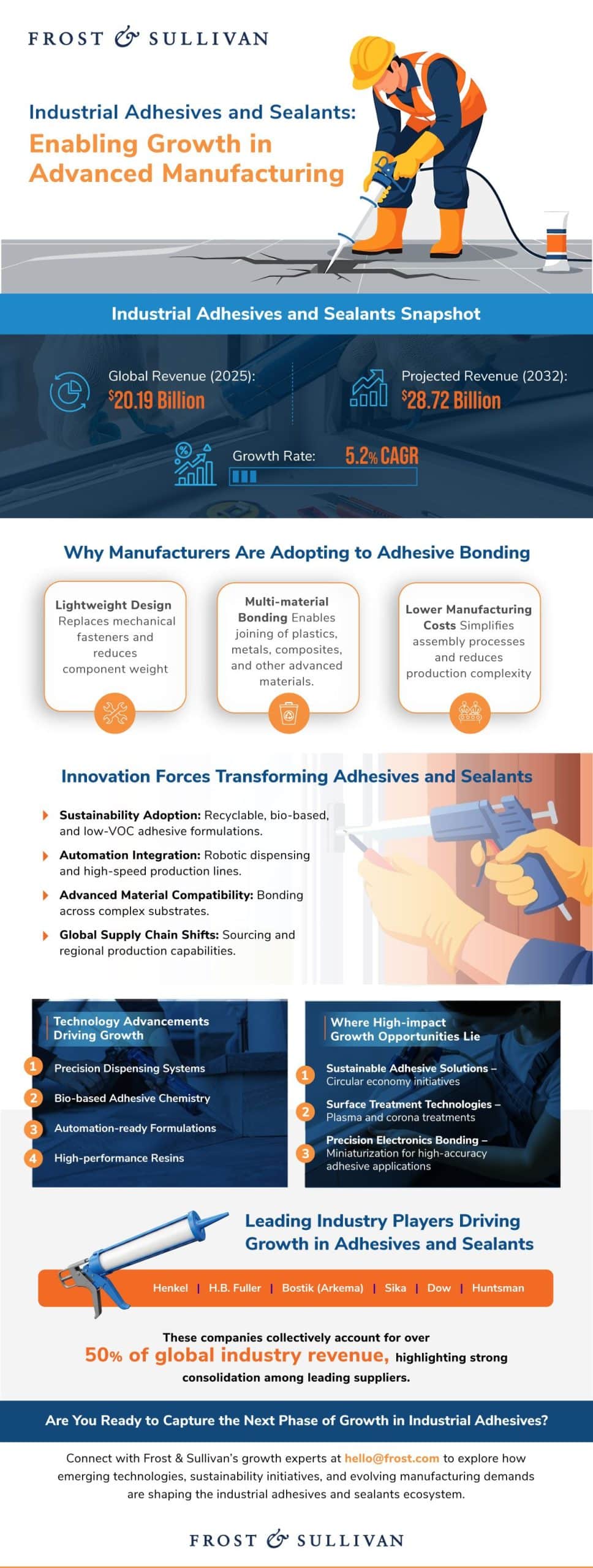
The global industrial adhesives and sealants industry is projected to grow from $20.19 billion in 2025 to $28.72 billion by 2032, at a CAGR of 5.2%. This growth reflects major shifts in manufacturing driven by automation, sustainability mandates, and advanced materials. In this environment, industrial adhesives and sealants are emerging as strategic enablers of modern manufacturing, supporting lightweight designs, improving durability, and simplifying complex assembly processes across industries such as packaging, electronics, industrial machinery, non-wovens and consumer goods.
What will distinguish industry leaders in the evolving adhesives and sealants ecosystem?
Gain strategic understanding of
- Emerging growth opportunities
- Key technology shifts
- Competitive positioning
Industry leaders view adhesives as critical innovation drivers rather than functional materials. By investing in advanced bonding technologies and aligning product strategies with evolving industry demands, organizations will be better positioned to capitalize on new growth opportunities and strengthen their competitive position in the global manufacturing ecosystem.
What strategic priorities will define competitive advantage in the evolving adhesives and sealants ecosystem?
Listen to Our Growth Podcast Episode on Growth Opportunities in Adhesives and Sealants
The Expanding Role of Industrial Adhesives and Sealants in Modern Manufacturing
Industrial adhesives and sealants enable the assembly of materials such as metals, plastics, composites, glass, and textiles, helping manufacturers create lighter, more durable, and more efficient products. Increasingly, industries are replacing traditional joining methods like bolts, rivets, and welding with adhesive bonding to streamline production and enhance performance.
Unlike mechanical fasteners that concentrate stress at specific points, adhesives distribute stress evenly across surfaces, improving structural integrity while reducing weight and simplifying complex assembly processes. As manufacturers advance automation and multi-material designs, these technologies are becoming integral to modern production systems.
Today, industrial adhesives and sealants play a critical role across several high-growth sectors, including:
- Packaging
- Electrical and electronics (including industrial machinery)
- Non-wovens and hygiene products
- Consumer goods such as footwear, toys, and sports equipment
Adhesives dominate the industry, accounting for more than 80% of total volume demand, reflecting their extensive use in bonding and assembly applications. Sealants complement these materials by providing gap filling, waterproofing, and protection against air, moisture, dust, and chemicals in demanding industrial environments.
Strategic Imperatives Driving Growth in the Adhesives and Sealants Industry
- Transformative Megatrends (Sustainability and Circular Economy)
The shift toward sustainable materials, recyclable packaging, and low-volatile organic compounds (VOC) or bio-based adhesive formulations is reshaping product development and regulatory compliance requirements. - Geopolitical Chaos (Supply Chain and Trade Disruptions)
Rising tariffs, regulatory changes, and supply chain disruptions are increasing production costs and complexity, pushing companies to strengthen sourcing strategies and supply resilience. - Disruptive Technologies (Automation and Advanced Manufacturing)
The rise of smart factories, automated dispensing systems, and robotics is driving demand for adhesives compatible with high-precision and automated manufacturing processes.
Explore the full analysis to understand how sustainability, automation, and advanced materials are reshaping industrial adhesives and sealants.
Key Growth Drivers Accelerating Industrial Adhesives and Sealants Adoption
- Expanding Packaging Applications
The growth of eCommerce and Fast-moving Consumer Goods (FMCG) industries is increasing the need for advanced packaging solutions. Adhesives are supporting high-speed carton sealing, labeling, and flexible packaging processes. - Advancing Electronics Manufacturing
Miniaturization and greater device functionality are driving demand for adhesives that are providing thermal management, electrical insulation, and protection for sensitive components. - Rising Demand for Non-wovens and Hygiene Products
The growing consumption of diapers, medical disposables, and wipes is driving the use of hot-melt and water-based adhesives. - Increasing Applications in Industrial Machinery
Adhesives and sealants are supporting machinery assembly by improving durability, vibration resistance, and protection against moisture and chemicals.
Expert Corner
“End-use industries such as packaging, electronics, and non-wovens are redefining adhesive requirements, pushing manufacturers to develop high-performance and more sustainable adhesive and sealant solutions. Companies that align product development with these shifts will be better positioned to protect their market position and capture emerging growth opportunities.”
Simran Tamboli – Research Analyst, Chemicals, Materials & Nutrition, Frost & Sullivan
Key Restraints and Challenges in the Adhesives and Sealants Landscape
Raw Material Price Volatility
Adhesive formulations are relying heavily on petrochemical feedstocks, making manufacturers vulnerable to fluctuations in oil and gas prices.
Hybrid Joining Technologies
Some manufacturers are adopting hybrid joining techniques that combine adhesives with mechanical fasteners, reducing the volume of adhesives required.
Process Optimization
Advancements in application technology are enabling more precise adhesive dispensing, reducing the amount of adhesive required per product.
Emerging Technologies Transforming Industrial Adhesives and Sealants
- Precision Dispensing Systems: Advanced dispensing technologies are enabling application accuracy, enhancing bonding consistency while minimizing material waste.
- Bio-based Adhesive Formulations: Renewable and carbon-derived chemistries are driving the development of more sustainable adhesive solutions.
- Integration with Smart Manufacturing: Adhesives designed for automated production lines are enabling faster curing and precise robotic dispensing in high-volume manufacturing
Download the full analysis on adhesives and sealants to discover the innovations and technologies shaping the future of manufacturing.
Growth Opportunities Redefining the Adhesives and Sealants Ecosystem
Sustainable Adhesive Technologies
Bio-based, low-VOC, and recyclable adhesive formulations are gaining traction as manufacturers respond to sustainability regulations and circular economy initiatives.
High-precision Adhesives for Automated Manufacturing
Adhesives designed for robotic dispensing and automated assembly lines are supporting high-speed, high-precision manufacturing processes.
Advanced Surface Treatment Solutions
Technologies such as plasma and corona treatment are improving surface preparation, enhancing adhesive bonding performance across complex substrates like metals, plastics, and composites.
Strategic Best Practices for Industry Leaders
- Prioritize the development of eco-friendly adhesive formulations that align with evolving regulatory requirements, circular economy goals, and customer sustainability expectations.
- Develop adhesive solutions compatible with robotic dispensing systems and automated manufacturing environments to support high-speed, precision production.
- Partner with raw material suppliers, equipment manufacturers, and end users to co-develop advanced bonding solutions and accelerate innovation.
- Expand technology capabilities and market reach through targeted acquisitions and strategic alliances that enhance product portfolios and global presence.
Is your adhesives strategy aligned with the next phase of manufacturing innovation?
Access the analysis on adhesives and sealants to identify where the greatest opportunities are emerging.
Frequently Asked Questions
- What are industrial adhesives and sealants used for?
Industrial adhesives and sealants are used to bond and seal materials in manufacturing processes across industries such as packaging, electronics, machinery, and consumer goods.
- What is driving growth in the adhesives and sealants market?
Key drivers include expanding packaging demand, electronics manufacturing growth, rising use in hygiene products, and increased adoption in automated manufacturing environments.
- How is sustainability impacting the adhesives industry?
Manufacturers are developing bio-based, low-VOC, and recyclable adhesive formulations to meet regulatory requirements and environmental goals.
- Which industries use adhesives the most?
Packaging, electronics, industrial machinery, non-wovens, and consumer goods are among the largest end-use sectors for industrial adhesives.
- What technologies are shaping the future of adhesives?
Automation-compatible adhesives, precision dispensing systems, bio-based materials, and advanced surface treatment technologies are reshaping the industry.
Ready to Lead the Transformation?
- Book a Growth Strategy Session: Align your growth roadmap with Frost & Sullivan’s visionary Growth Pipeline™ Dialog.
- Engage with Growth Experts: Co-design AI-enabled, data-driven operating models that scale industry-specific and commercial impact.
- Share Your Transformation Story: Position your organization as a transformation leader through Frost & Sullivan’s Transformational Growth Leadership platform.
- Join the Growth Council: Collaborate with industry leaders shaping the future of your ecosystem.
- Nominate for the Best Practices Recognition: Be recognized for excellence in growth strategy, execution, and customer impact.
- Demonstrate Industry Positioning on the Frost Radar™: Benchmark your growth performance and innovation strength against industry competitors.
- Activate Brand & Demand Growth: Accelerate awareness, engagement, and revenue growth through integrated brand and demand generation strategies.