India’s Union Budget 2026–27 positions water as strategic infrastructure for national growth, with continued momentum across rural supply, urban utilities, and river conservation. The budget signals a gradual shift from infrastructure expansion toward service quality, governance, and measurable outcomes, creating targeted opportunities for technology providers, infrastructure developers, and water service operators.
Key Highlights
- Jal Jeevan Mission’s past underutilization highlights the complexity of the shift from infrastructure expansion to long-term operational sustainability, emphasizing the need for stronger governance, water quality monitoring, and reliable operations despite restored allocations in FY 2026–27.
- AMRUT 2.0’s steady allocations support urban water supply and sewerage expansion, while gaps in coverage and wastewater reuse targets highlight the opportunity to complete infrastructure and unlock greater potential for water reuse.
- As India increases its investments in high-value sectors such as microelectronics, biopharma, and critical minerals, rising industrial water demand intensifies both quantity and quality requirements, creating opportunities for advanced treatment, recycling, and high-technology infrastructure.
- The budget allocation reflects a push to strengthen industrial environmental compliance and resource efficiency, enhancing export competitiveness while supporting domestic sustainability goals.
Frost & Sullivan’s 6P Framework for India’s Water Sector
The 6P Framework for the Future of Sustainability and the Circular Economy outlines a pathway toward Net Zero. The future of sustainability will rely on delivering more with fewer resources, while the progression from policies to platforms will shape how sustainability strategies are implemented.
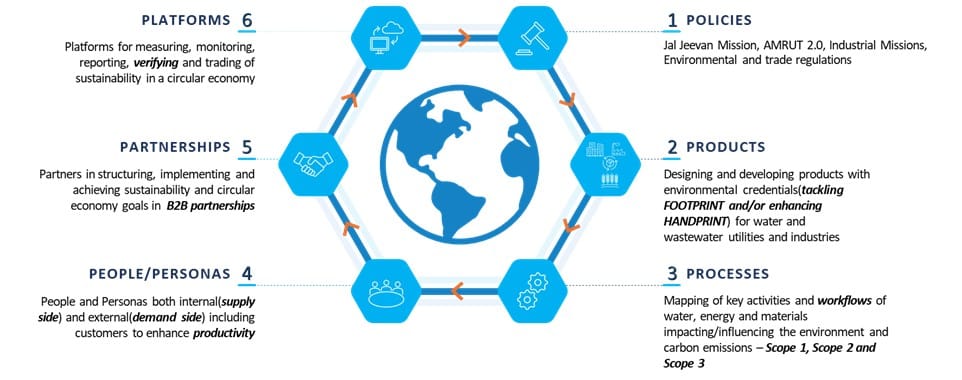
Figure 1: Frost & Sullivan’s 6P Framework
Table 1: Application of the 6P Framework to Growth Opportunities in India’s Water Sector
|
Jal Jeevan Mission (JJM) |
AMRUT 2.0 |
Industrial Water Demand |
Environmental Compliance & Global Trade |
|
|
Policies |
Aims to provide functional household tap connections to rural homes across India. The mission of is extended to 2028 with a critical shift from a department-based to a service delivery approach governed by MoUs(1) with States. |
Focused on universal urban water supply and sewerage management in 500 cities. Implementing a circular economy of water, specifically targeting the recycling of treated wastewater to meet 20% of municipal and 40% of industrial demand. |
Promotion and budget allocation towards industries such as Semiconductor, Biopharma, and Critical Mineral requires specialized water standards for fabs and labs. |
Cleaner production and lifecycle compliance for maintaining environmental compliance and to enhance global export competitiveness (eg: EU-FTA trade). |
|
Products |
Products must evolve from basic pipes and taps to flow meters and field test kits as the budget is now tied to specific performance metrics like chlorine levels and turbidity. |
Urban household taps, sewerage and septage systems, and treated wastewater for reuse. |
Reverse Osmosis plus Electro deionization systems, nanofiltration, polishing units and Zero-Liquid-Discharge (ZLD) units. |
Advanced water recycling and reuse systems. |
|
Processes |
Emphasis on community participation for the long-term O&M (2) of piped water schemes. Workflows now prioritize regularity and quality over infrastructure expansion. This process requires a feedback loop where community-led quality testing informs the platform. |
Identifying bankable projects via Urban Challenge Fund (UCF), requiring funds from bonds or Public–Private Partnerships. |
Manufacturing ultra-pure water for semiconductor fabs; cleaning/cooling for biopharma; and resource recovery from mineral tailings. |
Cleaner production and lifecycle compliance to prove that exported goods meet global sustainability standards. |
|
People / Personas |
Gram Panchayats evolve from passive recipients to active utility managers responsible for issuing water supply schedules and managing O&M.(2) |
Urban Local Bodies (ULBs) and private investors. |
EPC (Engineering, Procurement, and Construction) firms, membrane vendors, and wastewater specialists. |
Exporters (especially in steel and fertilizers) who must meet global sustainability standards to remain competitive. |
|
Partnerships |
Formalized via MoUs(1) with State Level Implementing Agencies to ensure citizen-centric delivery rather than just asset creation. |
Public-Private Partnerships (PPP) are heavily promoted to bridge the funding gap. |
Strategic collaborations between industrial policymakers and technology providers to build manufacturing hubs. |
International trade partnerships and government led initiatives to enhance export competitiveness |
|
Platforms |
The Output Outcome Monitoring Framework (OOMF) now tracks specific metrics: chlorine testing and turbidity levels (target >90% of villages testing as per protocol) and regularity of supply (target >80% of villages). |
Geo-spatial database, called the Urban Water body Information System (UWaIS) that provides data on urban water bodies, related aquifer and groundwater characteristics for the cities. UCF portal for project submission and approval. |
Systems for meeting stricter ESG (Environmental, Social, and Governance) standards and managing high-tech effluent treatment. |
Verification platforms for accounting for water use and resource efficiency to satisfy international regulatory requirements. |


(1) Memorandum of Understanding, (2) Operations and maintenance
Government Programs Shaping India’s Water Sector
The Union Budget 2026–27 highlights major investments in water supply, sanitation, and river conservation, while signaling growing attention to water-intensive industries shaping India’s future growth:
1) Jal Jeevan Mission: Rural Water Supply
The Jal Jeevan Mission (JJM) continues to receive strong notional backing, with ₹67,670 crore (~$7.44 billion) allocated in FY 2026–27, restoring funding to earlier levels. However, recent trends reveal a persistent gap between allocation and utilization.
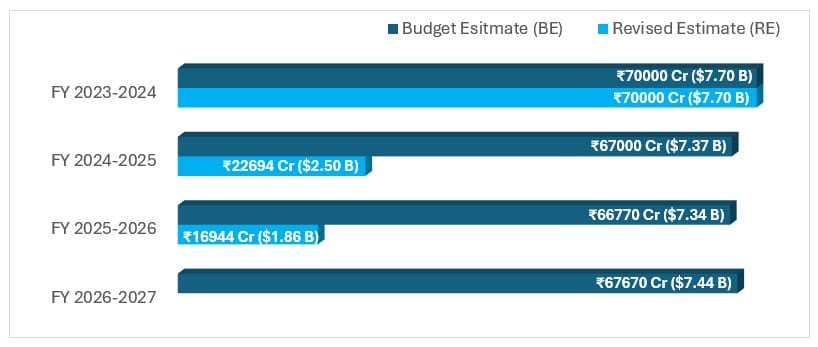
Figure 2: BE vs RE for Jal Jeevan Mission, FY 2023–24 to FY 2026–27 in ₹ Crore ($ Billion)
In FY 2024–25, the Budget Estimate (BE) of ₹70,163 crore (~$7.72 billion) was revised down sharply to ₹22,615 crore (~$2.49 billion). The pattern repeated in FY 2025–26, where the ₹67,000 crore (~$7.37 billion) BE fell further to ₹17,000 crore (~$1.87 billion) in the Revised Estimate (RE), leaving nearly 75% of the originally planned allocation unutilized.
JJM aims to provide functional household tap connections delivering 55 liters per capita per day of safe drinking water to rural homes across India. As of early 2026, over 157.2 million rural households (about 81%) have received functional tap connections. This reflects a significant shift from infrastructure expansion to long-term operational sustainability. The focus is increasingly on regularity and water quality. The budget is tied to specific performance metrics such as schedules issued by Gram Panchayats, chlorine testing, and turbidity levels.
The restored FY 2026–27 allocation therefore represents a renewed push, but the mission’s effectiveness will hinge less on headline allocations and more on governance strength and sustained service delivery capacity.
Other allocations under the Ministry of Jal Shakti include ₹6,587 crore (~$725 million) for irrigation expansion and efficiency, ₹3,100 crore (~$341 million) for river rejuvenation and sewage treatment to improve Ganga water quality, and ₹1,906 crore (~$210 million) for river interlinking projects focused on regional water balancing.
Additional investments of ₹797 crore (~$88 million) target flood control and anti-erosion works, while ₹550 crore (~$61 million) supports sewerage infrastructure and pollution reduction across other river basins.
2) AMRUT 2.0: Urban Water Security
The Atal Mission for Rejuvenation and Urban Transformation (AMRUT) 2.0, launched in 2021, aims to provide functional household taps for water supply in all statutory towns and to manage sewerage and septage in the 500 cities covered under AMRUT’s first phase, while promoting a circular economy of water and strengthening urban utility reforms.
A key target is to recycle treated wastewater to meet 20% of municipal water demand and 40% of industrial water demand in participating cities, alongside water conservation, reuse, and the rejuvenation of water bodies.
BE allocations have remained steady at ₹8,000 crore (~$880 million) per year from FY 2023–24 to FY 2026–27.
Approved projects under AMRUT 2.0 include 11,393 megaliters per day (MLD) of water treatment capacity and 17.8 million new tap connections, 6,649 MLD of sewage treatment capacity and 6.5 million sewer connections, along with scaling reuse from the current 6,535 MLD to meet the 20%/40% targets. These developments create significant opportunities for recycling, infrastructure development, and tertiary treatment through public-private partnerships.
3) Industrial Water Demand: Strategic Manufacturing, Biopharma, and Minerals
Budget 2026–27 signals a clear pivot toward high-value manufacturing sectors, which are creating new and specialized water requirements.
The India Semiconductor Mission 2.0 was allocated ₹40,000 crore (~$4.4 billion), a significant increase from previous allocations. Semiconductor fabs and electronics parks require ultra-pure water far beyond municipal treatment standards. This surge creates demand for reverse osmosis (RO) plus electro deionization (EDI) systems, nanofiltration, polishing units, and zero liquid discharge (ZLD) effluent treatment, providing long-term opportunities for water technology providers and EPC firms.
The Biopharma SHAKTI scheme will receive ₹10,000 crore (~$1.1 billion) over five years, and three chemical parks were allocated ₹600 crore (~$66 million). Biopharma and chemical plants require water for reactors, cooling, and clean-in-place systems and produce wastewater with high chemical oxygen demand (COD) and biochemical oxygen demand (BOD) loads, organic solvents, and chemical residues. These investments are likely to boost demand for advanced effluent treatment plants, tertiary treatment units, sludge recovery systems, and water recycling technologies.
Rare earth and critical mineral initiatives have also been strengthened, including ₹440 crore (~$48 million) for critical mineral processing and technology. Mineral extraction and processing use large volumes of water and generate tailings and reject streams, creating demand for sediment control, tailwater treatment, and recycling systems. Integrating treatment with resource recovery improves efficiency, reduces environmental risk, and helps meet stricter ESG standards.
Together, these allocations show that industrial policy is increasingly shaping water infrastructure demand. Unlike municipal projects, these are high-value, technology-intensive opportunities that benefit EPC contractors, membrane vendors, and wastewater specialists, while utilities and service providers can earn recurring revenue from O&M.
4) Environmental Compliance and Trade Considerations
The Budget allocated ₹20,000 crore (~$2.2 billion) for Carbon Capture, Utilization and Storage (CCUS), a notable increase targeting high-emission sectors. This aligns with India’s net-zero 2070 strategy.
This comes as India moves toward the India–EU Free Trade Agreement, while the EU’s Carbon Border Adjustment Mechanism (CBAM) requires importers to account for embedded carbon in products such as steel and fertilizers. While CBAM does not cover water directly, EU regulations increasingly emphasize sustainable production, resource efficiency, and lifecycle compliance, including recycling.
The budget allocation signals a government push to enhance export competitiveness in developed markets by enabling cleaner production and more efficient resource use. Industries that invest in water treatment, recycling, and reuse systems can better meet global sustainability standards and reduce export risk.
Ready to Lead the Transformation?
- Book a Growth Strategy Session: Align your growth roadmap with Frost & Sullivan’s visionary Growth Pipeline™ Dialog.
- Engage with Growth Experts: Co-design AI-enabled, data-driven operating models that scale industry-specific and commercial impact.
- Share Your Transformation Story: Position your organization as a transformation leader through Frost & Sullivan’s Transformational Growth Leadership platform.
- Join the Growth Council: Collaborate with industry leaders shaping the future of your ecosystem.
- Nominate for the Best Practices Recognition: Be recognized for excellence in growth strategy, execution, and customer impact.
- Demonstrate Industry Positioning on the Frost Radar™: Benchmark your growth performance and innovation strength against industry competitors.
- Activate Brand & Demand Growth: Accelerate awareness, engagement, and revenue growth through integrated brand and demand generation strategies.
Annexure: Growth Opportunities Supporting India’s Water Sector Transformation
The Union Budget 2026–27 highlights several policy priorities that are reshaping India’s water landscape. Investments in rural water supply, urban wastewater infrastructure, industrial manufacturing, and environmental compliance are gradually expanding the scope of water infrastructure and technology adoption across the country.
These developments closely reflect the themes Frost & Sullivan tracks in its research on water treatment technologies, infrastructure modernization, and industrial water management. The following analyses provide additional perspective on the technology adoption trends and investment areas expected to influence the sector in the coming years: