For decades, competitive advantage in the food industry has been shaped by three enduring drivers: taste, convenience, and affordability. While these factors still remain critical, health outcome is emerging as a fourth dimension.
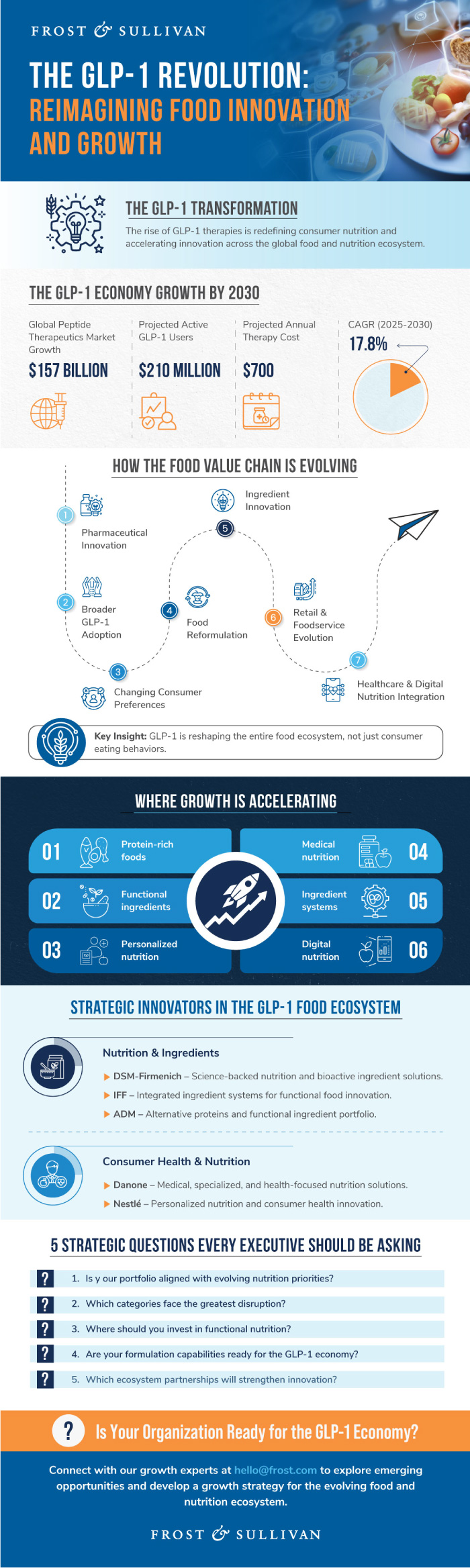
The rapid rise of glucagon-like peptide-1 (GLP-1) therapies is creating one of the most significant structural changes in the global food industry. With the global peptide therapeutics market projected to reach $157 billion and more than 210 million active GLP-1 users expected by 2030, food companies are facing a new competitive reality in which health outcomes influence purchasing decisions and category growth.
How does your R&D organization compare with high-performing innovation leaders?
Access:
- Critical shifts in consumer eating behaviors
- Growth opportunities across the food value chain
- Strategic frameworks for innovation and long-term growth
For executive leaders, this transformation extends beyond product innovation. It calls for strategic portfolio realignment, targeted investment, and stronger ecosystem collaboration to capture emerging growth opportunities and create sustainable competitive advantage.
How will GLP-1 reshape your portfolio, innovation, and growth strategy?
What Is GLP-1 and Why Does It Matter?
Glucagon-like peptide-1 is a naturally occurring hormone that regulates appetite, slows gastric emptying, and improves blood sugar control. Therapies that mimic GLP-1 were initially developed to treat Type 2 diabetes and have become some of the best GLP-1 therapies for weight loss, helping millions of patients manage obesity and metabolic health.
As clinical applications broaden, treatment accessibility improves, and new oral formulations enter the industry, GLP-1 adoption is expected to extend across a larger patient population. This expanding user base is creating a foundational shift in eating patterns, prompting food industry leaders to reassess how future consumer preferences may evolve.
While prescription GLP-1 therapies are driving today’s industry transformation, consumer awareness of metabolic health is also increasing interest in natural GLP-1 approaches and GLP-1 supplements designed to support appetite regulation and overall wellness. Although these products do not replicate the clinical efficacy of prescription therapies, they reflect a broader shift toward nutrition solutions that complement healthier lifestyles.
Consumer Behavior Shift
Consumer expectations are evolving as GLP-1 adoption reshapes dietary preferences and nutrition priorities. Understanding these behavioral shifts will be critical for organizations looking to align product innovation with future demand.
| Conventional Consumption Patterns | Emerging GLP-1 Driven Preferences |
| Large meal portions | Portion-controlled meals |
| Frequent discretionary snacking | Fewer, more intentional eating occasions |
| Indulgence-led purchasing | Nutrition-led purchasing |
| General-purpose foods | Functional and health-oriented foods |
| Calories as a purchasing factor | Protein, satiety, and metabolic health as purchasing priorities |
| Standardized nutrition | Personalized nutrition solutions |
How Consumer Eating Behaviors Are Setting New Expectations for Food Innovation
Natural GLP-1 therapies are influencing how consumers approach food, placing greater emphasis on nutritional value with every eating occasion. As appetite regulation and satiety improve, consumers are making more intentional food choices that support their health and wellness goals.
Key behavioral changes include:
- Smaller portions and fewer eating occasions, increasing the need for nutrient-dense products.
- Reduced discretionary snacking, encouraging healthier snack alternatives with greater nutritional value.
- Higher demand for protein-rich foods to support satiety, muscle preservation, and metabolic wellness.
- Growing preference for functional nutrition, including products supporting gut health, hydration, and healthy aging.
- Continued demand for indulgence in moderation, creating opportunities for premiumization and portion innovation.
These evolving preferences are reshaping business priorities across the food value chain.
Organizations should evaluate:
- Portfolio exposure to changing consumption patterns.
- Reformulation opportunities for existing product lines.
- Investments in protein, functional ingredients, and integrated nutrition systems.
- Supply chain readiness for changing ingredient demand.
- Retail and foodservice strategies aligned with health-oriented purchasing behaviors.
The real opportunity is not determined by how much consumers eat, but by how their food choices are reshaping demand across food categories.
Strategic Ecosystem Partnerships and Collaborative Innovation
The convergence of food, healthcare, and digital wellness is reshaping how organizations innovate and compete. Food manufacturers, ingredient suppliers, healthcare organizations, and digital health companies are becoming increasingly interconnected, creating opportunities to accelerate innovation through collaboration.
Future growth will depend on partnerships spanning:
- Food manufacturing
- Ingredient innovation
- Nutrition science
- Healthcare
- Diagnostics
- Digital health
Organizations that build collaborative ecosystems can accelerate product development, improve consumer engagement, and respond more effectively to changing market expectations.
Why Formulation Capabilities Are Becoming a Competitive Differentiator
The GLP-1 economy is shifting competition beyond individual ingredients toward integrated formulation capabilities. As food manufacturers reformulate products to increase protein, reduce calories, improve satiety, and maintain taste, ingredient suppliers are evolving into strategic formulation partners.
Competitive differentiation will depend on the ability to deliver:
- Multi-functional ingredient systems rather than standalone ingredients.
- Solutions that improve protein density while preserving taste and texture.
- Clinically supported functional ingredients for metabolic and digestive health.
- Application-specific formulations tailored to different food categories.
- Faster co-development and commercialization with brand owners.
As value shifts from commodity ingredients to integrated nutrition solutions, formulation expertise is becoming a key driver of long-term growth.
According to Frost & Sullivan, the long-term impact of GLP-1 adoption will extend far beyond ingredient reformulation. Future food industry leaders will differentiate through integrated nutrition platforms that combine clinical validation, formulation expertise, personalized nutrition, and ecosystem collaboration to deliver measurable health outcomes and long-term consumer value.
Top 5 Growth Opportunities Shaping GLP-1 Adoption
- Protein-rich Foods and Beverages: Protein is becoming an even stronger nutritional priority as consumers seek solutions that support satiety, muscle preservation, and metabolic health. This is expected to accelerate innovation across dairy, beverages, snacks, and meal solutions.
- Functional Nutrition: Consumers are seeking products that deliver measurable health benefits beyond basic nutrition. Functional foods supporting gut health, hydration, metabolic wellness, healthy aging, and immune health are gaining strategic importance.
- Integrated Ingredient Systems: Demand is shifting beyond individual ingredients toward integrated systems combining proteins, fibers, probiotics, postbiotics, bioactives, and advanced nutrient delivery technologies that simplify product development and improve health outcomes.
- Personalized Nutrition: Advances in diagnostics, biomarker-based nutrition, and digital health platforms are creating opportunities for tailored nutritional solutions that address individual health goals and lifestyle needs.
- Medical and Specialized Nutrition: The convergence of healthcare and food is expanding opportunities for products that bridge clinical nutrition and everyday consumption, particularly in weight management, healthy aging, and recovery.
Organizations that align innovation strategies with these emerging value pools can strengthen differentiation while responding to changing consumer priorities.
Access the Sample Analysis to Explore More Growth Opportunities in GLP-1 Adoption
What Should Food Industry Leaders Do Now?
The GLP-1 economy requires more than incremental product innovation. It calls for a strategic reassessment of how organizations develop products, allocate capital, and build competitive advantage.
Industry leaders should focus on five strategic priorities:
- Rebalance portfolios toward protein-rich, functional, and portion-controlled offerings.
- Invest in science-backed innovation supported by clinical validation and evidence-based health claims.
- Build integrated nutrition platforms that combine multiple functional ingredients into complete solutions.
- Strengthen ecosystem partnerships across food manufacturing, ingredient science, healthcare, diagnostics, and digital health.
- Advance personalized nutrition capabilities through biomarker-driven insights and targeted nutritional solutions.
Organizations that move early will be better positioned to anticipate changing demand, accelerate innovation, and create long-term value across the food ecosystem.
How Frost & Sullivan Can Help
As a strategic growth partner, Frost & Sullivan helps organizations understand the evolving implications of GLP-1 adoption through market forecasting, competitive intelligence, innovation strategy, benchmarking, ecosystem mapping, and growth advisory. By combining data-driven analysis with industry expertise, we help organizations identify emerging value pools, prioritize investments, and develop strategies that support long-term growth.
Schedule a Growth Dialog to connect with our experts and explore how your organization compares with industry leaders and identify the strategic priorities that will drive future growth.
Frequently Asked Questions (FAQs):
What is the meaning of GLP-1?
GLP-1 (glucagon-like peptide-1) is a naturally occurring hormone that regulates appetite, slows digestion, and helps control blood sugar levels. Therapies that mimic GLP-1 are widely used to treat Type 2 diabetes and obesity, and their growing adoption is influencing consumer eating habits, nutrition priorities, and food innovation.
What is a GLP-1 supplement?
A GLP-1 supplement is a non-prescription nutritional product marketed to support appetite management or metabolic health. Unlike prescription GLP-1 medications, these supplements do not replicate GLP-1 receptor activity but reflect growing consumer interest in preventive health and nutrition-based wellness.
How big is the GLP-1 industry?
The GLP-1 industry is expanding rapidly, driven by rising obesity rates, broader clinical applications, and continued pharmaceutical innovation. Frost & Sullivan projects the global peptide therapeutics market to reach $157 billion by 2030, with more than 210 million active GLP-1 users expected worldwide.
What are the biggest GLP-1 companies in food and ingredients?
Leading food and ingredient companies are aligning their innovation strategies with evolving nutrition priorities. DSM-Firmenich is advancing science-backed ingredients and bioactives, IFF is strengthening integrated formulation capabilities, Danone is expanding specialized and medical nutrition, Nestlé is accelerating investments in health science and personalized nutrition, and ADM is broadening its portfolio of alternative proteins and functional ingredients.
Which food categories are expected to benefit from GLP-1 adoption?
High-growth opportunities are emerging across protein-rich dairy products, functional beverages, portion-controlled snacks, medical nutrition, personalized nutrition, and integrated ingredient systems. These categories align with consumers’ growing focus on satiety, muscle health, metabolic wellness, and overall nutrition.
What is the best GLP-1 for weight loss, and why does it matter to the food industry?
While the choice of GLP-1 therapy should always be determined by a healthcare professional, the broader trend is already influencing the food industry. As more consumers adopt GLP-1 therapies, demand is shifting toward smaller portions, higher-protein foods, functional ingredients, and nutrition-focused products, creating new opportunities for food manufacturers and ingredient suppliers.
Ready to Lead the Transformation?
- Schedule a Growth Strategy Dialog: Align your growth roadmap with Frost & Sullivan’s Visionary Growth Pipeline™ Dialog.
- Engage with Growth Experts: Co-design AI-enabled, data-driven operating models that scale industry-specific and commercial impact.
- Showcase Your Transformational Leadership: Position your organization as a transformation leader through Frost & Sullivan’s Transformational Growth Leadership platform.
- Join the Growth Council: Collaborate with industry leaders shaping the future of your ecosystem.
- Explore Best Practices Recognition: Be recognized for excellence in growth strategy, execution, and customer impact.
- Benchmark Your Industry Positioning on the Frost Radar™: Benchmark your growth performance and innovation strength against industry competitors.
- Tell Your Story: Accelerate awareness, engagement, and revenue growth through integrated brand and demand generation strategies.