This blog is based on Frost & Sullivan’s latest analysis, “Flavors and Fragrances Market, Global, 2025–2032,” authored by Nimisha Dhomne from the Chemicals, Materials, and Nutrition Practice Area.
The flavors and fragrances (F&F) industry is accelerating toward a fundamental shift in consumer expectations, driven by growing demand for natural, clean-label, and wellness-oriented products. This evolving landscape is projected to expand from $36.03 billion in 2025 to $52.27 billion by 2032, highlighting strong growth potential even as organizations navigate cost pressures, scalability demands, and regulatory compliance.
Companies are rethinking how they innovate and compete by prioritizing bio-based ingredients, tailoring sensory experiences to evolving consumer preferences, and embedding health and wellness into product development. Future growth will depend on the ability to scale these capabilities while maintaining operational efficiency and regulatory alignment.
Flavors & Fragrances Industry
- What is driving growth?
- Where are high-impact growth opportunities?
- Who are the leading players in F&F?
Is your organization ready to turn this transformation into a sustainable competitive advantage?
Listen to our podcast episode on Growth Opportunities in Flavors and Fragrances.
Why Flavors & Fragrances Are Becoming Central to Competitive Strategy
Flavors and fragrances, once viewed primarily as functional inputs for enhancing taste and scent, are now emerging as central drivers of brand identity, consumer engagement, and product positioning.
In food and beverage categories, flavors are enabling reformulation strategies that reduce sugar, salt, and artificial additives while preserving taste and consumer acceptance. In personal care and home care, fragrances are evolving beyond aesthetics to deliver emotional and wellness benefits, influencing purchase decisions and brand loyalty.
This transition is reflecting a broader move from product-centric to experience-driven innovation, where sensory differentiation is becoming a key driver of competitive advantage.
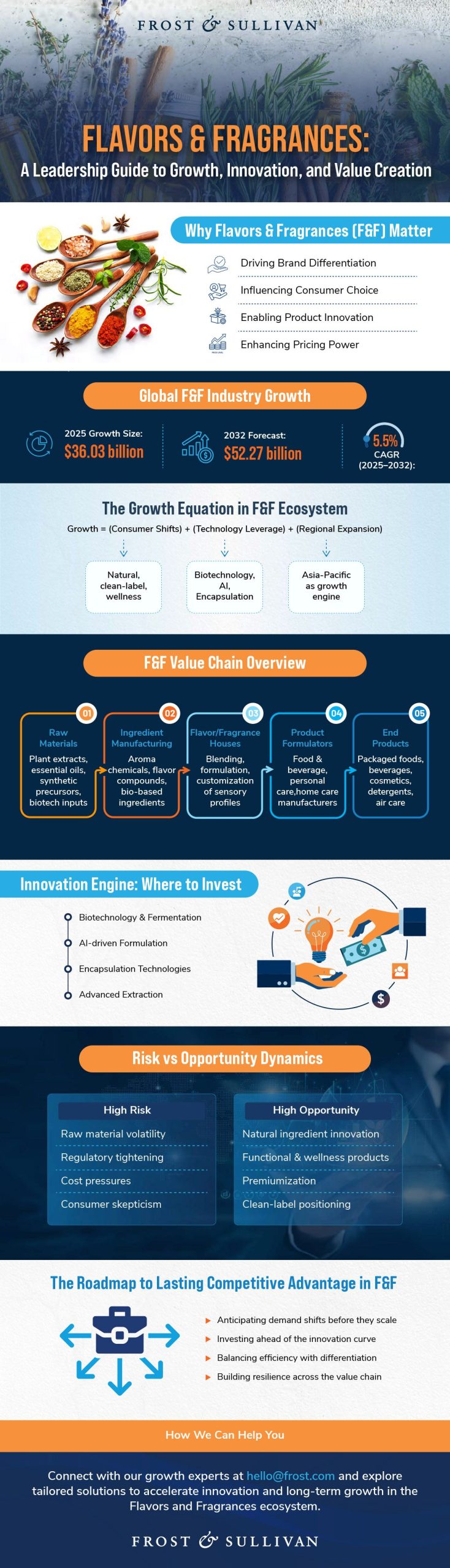
Strategic Imperatives Shaping Growth in the Flavors and Fragrances Ecosystem
- Transformative Megatrends: Health-driven Consumption Is Redefining Demand
The rapid adoption of GLP-1 weight-management drugs is triggering a structural shift in dietary behavior, with consumers moving away from high-sugar, indulgent categories toward nutrient-dense and portion-controlled products.
To remain relevant, organizations that proactively realign portfolios toward health-oriented applications, will be better positioned to form strategic partnerships with brands undergoing reformulation.
- Disruptive Technologies: Biotechnology Is Redefining Innovation
Consumer preference for natural and sustainable ingredients is accelerating the adoption of biotechnology across flavor and fragrance development.
Key shifts include:
- Expansion of fermentation-based and bio-derived ingredients
- Increased use of advanced R&D and formulation technologies
- Strategic investments and partnerships to build biotech-enabled portfolios
- Competitive Intensity: Fragmentation Meets Consolidation
The industry is reflecting a dual structure:
- Flavors are remaining fragmented, with regional players driving growth through customization and local preferences
- Fragrances are becoming more consolidated, led by global players leveraging strong R&D, IP, and brand equity
Key Challenges Shaping Strategic Decision-making
Despite strong growth potential, the industry is facing a range of complex challenges that require strategic attention:
- Raw Material Volatility: Natural flavor ingredients such as vanilla, citrus, and essential oils are highly sensitive to climate conditions and supply disruptions, creating pricing pressure and availability risks.
- Regulatory Complexity: Evolving regulations across major regions are increasing compliance requirements, particularly around ingredient safety, labeling, and sustainability claims.
- Cost and Performance Trade-offs: Natural ingredients are presenting higher costs and stability limitations than synthetic alternatives, requiring careful formulation and pricing strategies.
- Consumer Perception and Safety Concerns: Increasing scrutiny around ingredient safety and transparency is influencing purchasing behavior and brand trust.
Technologies Driving Industry Evolution in Flavors and Fragrances
Technology is emerging as a critical enabler of transformation, reshaping how flavors and fragrances are being developed and delivered:
- Biotechnology and Fermentation: Enabling scalable production of natural and bio-based ingredients with stronger sustainability and consistency.
- Encapsulation and Delivery Systems: Enhancing stability, shelf life, and controlled release of flavor and fragrance compounds.
- AI and Digital Formulation Tools: Accelerating product development cycles and enabling more precise customization based on consumer preferences .
- Advanced Extraction Technologies: Improving yield, efficiency, and environmental performance in ingredient production.
High-impact Growth Opportunities in Flavors and Fragrances Landscape
- Wellness and Functional Beverages: Increasing demand for drinks that combine health benefits with appealing taste profiles is driving innovation in flavor systems.
- Functional Fragrances: Fragrances that offer mood-enhancing, stress-relieving, or sleep-support benefits are gaining traction across multiple product categories.
- Asia-Pacific Expansion: Rapid urbanization, rising incomes, and diverse cultural preferences are making Asia-Pacific a key growth region.
Ready to uncover where growth is headed? Download the full Flavors & Fragrances analysis.
Companies Leading the Transformation in Flavors and Fragrances Ecosystem
- Givaudan is strengthening its leadership through biotechnology platforms and wellness-focused fragrance programs, while expanding capabilities in natural ingredients and sensory science.
- International Flavors & Fragrances is advancing integrated solutions by combining flavors, fragrances, and biosciences, with a strong focus on health, sustainability, and functional ingredients.
- Symrise is focusing on digitalization and AI-enabled product development, alongside sustainable sourcing and circular economy initiatives.
- MANE is differentiating through high-value natural ingredients, proprietary extraction technologies, and close collaboration with regional and global brands.
At the same time, smaller and regional players are continuing to play a critical role by leveraging local consumer knowledge, customization capabilities, and agile innovation models.
Best Practices for Industry Leaders: Strategies to Navigate Complexity and Accelerate Growth
To navigate this evolving landscape effectively, industry leaders should focus on:
- Embedding consumer-centric innovation into strategy
- Building flexible and resilient supply chains
- Leveraging data and digital tools for faster decision-making
- Strengthening cross-functional and external partnerships
- Balancing cost efficiency with differentiation and performance
The flavors and fragrances industry is entering a phase where growth depends on effectively aligning health, sustainability, and sensory innovation. Organizations that combine technology investment with agile operations and consumer-focused strategies will gain a clear edge.
Frequently Asked Questions
- What are flavors and fragrances?
Flavors and fragrances are ingredients used to enhance sensory experiences in products. Flavors are added to food and beverages to create or improve taste, while fragrances are used in personal care, home care, and cosmetic products to provide distinctive scents and influence consumer perception. - How big is the flavors and fragrances industry?
The global flavors and fragrances industry generated approximately $36.03 billion in 2025 and is projected to reach $52.27 billion by 2032, reflecting steady growth driven by demand across food, beverage, personal care, and wellness applications. - What drives growth in the flavors and fragrances market?
Growth is driven by several key factors, including rising demand for natural and clean-label ingredients, increasing reformulation of food products to reduce sugar and additives, expanding use of fragrances in personal and home care, and advancements in biotechnology and ingredient innovation. - Who are the top players in the F&F industry?
Leading companies include Givaudan, International Flavors & Fragrances, dsm-firmenich, Symrise, and MANE. These companies lead through strong R&D, global presence, and innovation capabilities. - Are synthetic or natural ingredients more popular?
Demand is increasingly shifting toward natural and bio-based ingredients due to consumer preference for clean-label and sustainable products. However, synthetic ingredients continue to be widely used because they offer cost efficiency, consistency, and stability, making both segments important in the overall industry.
Ready to Lead the Transformation?
- Book a Growth Strategy Session: Align your growth roadmap with Frost & Sullivan’s visionary Growth Pipeline™ Dialog.
- Engage with Growth Experts: Co-design AI-enabled, data-driven operating models that scale industry-specific and commercial impact.
- Share Your Transformation Story: Position your organization as a transformation leader through Frost & Sullivan’s Transformational Growth Leadership platform.
- Join the Growth Council: Collaborate with industry leaders shaping the future of your ecosystem.
- Nominate for the Best Practices Recognition: Be recognized for excellence in growth strategy, execution, and customer impact.
- Demonstrate Industry Positioning on the Frost Radar™: Benchmark your growth performance and innovation strength against industry competitors.
- Activate Brand & Demand Growth: Accelerate awareness, engagement, and revenue growth through integrated brand and demand generation strategies.