This blog is based on our analyses – Top 10 Growth Opportunities for the Global Water Utilities Market, 2025 and Top 10 Growth Opportunities in the Global Residential, Commercial HoReCa, and Institutional Water Solutions Markets, 2025, authored by Frost & Sullivan’s Growth Experts, Paul Hudson and Julieta Paez, from the Waste, Water and Air team.
Utilities, residential, commercial, and institutional segments are under mounting pressure from climate change, population growth, and urbanization. These forces are intensifying water stress and pollution, making conservation, reuse, and efficient resource management essential across all segments.
To address these challenges, providers are implementing smart water solutions that optimize operations, reduce consumption, and deliver eco-friendly services. By combining these initiatives with innovative business models, organizations can address water scarcity, drive sustainability, and capture high-value growth opportunities in a rapidly evolving water landscape.
Explore how transformative megatrends, disruptive technologies, and innovative business models are reshaping global water networks.
What growth strategies will your organization adopt to thrive in the evolving water ecosystem?
Explore the strategies to thrive in the evolving water ecosystem — click here
Growth Avenues in the Global Water Ecosystem
How is your organization responding to megatrends redefining water networks worldwide?
See how digital water management enables smarter, more efficient operations.
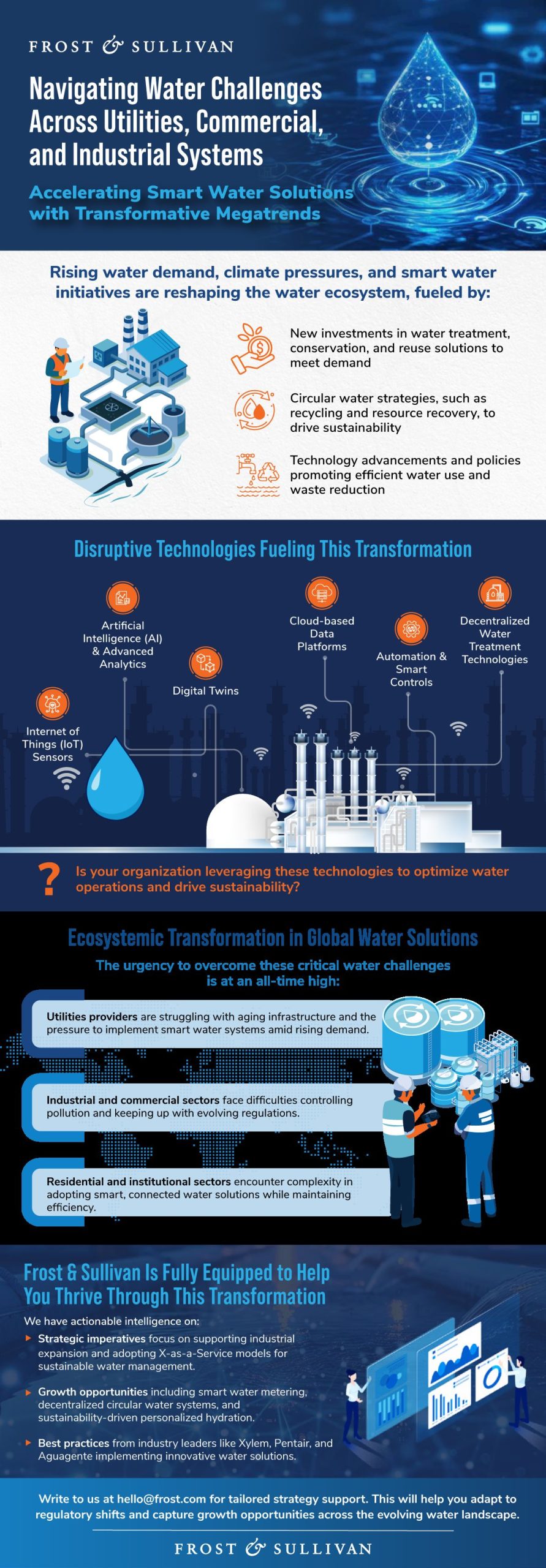
What’s Driving Transformation Across Water Networks
These imperatives are driving a paradigm shift in water management:
- Transformative Megatrends: Climate volatility, urban expansion, and population growth are driving the adoption of smart and circular water strategies.
- Disruptive Technologies: Internet of Things (IoT), AI, and digital twins are improving monitoring, system performance, and water quality standards.
- Innovative Business Models: X-as-a-Service models, outcome-based contracts, and new financing mechanisms are accelerating infrastructure upgrades and sustainable adoption.
Is your organization aligned with the forces transforming water infrastructure and management?
Companies to Action
These industry leaders are pioneering innovative water solutions, setting new benchmarks across utilities, residential, commercial, and institutional segments:
- Xylem Sensus: Delivering iPERL+ smart water meters with 20-year accuracy and providing Sensus Analytics for seamless automated meter reading (AMR)/advanced metering infrastructure (AMI) integration.
- Hydraloop: Offering decentralized, industrial water recycling devices for residential and commercial buildings, collecting, treating, and reusing greywater from showers, washers, and AC units.
- Pentair: Providing smart pool solutions, including IntelliFlo3® Variable Speed Pumps, optimizing energy efficiency, automation, and light-emitting diode (LED) systems while minimizing environmental impact.
Do you have the right tools to benchmark performance and partner with providers driving smart water solutions?
Discover how industry leaders are transforming water systems
High-impact Growth Opportunities in Global Water Systems
These opportunities can help providers reduce costs, optimize resource use, and align with sustainability priorities:
- Innovative Financing Models
Utilities providers in developing countries are adopting new financing and business models to attract private investments, reduce reliance on subsidies, and strengthen infrastructure sustainability. Key approaches include:
- Implementing performance- or outcome-based contracts to reduce water loss and improve revenue collection.
- Leveraging Metering-as-a-Service (MaaS) models for smart water metering projects, with examples in Botswana, India, and Indonesia.
- Collaborating with financial institutions such as the World Bank, ADB, and IFC to restructure policies, build capacity, and ensure fair returns for investors.
Are you leveraging outcome-based and smart financing models to accelerate water infrastructure upgrades?
- Digital Innovation
Digital technologies are transforming how water is monitored, managed, and conserved. Providers are leveraging these innovations, including:
- Implementing Internet of Things (IoT) devices and smart sensors to track usage, detect leaks, and optimize system performance.
- Leveraging AI and advanced analytics to forecast demand, detect anomalies, and allocate resources efficiently.
- Adopting digital twins to simulate operations, enable predictive maintenance, and optimize water networks.
Is your organization equipped with the right tools to thwart new challenges in water management?
- Point-of-use Closed-loop Water Solutions
Point-of-use closed-loop systems are transforming water conservation and reuse in residential and commercial buildings by saving water, reducing energy consumption, and lowering carbon dioxide (CO₂) emissions. Providers are adopting strategies such as:
- Creating cost-effective, accessible systems to enable broader adoption across income segments.
- Building retrofit-friendly solutions that are easy to operate and maintain.
- Integrating digital platforms to provide technical support, real-time insights, and actionable water-saving guidance
Are you implementing best practices to maximize water reuse and conservation?
Your guide to leading water system transformation is just one click away — access it here.
Key Takeaways for Water Solution Providers
Thriving in the evolving water ecosystem requires more than incremental change — it demands bold, decisive action. So, solution providers should focus on:
- Prioritizing climate-proof infrastructure and resource-efficient designs to withstand volatility.
- Leveraging data, AI, and smart monitoring systems to enable predictive insights and operational excellence.
- Exploring outcome-based contracts, MaaS, and public–private partnerships to unlock funding and accelerate modernization.
- Partnering with utilities, commercial facilities, and technology innovators to deliver integrated, circular solutions.
Organizations that act now will be best positioned to lead the transition toward smarter, more efficient water systems.
What steps will your organization take to lead in smart and sustainable water solutions?
Looking to prioritize investments, explore new opportunities, and benchmark your strategy against leaders in smart water management?
Get in touch with our Waste, Water, & Air Growth Experts to know more