This blog is based on our analysis – HVAC Equipment Market, Global, 2026–2031 and HVAC Equipment Market, India, 2025–2030, authored by Frost & Sullivan’s Growth Expert, Yoganandhan Jayavel, from the Energy & Buildings Practice Area.
Rising temperatures, rapid urbanization, and continued infrastructure development are changing what buildings require from heating, ventilation, and air conditioning (HVAC) systems. Concerns about pollution and indoor air quality are adding to this demand as building owners seek comfortable indoor conditions without placing greater pressure on energy use. These factors are expected to increase global market revenue from $255.40 billion in 2025 to $383.60 billion by 2031, at a CAGR of 7%.
As demand rises, HVAC systems are being designed to respond more precisely to changing building conditions. Internet of Things (IoT)-enabled solutions use real-time data and remote controls to improve system performance and give users greater control over temperature and air quality. However, high initial costs and a shortage of skilled professionals continue to slow adoption.
Strengthen Your HVAC Growth Strategy
Explore the applications, and investment priorities influencing the future of the global HVAC equipment market.
This gives HVAC companies an opportunity to develop systems that balance performance, energy use, cost, and ease of implementation. Understanding these market changes will help businesses identify where the strongest opportunities lie.
Which technologies and market developments will define the next phase of growth in the global HVAC equipment industry?
Listen to our latest podcast on the technology advances and strategic priorities influencing the HVAC equipment industry.
Top 3 Strategic Imperatives Shaping the HVAC Equipment Industry
- Innovative Business Models: Customers want to improve energy performance without investing heavily in new equipment. HVAC-as-a-Service (HaaS) and Cooling-as-a-Service (CaaS) allow them to pay for the performance they receive. For OEMs, these models turn one-time sales into recurring revenue.
- Disruptive Technologies: Smart sensors, cloud controls, and predictive analytics give operators a clearer view of system performance. This visibility helps them manage energy use and address maintenance issues before equipment fails. Low-global warming potential (GWP) refrigerants and electrified heating also help manufacturers meet tighter environmental requirements.
- Transformative Megatrends: Rising temperatures and expanding cities are placing greater demands on heating and cooling systems. This pressure is particularly high because buildings account for nearly 40% of global energy consumption. Improving HVAC efficiency can therefore make a meaningful contribution to net-zero building goals.
HVAC Equipment Industry – At a Glance
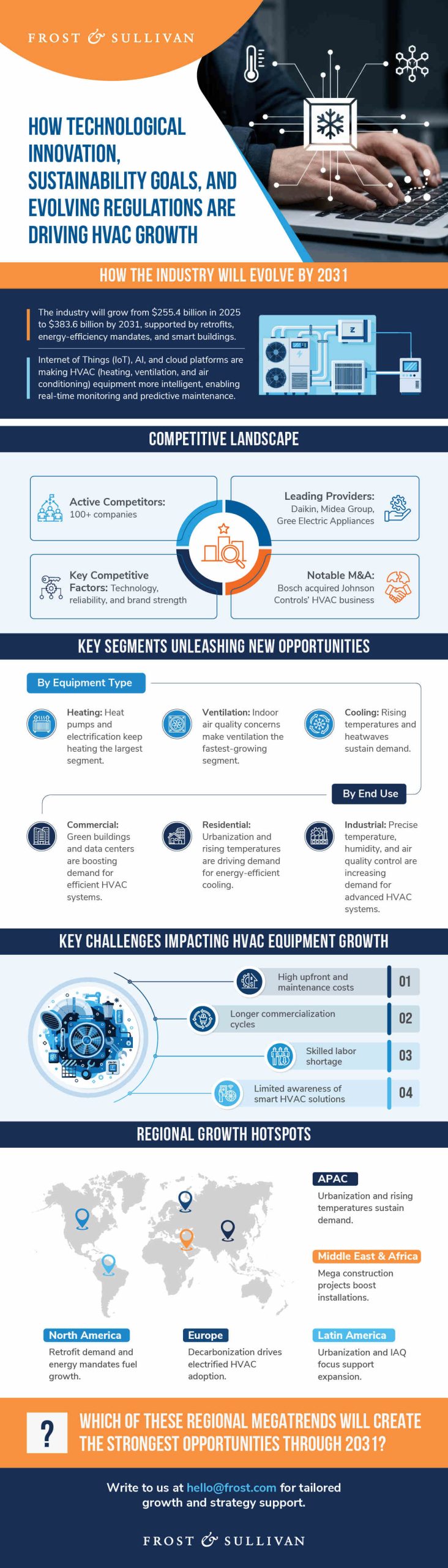
What Is Driving Demand for HVAC Equipment?
- Regulatory Compliance: Tighter carbon-emission rules are driving building owners to replace older, inefficient equipment. This is increasing demand for low-emission heating and cooling solutions.
- Operating Cost Savings: Rising energy costs are making efficiency a key purchasing consideration. Systems that use less power can reduce operating expenses throughout their working life.
- Healthier Indoor Environments: Greater attention to ventilation is changing how customers assess HVAC equipment. Airflow and filtration performance now play a larger role in equipment selection.
- Centralized Building Management: Building operators want to manage heating, cooling, lighting, and other functions through a single platform. This is raising demand for equipment that connects easily with building management systems.
- New Construction Activity: Homes, offices, hospitals, data centers, and public facilities need dependable temperature and airflow control. Construction across these building categories is expanding the installed base.
Comparing HVAC Growth Across Global Markets
|
Region |
Market Scale |
Growth Potential |
|
Asia-Pacific |
$107.78 billion in 2025, accounting for 42.2% of global revenue |
Rapid urban growth, rising temperatures, and a large manufacturing base make this the industry’s biggest regional market. |
|
North America |
$60.02 billion in 2025, growing at a 7% CAGR through 2031 |
Aging buildings and tighter efficiency rules are creating a strong HVAC replacement market. |
|
Europe |
$53.89 billion in 2025 |
The move away from fossil fuel heating is increasing demand for electric and energy-efficient systems. |
|
Middle East and Africa |
Around $3 trillion in planned real estate and infrastructure projects |
Large projects in Saudi Arabia, the UAE, Egypt, and Kuwait are creating substantial cooling requirements. |
|
Latin America |
Growing at a 5.8% CAGR through 2031 |
New infrastructure and greater attention to indoor air quality are increasing demand for cooling and ventilation systems. |
Top Growth Opportunities for HVAC Manufacturers
- Remote HVAC Maintenance Using IoT and Cloud Platforms
Maintaining equipment across multiple buildings is difficult when every inspection requires an on-site technician. Internet of Things (IoT) sensors collect data on temperature, humidity, energy use, and equipment condition, while cloud platforms identify early signs of a fault. Service teams can respond sooner, reduce unplanned downtime, and avoid unnecessary visits.
Manufacturers can build a service business around connected equipment by:
- Installing sensors and cloud connectivity in new systems to collect operating data.
- Using this data to diagnose faults remotely and schedule maintenance before a breakdown.
- Offering remote monitoring subscriptions and digital maintenance agreements.
- AI- and ML-enabled HVAC Systems
Heating, cooling, and ventilation requirements change with occupancy, weather, and energy prices. Artificial intelligence (AI) and machine learning (ML) can use these inputs to adjust settings and balance loads across building zones. This helps maintain indoor comfort while controlling energy use and operating costs.
Manufacturers can turn automated control into measurable customer value by:
- Designing systems that respond to changes in building use and outdoor conditions.
- Refining system settings using historical and real-time performance data.
- Giving customers clear information on energy use, operating costs, and indoor conditions.
What Will Set HVAC Market Leaders Apart?
Future HVAC purchasing decisions will depend on how well equipment responds to changing building requirements over time. Building owners will favor systems that can accommodate new efficiency standards, different occupancy patterns, and future upgrades without requiring complete replacement.
Product flexibility will therefore become a stronger point of competition. Manufacturers that consider future requirements during the design stage will be better placed to retain customers as expectations change.
Frequently Asked Questions (FAQs)
What exactly does HVAC mean?
HVAC stands for Heating, Ventilation, and Air Conditioning. It refers to the systems and equipment used to control indoor temperature, airflow, humidity, and air quality in homes, commercial buildings, and industrial facilities.
What is HVAC equipment?
HVAC equipment includes the systems and components used for heating, cooling, ventilation, and indoor air quality control. Common examples include air conditioners, heat pumps, furnaces, boilers, chillers, air handling units, ventilation fans, ductwork, thermostats, and control systems.
What kind of industry is HVAC?
The HVAC industry is part of the broader building and construction ecosystem. It includes the manufacturing, installation, maintenance, and servicing of heating, ventilation, air conditioning, refrigeration, and building climate-control systems across residential, commercial, and industrial facilities.
What are the three types of HVAC?
HVAC systems are commonly grouped into three broad categories: split systems, packaged systems, and ductless systems. Split systems have separate indoor and outdoor units, packaged systems combine heating and cooling components in one unit, and ductless or mini-split systems provide heating and cooling without extensive ductwork.
What are the major HVAC industries in India?
India’s HVAC industry includes major segments such as residential and commercial air conditioning, industrial HVAC, ventilation, refrigeration, and building automation. Key demand sectors include commercial real estate, healthcare, data centers, manufacturing, hospitality, retail, and residential buildings.
Ready to Lead the Transformation?
- Schedule a Growth Strategy Dialog: Align your growth roadmap with Frost & Sullivan’s Visionary Growth Pipeline™ Dialog.
- Engage with Growth Experts: Co-design AI-enabled, data-driven operating models that scale industry-specific and commercial impact.
- Showcase Your Transformational Leadership: Position your organization as a transformation leader through Frost & Sullivan’s Transformational Growth Leadership platform.
- Join the Growth Council: Collaborate with industry leaders shaping the future of your ecosystem.
- Explore Best Practices Recognition: Be recognized for excellence in growth strategy, execution, and customer impact.
- Benchmark Your Industry Positioning on the Frost Radar™: Benchmark your growth performance and innovation strength against industry competitors.
- Tell Your Story: Accelerate awareness, engagement, and revenue growth through integrated brand and demand generation strategies.