This blog is based on our analyses – Growth Opportunities in Global Homes and Buildings Industry, 2026, Top 5 Growth Opportunities in Smart Buildings, 2026, Top 5 Growth Opportunities in Digital Construction Management, 2026, Top 8 Growth Opportunities in Workplace Management, 2026, Top 8 Growth Opportunities in HVAC, 2026 – authored by Frost & Sullivan’s Growth Expert, Anirudh Baskaran, Janice Wung, and Yoganandhan Jayavel, from the Homes & Buildings team.
The homes and buildings ecosystem is evolving as AI, automation, and sustainability mandates reshape construction, smart buildings, workplace management, and HVAC (heating, ventilation, and air conditioning) systems. The industry is expected to grow by 4.0%–7.7% in 2026, driven by rising investments in AI-powered building technologies, connected infrastructure, and energy-efficient solutions.
In construction, agentic AI, robotics, and digital tools are reducing delays and strengthening cost control. Smart buildings are using AI and Internet of Things (IoT) to enable real-time optimization, while workplace management is becoming more data-driven, focused on hybrid work and portfolio performance. HVAC systems are also evolving, with predictive capabilities and low-global warming potential (GWP) innovations improving efficiency and sustainability.
The Future of the Built Environment
Discover how integrated ecosystems across construction, buildings, workplace, and HVAC are driving the next phase of growth.
As the transformation accelerates, the focus is shifting toward integrated strategies that deliver measurable impact. Organizations that align investments across these areas will be better positioned to improve performance, meet sustainability goals, and unlock long-term growth through 2030.
Are your investments aligned to capture value across the built environment lifecycle?
Listen to our latest podcast episode on built environment growth opportunities.
Key Growth Drivers Across Digital Construction, Smart Buildings, Workplace Management, and HVAC
Organizations must act on these imperatives to stay competitive:
Digital Construction
- Disruptive Technologies: Agentic AI managing scheduling, resource allocation, and risk assessment in real time across project sites.
- Innovative Business Models: Robot-as-a-Service (RaaS) lowering adoption barriers for smaller firms, with construction robotics projected to grow at 20–25% in 2026.
Smart Buildings
- Disruptive Technologies: Autonomous edge AI delivering 20–30% energy savings by orchestrating HVAC, lighting, and occupancy data in real time.
- Competitive Intensity: Zero-trust cybersecurity frameworks emerging as non-negotiable differentiators across connected building portfolios.
Workplace Management
- Transformative Megatrends: Hybrid work permanently restructuring how space is used, valued, and managed across portfolios.
- Industry Convergence: Workplace ecosystems converging across technology, real estate, and people policies, making trust and transparency strategic priorities.
HVAC Systems
- Disruptive Technologies: AI, machine learning (ML), and Internet of Things (IoT) shifting HVAC from equipment sales to proactive, outcome-based operations.
- Geopolitical Chaos: Low-GWP refrigerant regulations compelling manufacturers to redesign systems and supply chains globally.
Which growth processes and strategies will help your teams adapt to these headwinds?
The Homes and Buildings Industry – At a Glance
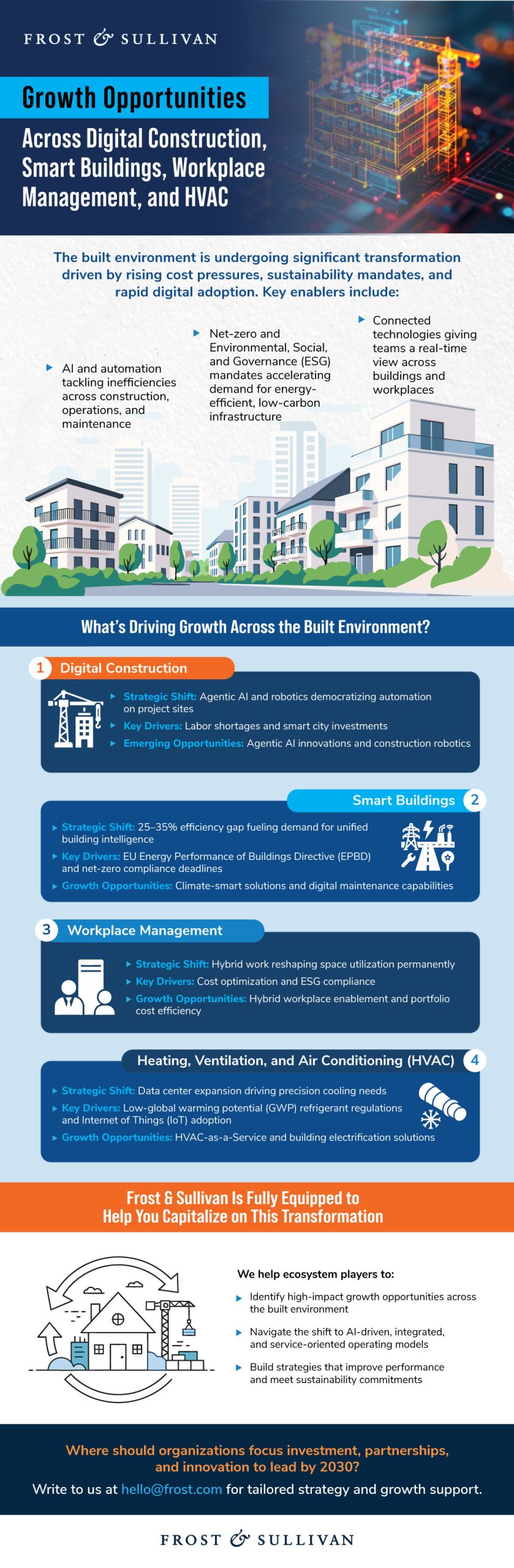
Top Built Environment Investment Opportunities for 2026 and Beyond
As the built environment evolves, organizations must identify where strategic investments will generate maximum impact. The following avenues shed light on the key opportunities:
Digital Construction
Digital construction is a strong investment area as labor shortages and delivery risk increase. Agentic AI improves forecasting, risk tracking, and coordination, while modular builds and 3D-printing robotics scale output through flexible RaaS models. These tools shorten timelines and reduce rework by catching issues earlier.
Smart Buildings
Smart buildings are moving toward measurable gains in energy performance and resilience. Electrification with next-generation heat pumps and AI energy controls cuts emissions, and predictive maintenance reduces failures and extends asset life. This improves comfort while lowering operating and lifecycle costs.
Workplace Management
Workplace management now depends on usage data, not assumptions. AI-driven space intelligence supports consolidation and planning, while portfolio optimization reduces surplus space based on real attendance and utilization patterns. It also helps standardize decisions across sites, which makes footprint changes easier to justify.
HVAC Systems
HVAC delivers fast returns when monitored and maintained proactively. IoT and cloud tools provide real-time performance data, and AI/ML enables earlier fault detection and longer equipment life. This reduces downtime and improves efficiency without major system replacements.
Are you implementing the right best practices to capitalize on emerging growth opportunities in the homes & buildings sector?
Companies to Action: Who Is Leading the Transformation in the Built Environment?
Digital Construction
- Procore: Centralizing project data to deliver real-time insights and automate workflows through agentic AI.
- Autodesk: Helping project leaders manage risks across cost, schedule, quality, and safety using AI and machine learning.
Smart Buildings
- ABB: Simplifying building management through Analyze, Control, and Optimize energy-efficient solution pillars.
- BrainBox AI: Optimizing HVAC performance by autonomously learning building operational patterns and energy flows.
Workplace Management
- Google Cloud: Deploying AI agents connected to enterprise data and workplace applications through Gemini Enterprise.
- Workday: Unifying people and financial data with external platforms to enable real-time insights and AI-driven innovation.
HVAC Systems
- Mitsubishi Electric Trane HVAC US: Enabling remote monitoring and real-time anomaly detection across variable refrigerant flow (VRF) systems through Kenza Cloud.
Blynk Technologies: Providing remote HVAC monitoring, automated controls, and predictive maintenance notifications to reduce service costs.
Is your team leveraging smart building technologies to stay competitive with these industry leaders?
Building the Foundation for an Intelligent, Connected Future
The next phase of growth in the built environment will not come from isolated pilots or one-off upgrades. It will come from bringing together construction delivery, building operations, workplace strategy, and HVAC performance into a connected system that improves cost, energy use, and resilience at the same time.
The question is no longer whether these technologies will shape the homes and buildings sector. It is whether your roadmap is built to capture value across the full asset lifecycle.
Frequently Asked Questions (FAQs)
What are the biggest growth opportunities in the built environment in 2026?
The four highest-growth areas are digital construction (driven by agentic AI and robotics), smart buildings (AI-powered energy management and cybersecurity), AI-led workplace management, and intelligent HVAC systems with IoT-based predictive maintenance.
What is agentic AI in construction?
Agentic AI systems in construction can observe site conditions, plan actions, make decisions, and refine strategies in real time without constant human oversight. They are being deployed for workforce forecasting, schedule management, risk assessment, and resource coordination.
How does AI improve HVAC performance?
AI-powered fault detection analyses data from IoT sensors across HVAC systems to identify anomalies before they become failures. This enables planned maintenance interventions rather than emergency repairs, reducing costs and extending equipment lifespan.
What does hybrid work mean for real estate strategy?
Hybrid work has permanently reduced average office attendance, leaving many organizations carrying surplus space. Smart workplace management strategies use real-time occupancy data to identify underutilized space, enabling data-driven consolidation and portfolio optimization decisions.
Ready to Lead the Transformation?
- Book a Growth Strategy Session: Align your growth roadmap with Frost & Sullivan’s visionary Growth Pipeline™ Dialog.
- Engage with Growth Experts: Co-design AI-enabled, data-driven operating models that scale industry-specific and commercial impact.
- Share Your Transformation Story: Position your organization as a transformation leader through Frost & Sullivan’s Transformational Growth Leadership platform.
- Join the Growth Council: Collaborate with industry leaders shaping the future of your ecosystem.
- Nominate for the Best Practices Recognition: Be recognized for excellence in growth strategy, execution, and customer impact.
- Demonstrate Industry Positioning on the Frost Radar™: Benchmark your growth performance and innovation strength against industry competitors.
- Activate Brand & Demand Growth: Accelerate awareness, engagement, and revenue growth through integrated brand and demand generation strategies.