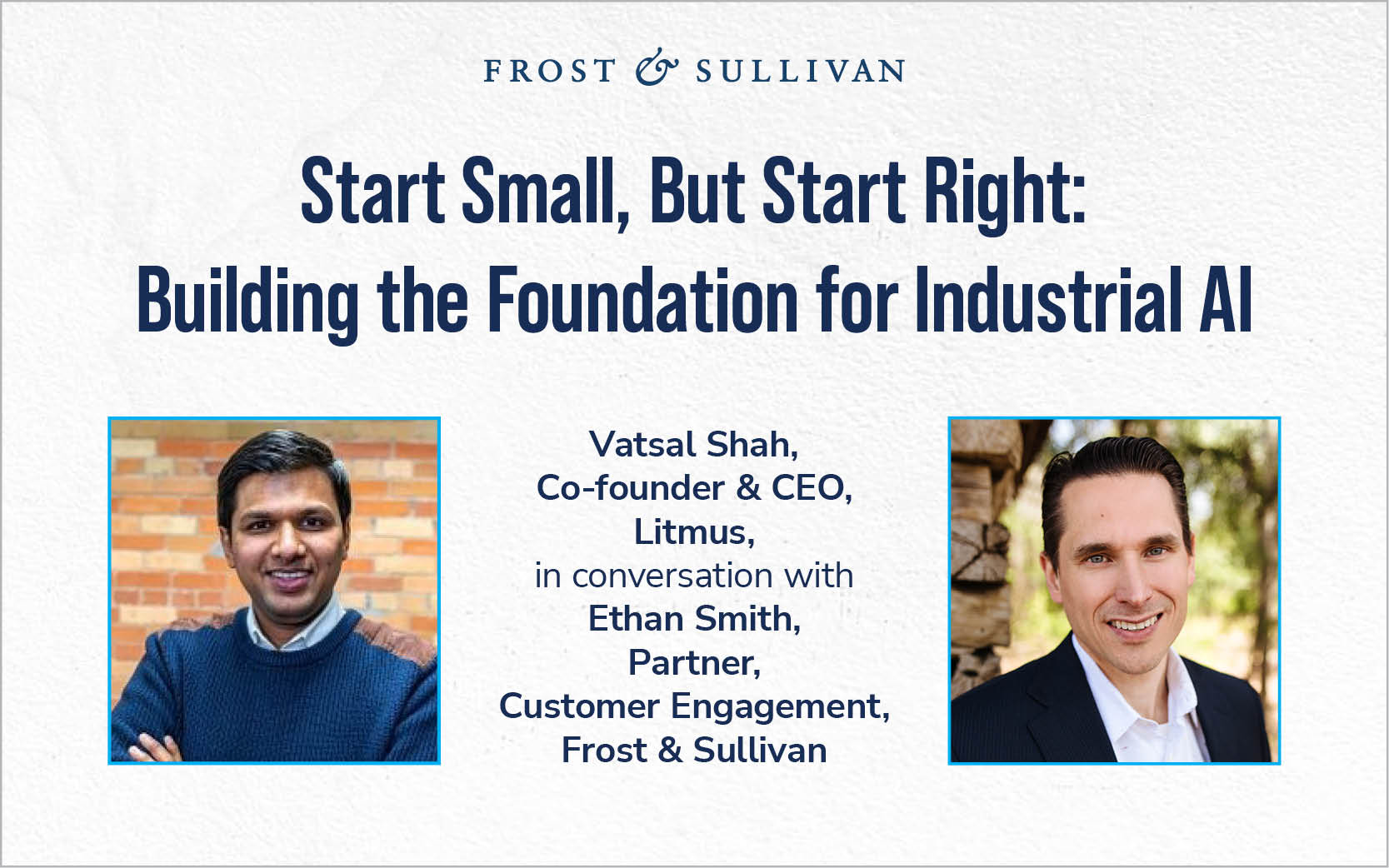
Vatsal Shah, Co-founder & CEO, Litmus, in conversation with Ethan Smith, Partner, Customer Engagement at Frost & Sullivan
Industrial companies generate enormous amounts of data. The bigger challenge is collecting, understanding, and putting that data to work.
For Vatsal Shah, Co-founder and CEO of Litmus, that challenge is deeply personal. He began his career as an industrial automation engineer working with distributed control system (DCS) and programmable logic controller (PLC) systems in power plants, where he saw first-hand how difficult it was to collect, understand, and use industrial data for business operations. That experience ultimately led to the founding of Litmus and its focus on solving what Shah describes as the complex data problem across manufacturing and industry.
Today, Litmus positions itself as an industrial edge data platform that connects heterogeneous operational technology (OT) systems, brings intelligence to industrial data, and makes that data available across the broader cloud, enterprise, and partner ecosystem. Shah describes the company’s role simply: “We are Switzerland for industrial data.”
That foundation has supported a period of triple-digit growth, driven not simply by technology adoption, but by a relentless focus on customer outcomes, time to value, scale, and ecosystem partnerships. As industrial artificial intelligence (AI) accelerates demand for AI-ready data, Shah sees an even larger opportunity: making Litmus the foundational data layer that enables the next generation of industrial applications.
“Start small but start right. Once again, there are 100 ways to do proof of concepts. There are many different approaches that are being taken in the market. They are not replicable, they are not successful in the long run, they are not repeatable, they are not scalable.”
—Vatsal Shah, Co-founder & CEO, Litmus
From Industrial Automation to the Data Layer
Ethan Smith: Let’s start with you. Who is Vatsal Shah, and what is Litmus?
Vatsal Shah: I am Vatsal Shah, co-founder and CEO at Litmus. I started my career as an industrial automation engineer, working in the field. My first job was in a power plant, dealing with DCS and PLC systems.
I spent the early part of my career integrating complex, closed-loop legacy industrial systems. What I saw first-hand was how difficult it was to collect all the data, understand that data, and actually use it for business operations. That fundamental challenge is what led us to found Litmus.
Litmus is the solution to the complex data problem in the manufacturing and industrial world. We are an industrial edge data platform. Our mission is to unify the industrial ecosystem through a single, scalable platform that connects different types of OT systems and assets, including PLCs going back decades. We collect the data and understand it.
Then, right at the edge, we bring intelligence to that data: how to model it, normalize it, analyse it, store it, and process it.
The third major component for us is integration. Once you have the data and have performed intelligent operations on it, how do you make it available to the broader partner, cloud, and enterprise ecosystem, including Google Cloud, Microsoft Azure, Amazon Web Services (AWS), and Databricks?
That’s what we do. In short, we are the Switzerland for industrial data.
Growth Built Around Customer Outcomes
Ethan Smith: Litmus has experienced an impressive period of triple-digit growth. What do you see as the key factors behind that growth?
Vatsal Shah: It has definitely been a remarkable period for us. We are seeing tremendous momentum across the board. But, as they say, you keep building for a long time and then you might actually get lucky.
Over the last five years of triple-digit growth, there have been a lot of factors behind it. One of the first is that, as a company, we really focus on customer outcomes rather than developing technology product features.
Do you know what we sell? We sell time to value.
How do you connect all of your manufacturing facilities in days? How do you analyse the data in a matter of hours? How do you make it available for enterprise use cases? How do you model it? And how do you replicate that recipe of success from plant number one to plant number 200?
That time to value is what we sell. We always focus on customer outcomes rather than simply selling technical features. That has been a major factor in our success because it resonates so well with users.
From Proof of Concept to Impact at Scale
Ethan Smith: You have talked about the importance of customer outcomes and time to value. How did that translate into the way you approached scale?
Vatsal Shah: A big part of it was the discipline around scale. There are 100 ways to do a proof of concept. You can purchase from different vendors and get that instant gratification that everybody’s looking for. But there is one right way to scale.
That really resonated with us. We talk about impact at scale. When we talk about time to value, we talk about it at scale. So we kept the discipline to go across multiple sites. We took the challenges head-on to solve problems at scale and helped customers move from one site to 10 sites and beyond.
That discipline really helped us. Triple-digit growth is a result of us doing something right for our customers. We do the scale story very well.
AI Is Changing the Value of Industrial Data
Ethan Smith: And how has AI changed that opportunity?
Vatsal Shah: One factor we cannot ignore is the influence of AI itself. Up until the emergence of generative AI, the idea was that machine learning systems represented one of the highest-value consumers of industrial data. You had raw data, you cleaned and contextualized that data, and then made it available to machine learning and deep learning systems.
With the growth of generative AI and reasoning AI models, the number of consumers of data has exploded. AI agents, AI-ready data, and the way enterprises started thinking about AI-ready data became a huge accelerant for us.
The Ecosystem Multiplies the Opportunity
Ethan Smith: Partnerships also seem to play an important role in that growth. How has the ecosystem contributed?
Vatsal Shah: The channel and ecosystem we have built has been another major factor. One of our first hyperscaler partnerships was with Google Cloud. We started by solving problems at scale and at hyperscaler scale. These partners are thinking about large numbers of sites, large amounts of data, and many different use cases built on top of that data. Understanding that ecosystem and becoming the central edge data platform for the broader ecosystem and channel model worked very well for us.
Today, we work with Google, Microsoft, AWS, and Databricks. Our alignment with their go-to-market strategies has definitely helped us achieve the growth we were looking for.
The Next Ambition: Becoming the Industrial Data Layer
Ethan Smith: Looking ahead three to five years, what are your biggest ambitions for Litmus?
Vatsal Shah: If we look forward three to five years, our mid-term objective is really to own the industrial data layer for the industrial world, across manufacturing, discrete, hybrid, and process industries.
We want to become the de facto industrial data platform, bringing together connectivity, intelligence, and Industrial DataOps as the foundational layers of that platform.
The second thing is that we want to have a global footprint. We already have offices across North America and Europe, and we have expanded into India and Japan. We are also aggressively expanding into the Middle East.
Every region has its own challenges, vendors, and approaches, so global expansion is an important part of our growth strategy. And with the acceleration of industrial AI, we want to become an accelerant for industrial AI companies. We are already working with close to 20 different industrial AI products, including agents, business intelligence, and workflow services. They want to execute those applications on Litmus. So our aspiration is to become the de facto foundation, enable the next generation of applications, and go global.
From Data Foundation to Closed-loop AI
Ethan Smith: And what do you see beyond that three-to-five-year horizon?
Vatsal Shah: Beyond three years, I would really like to see closed-loop control use cases enabled through AI.
One of the most elegant systems in my mind is the proportional-integral-derivative (PID) controller. It is simple and elegant, with rules that are set, and it is used across plants around the world. The question is: can you augment those robust controllers with some sort of AI-driven feedback?
I would like to see the industry, in three or four years, using AI-controlled closed-loop applications for better energy optimization, better quality, better yield, and less scrap.
Those are the things I would like to see us enable with AI.
Radical Simplification as a Product Philosophy
Ethan Smith: You have got some ambitious goals ahead. How do you make sure Litmus keeps innovating as you scale?
Vatsal Shah: We want Litmus to be an out-of-the-box, practical, interoperable platform that is trusted for running critical operations. We are not yet another platform on the plant floor. One of the biggest problems for users is that everybody is trying to solve a small piece of the puzzle. These multi-vendor approaches almost always fail when you try to scale them across large enterprises. Rather than becoming another platform that solves one small use case, we want to holistically solve the problem from point A to point B and deliver the result.
Our positioning is that we want to be the connective tissue between industrial machines and modern industrial AI. Our brand position is radical simplification. There may be 100 ways to do a proof of concept, but how do you simplify the process so you get things right the first time?
How do you unify connectivity, intelligence, and integration into one complete foundation that can go from plant number one to plant number 200 in an out-of-the-box way?
That’s how we want to position the product.
Innovation Means Knowing What Not to Build
Ethan Smith: And what does that philosophy mean for your innovation process?
Vatsal Shah: One of our core company philosophies is that we want to be at the bleeding edge. For every new feature we develop, we actually kill three features that we never develop or push into the market in the first place.
We spend close to 50% of our money on R&D. We spend a significant amount of time understanding customer requirements, researching the product, and figuring out how to bring a radically simplified product to the market.
We also meet customers where they are. Some customers have 30-year-old PLCs. Others have 20-year-old PLCs or legacy historian systems. We enable those environments and develop features at a pace that nobody else can match.
Follow Customers, Not Competitors
Ethan Smith: What about competition? How do you make sure Litmus stays ahead?
Vatsal Shah: We don’t really get inspired by competition. There’s a line we always put on the wall: “Competition is for suckers.”
All you do as a company is follow your customers and follow your partners. You listen to your customers. Sometimes the feedback is constructive; sometimes it is very direct about exactly what you should be doing. But you don’t look to competitors for that direction. Why would I follow somebody else’s customer’s feedback? I have to follow our own customers and our own partners. Let competitors stay on their own track. All I care about is how we bring value to our own users. That’s exactly what we have been doing over the last 10 years.
Closing Reflection: Start Small, But Start Right
Litmus’s growth story is ultimately built on a deceptively simple principle: make industrial data usable, valuable, and scalable.
Vatsal Shah’s experience as an automation engineer exposed him to the fundamental challenge facing industrial organizations: enormous amounts of data trapped across complex and heterogeneous systems. Litmus was founded to address that challenge by bringing connectivity, intelligence, and integration together in a unified industrial edge data platform.
That foundation has enabled Litmus to build its growth around customer outcomes rather than technology features. The company’s focus on time to value, disciplined scaling, AI-ready data, and a strong hyperscaler and partner ecosystem has helped turn individual implementations into repeatable, multi-site impact.
The next phase is even more ambitious: becoming a foundational industrial data layer, enabling the next generation of industrial AI applications, and ultimately helping bring AI into closed-loop industrial control.
But Shah’s message to the wider industrial community is not to wait for the perfect transformation strategy.
Start small but start right.
For industrial organizations, the opportunity is to begin now, while building a foundation that is repeatable, scalable, and capable of supporting what comes next.
“There has never been a better opportunity to revitalize manufacturing in the world.”
And as industrial AI continues to accelerate, the organizations that build the right data foundation today will be better positioned to turn that opportunity into operational value tomorrow.

About Vatsal Shah
Vatsal Shah is the Co-founder and Chief Executive Officer of Litmus, an industrial edge data platform company enabling manufacturers to connect, contextualize, and operationalize industrial data at scale. As an entrepreneur and technology leader, he is driving Litmus’s vision of simplifying industrial data management and building a scalable foundation for industrial AI. His work focuses on bridging the gap between industrial operational technology and modern digital ecosystems, helping organizations make better use of data across their manufacturing operations. Vatsal is passionate about advancing industrial connectivity, data intelligence, and the application of AI to enable smarter, more efficient, and increasingly autonomous industrial operations.
Ethan Smith is Partner, Customer Engagement at Frost & Sullivan, with 25 years of experience in global strategy and business development. He has supported growth initiatives for Fortune 100 companies and technology start-ups, with expertise in go-to-market strategy, new market entry, value proposition development, partner channels, and new business models. His cross-industry experience spans energy, industrial automation and software, healthcare technology, and automotive, with particular expertise in electrification, alternative fuels, and manufacturing. Ethan has worked with major organizations including GE, 3M, Caterpillar, Shell, Dow, ExxonMobil, and SLB. He holds a bachelor’s degree in Economics from Trinity University and has completed professional development in Energy Innovation at Stanford University.

Ready to Lead the Transformation?
- Schedule a Growth Strategy Dialog: Align your growth roadmap with Frost & Sullivan’s Visionary Growth Pipeline™ Dialog.
- Engage with Growth Experts: Co-design AI-enabled, data-driven operating models that scale industry-specific and commercial impact.
- Showcase Your Transformational Leadership: Position your organization as a transformation leader through Frost & Sullivan’s Transformational Growth Leadership platform.
- Join the Growth Council: Collaborate with industry leaders shaping the future of your ecosystem.
- Explore Best Practices Recognition: Be recognized for excellence in growth strategy, execution, and customer impact.
- Benchmark Your Industry Positioning on the Frost Radar™: Benchmark your growth performance and innovation strength against industry competitors.
- Tell Your Story: Accelerate awareness, engagement, and revenue growth through integrated brand and demand generation strategies.
Appendix
Frost & Sullivan delivers actionable intelligence that helps industrial leaders, technology providers, and manufacturers identify emerging growth opportunities and accelerate transformational change across industrial automation and digital manufacturing. Our expertise spans industrial AI, industrial data, manufacturing data analytics, edge computing, automation software, and connected operations. To learn more about the latest growth opportunities, strategic imperatives, companies to action, and best practices shaping the future of industrial transformation, explore our portfolio of growth analyses.
- Frost Radar™: Industrial Connectivity Software, 2026
- Growth Opportunities in Emerging Industrial AI Ecosystem, Global, 2025–2029
- Top 10 Growth Opportunities in AI Technologies and Platforms
- Top 10 Growth Opportunities in AI Implementation and Managed Services
- Physical and Embodied AI for Highly Dexterous Robotics
YOUR TRANSFORMATIONAL GROWTH JOURNEY STARTS HERE
Frost & Sullivan’s Growth Pipeline Engine, transformational strategies and best-practice models drive the generation, evaluation, and implementation of powerful growth opportunities. Is your company prepared to survive and thrive through the coming transformation?