This blog is based on the recent Frost & Sullivan analysis, “Advanced Wound Care Industry Driving Transformational Growth by Developing Digital Wound Management Solutions, Global, 2024–2030,” authored by Lucila Martin, Industry Analyst, Healthcare & Life Sciences Practice.
The global cell biology research market is experiencing a wave of transformational growth. From single-cell genomics to AI-powered image analysis, the field is advancing at a pace that’s reshaping life sciences, drug discovery, and precision medicine.
Ready to Lead the Future of Cell Biology?
Download Frost & Sullivan’s full report and turn cutting-edge insights into action.
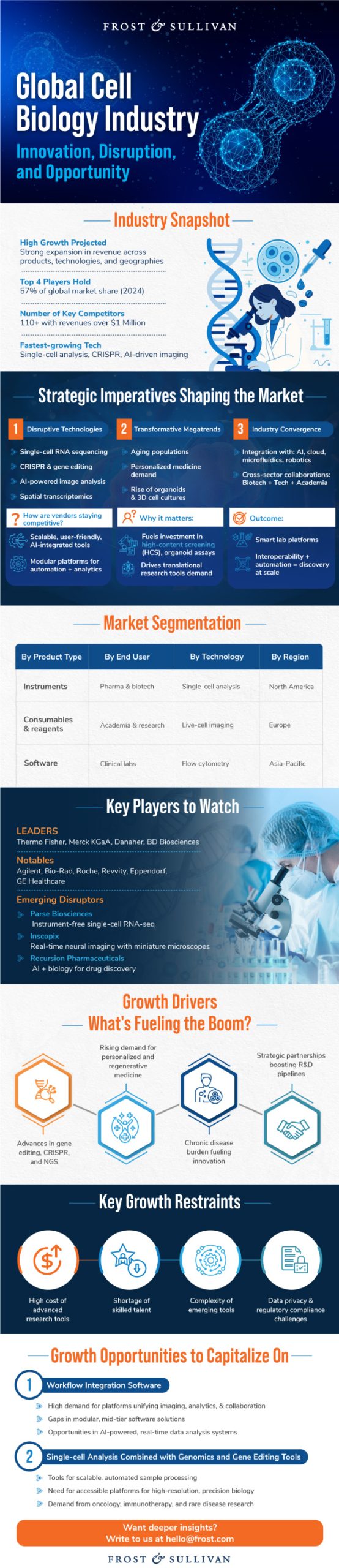
Let’s explore the key growth drivers, market segmentation, competitive strategies, and bold questions that every industry stakeholder should be asking now.
What’s Fueling the Surge in Cell Biology Research?
- Single-cell Breakthroughs: The New Frontier of Precision
Single-cell RNA sequencing (scRNA-seq), spatial transcriptomics, and CRISPR-based tools are giving researchers granular control over how they study and manipulate cells.
Are your platforms capable of resolving rare cell populations, tumor heterogeneity, and lineage tracing at the single-cell level?
Technologies like Parse Biosciences’ Evercode and Mission Bio’s multiomic tools are democratizing access to high-throughput single-cell research, while integrating into genomics workflows more seamlessly than ever before.
- AI & Automation: The Digital Transformation of the Lab
Artificial intelligence is doing more than just accelerating data analysis—it’s enabling real-time imaging, automating repetitive workflows, and identifying new patterns in large, complex datasets.
Are you using AI to reduce manual errors, enhance reproducibility, and accelerate hypothesis generation in your lab?
With increased pressure to innovate faster and more accurately, digital-first labs are outperforming traditional setups—especially in high-throughput screening (HTS) and phenotypic drug discovery.
Which Segments Are Driving Market Expansion?
The Frost & Sullivan study segments the market by product, technology, end user, and geography:
- By Product: Instruments, reagents, consumables, software platforms
- By Technology: Single-cell analysis, CRISPR gene editing, live-cell imaging, flow cytometry, cell culture, high-content screening
- By End User: Academic institutions, biotech and pharma, contract research organizations (CROs), clinical labs
- By Region: North America leads in maturity and spend, but Asia-Pacific is growing fastest, particularly in China, South Korea, and India
Which geographic markets are ripe for your next expansion. Are you overlooking fast-growth regions like APAC or LATAM?
The demand for cell-based assays, organoids, and 3D cultures is particularly high in translational research and oncology.
Market Challenges: What’s Slowing Progress?
Even with strong tailwinds, the cell biology research market faces significant challenges:
- High Capital and Operational Costs – Advanced tools like high-throughput sequencers, flow cytometers, or CRISPR editing kits are often priced beyond the reach of smaller labs.
- Talent Gaps – Bioinformatics, AI modeling, and complex sample processing require highly trained personnel.
- Data Complexity – Managing and interpreting multiomic data sets with spatial and temporal dimensions is a major hurdle.
Do your teams have the tools and the talent to turn raw cell data into actionable biological insight?
Without skilled data scientists and intuitive software, even cutting-edge instruments may underperform in real-world settings.
Competitive Landscape: Who’s Leading and Why?
According to Frost & Sullivan, the top four players (Thermo Fisher, Merck, BD Biosciences, and Danaher) command 57% of market share. These companies are dominating by focusing on:
- Interoperability across instruments and software
- AI-driven analysis pipelines
- Streamlined lab automation solutions
- Strategic partnerships with academia and cloud providers
Is your product strategy focused on solving isolated problems or delivering integrated, scalable solutions that drive workflow transformation?
Emerging players like Parse Biosciences, Inscopix, Eppendorf and Recursion Pharmaceuticals are gaining ground by offering scalable, modular tools and by embedding AI into the discovery cycle.
Strategic Trends You Can’t Ignore
- Convergence Is Key – Cell biology now intersects with materials science, data science, and microfluidics. Smart labs are leveraging automation, robotics, and machine learning to build closed-loop, reproducible workflows.
Are you investing in platforms that seamlessly integrate lab automation, cloud infrastructure, and machine learning algorithms?
- Multi-Omics + Spatial Analysis – We are entering the era of truly multi-dimensional cell analysis, combining genomics, transcriptomics, proteomics, and spatial context to reveal biology in its natural state.
- Customization at Scale – Demand is growing for off-the-shelf yet customizable kits, organoids, and assays tailored to specific diseases or cell types.
Are you positioned to deliver not just tools but full-stack solutions tailored to cancer, neurodegeneration, or regenerative medicine?
Growth Opportunities: Where to Act Now
- Build Unified Software Platforms – Most labs still use fragmented systems across imaging, sequencing, and analysis. The need for interoperable, AI-powered software is immense.
- Expand Access to Single-cell Tools – Complex, high-cost systems are ripe for disruption. Scalable, easy-to-use platforms like those from Parse or Mission Bio are leading the charge.
- Capitalize on Cell Therapy & Regenerative Medicine – As stem cell therapies gain traction, researchers need better models for disease and therapy testing.
How is your product roadmap aligning with the explosion in personalized medicine, immunotherapy, and regenerative applications?
Why It Matters Now: The 2024–2030 Window
This decade will be a turning point for cell biology research. The convergence of technologies, rising chronic disease burden, and increased R&D funding create a unique moment to innovate—or fall behind.
Those who lead will:
- Be first to market with integrated solutions
- Secure long-term partnerships with top-tier research institutions and pharma
- Shape standards, workflows, and digital infrastructure for the industry
- Capture growth in emerging regions and therapeutic areas
Final Thought
The question isn’t whether the cell biology research market is growing it’s how fast, and who’s ready to lead. If you are still evaluating whether AI, automation, or single-cell platforms matter to your bottom line, the answer is already clear.
Are you building for the future or still optimizing for the past?
Download Frost & Sullivan’s full report to uncover the strategies, players, and technologies defining the market between now and 2030. Make your next move based on insight, not instinct.