This blog is based on Frost & Sullivan’s analyses, “Command and Control Solutions, Global, 2025–2030“ and “Frost Radar™: Command and Control Solutions, 2026,” authored by Pranav Sahai from the Security Practice Area.
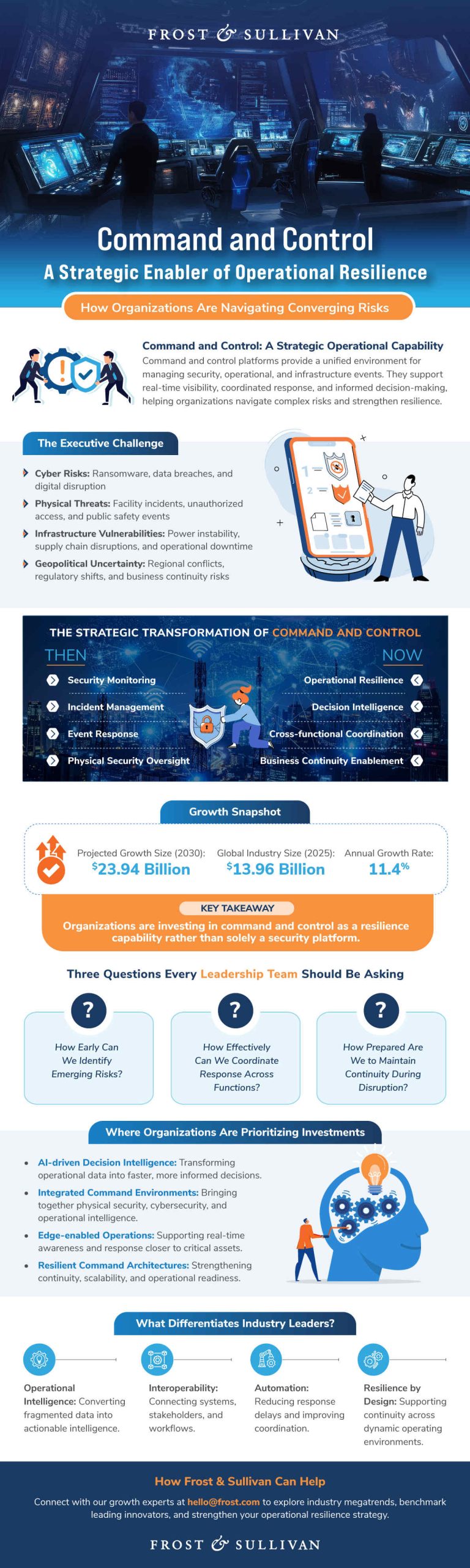
Organizations are operating in an environment defined by cyber threats, physical security incidents, infrastructure disruptions, and geopolitical uncertainty can have immediate operational consequences. As security and operational risks become interconnected, the global command and control landscape is projected to grow from $13.96 billion in 2025 to $23.94 billion by 2030. Growth is being driven by demand for integrated security operations, AI-enabled decision intelligence, and resilient command environments.
How are organizations transforming command and control to strengthen operational resilience and accelerate decision-making?
To explore the growth opportunities and innovators shaping the future of command and control
Command and control platforms are evolving beyond traditional monitoring and dispatch functions into integrated security operations platforms (ISOPs) that unify physical security, cybersecurity, operational technology, and communications intelligence. AI, automation, and multi-source data fusion are enabling organizations to improve situational awareness, accelerate response, and strengthen operational continuity across complex environments.
What strategies are leading organizations adopting to modernize command operations and improve resilience?
Tune into our podcast episode on growth opportunities across command and control solutions.
Why Organizations Are Advancing Toward Integrated Operational Environments
Traditional command environments relied on fragmented systems, manual workflows, and siloed operational views. However, growing operational complexity and the convergence of cyber and physical threats are driving demand for integrated command platforms capable of supporting coordinated response and informed decision-making.
Organizations are prioritizing platforms that enable:
- Real-time situational awareness across operational domains
- AI-driven alert prioritization and incident correlation
- Automated response workflows and orchestration
- Unified visibility across physical, cyber, and operational environments
- Multi-agency and cross-functional collaboration
To address these requirements, command and control platforms are integrating AI, advanced analytics, cloud-native architectures, edge computing, and cyber-physical intelligence, positioning command environments as strategic enablers of resilience and operational excellence.
Strategic Imperatives Reshaping Command and Control
Disruptive Technologies
AI, video analytics, automation, and multi-source data fusion are transforming command and control from operator-led monitoring environments into intelligence-driven decision platforms that improve operational efficiency and response effectiveness.
Industry Convergence
The convergence of physical security, cybersecurity, operational technology, and emergency response functions is accelerating demand for unified command environments capable of coordinating activities across multiple stakeholders and operational domains.
Geopolitical Chaos
Growing geopolitical uncertainty, infrastructure vulnerabilities, and operational disruptions are elevating command and control as a strategic capability that supports continuity, readiness, and resilience across mission-critical operations.
Key Growth Drivers Accelerating Command and Control Adoption
- Escalating Security and Operational Risks: Growing cyber threats, physical security incidents, civil unrest, and infrastructure disruptions are increasing demand for greater situational awareness and coordinated response capabilities.
- AI-driven Operational Intelligence: AI-powered analytics, event correlation, and automation are enabling organizations to improve decision-making, accelerate response times, and enhance operational efficiency.
- Cyber-physical Security Convergence: The convergence of physical security, cybersecurity, and operational technology is increasing demand for integrated command environments that support unified visibility and coordinated response.
- Critical Infrastructure Modernization: Smart city initiatives, transportation modernization, and infrastructure resilience programs are expanding deployment opportunities for command and control platforms.
Investment Priorities Supporting Resilient Command Operations
- AI-driven Decision Intelligence: Investments are accelerating in AI-powered analytics, event correlation, and automation capabilities that enhance operational awareness and support faster decision-making.
- Cyber-physical Convergence: Organizations are prioritizing unified command environments that bring together physical security, cybersecurity, and operational technologies to improve visibility and coordination.
- Edge-enabled Operations: Growing adoption of edge computing is supporting real-time data processing, low-latency analytics, and faster response across distributed and mission-critical environments.
- Cloud-native and Hybrid Architectures: Demand continues to grow for scalable and flexible deployment models that improve interoperability, multi-site coordination, and operational continuity.
Growth Opportunities Shaping the Future of Command and Control
- Edge AI-powered Operational Intelligence: AI and edge computing are enabling real-time threat detection, low-latency decision-making, and automated response across mission-critical environments.
- Energy-resilient Command Platforms: Organizations are integrating energy, security, and operational intelligence to strengthen continuity, resilience, and sustainability outcomes.
- Secure and Sovereign Command Operations: Growing focus on data sovereignty, compliance, and operational continuity is driving adoption of on-premises and hybrid command architectures that support secure and resilient operations.
Leading Innovators Transforming Command and Control
- Genetec is advancing software-native command environments through unified security operations, workflow orchestration, and operational coordination capabilities.
- Axon is redefining real-time operational intelligence through integrated sensor ecosystems, AI-driven situational awareness, and cloud-native command capabilities.
- Honeywell is enabling operational resilience through command environments that integrate physical security, operational technology, and infrastructure intelligence.
Download the full analysis to discover competitive benchmarking and innovation leadership across the command and control landscape.
Best Practices for Building Future-ready Command and Control Environments
- Embed AI and Automation into Decision-making: Leverage AI, machine learning, and workflow automation to improve situational awareness, accelerate response, and support more informed operational decisions.
- Prioritize Interoperability and Security Convergence: Adopt open and integrated platforms that unify physical security, cybersecurity, Operational Technology (OT), and enterprise systems within a common command environment.
- Align Command Platforms with Operational Outcomes: Tailor command and control capabilities to industry-specific workflows and resilience requirements to improve adoption, operational effectiveness, and long-term value creation.
The future of command and control will be defined by the ability to unify intelligence, coordinate response, and adapt to evolving operational challenges. Organizations that embrace integrated command environments will be better positioned to strengthen resilience and navigate an increasingly complex risk landscape.
Frequently Asked Questions (FAQs)
1. What is a command and control platform?
A command and control platform is a centralized operational environment that integrates data from security, operational, and communications systems to support situational awareness, decision-making, and coordinated response.
2. How is command and control evolving?
Command and control is evolving from traditional monitoring and dispatch environments into integrated security operations platforms that combine AI, automation, analytics, and cyber-physical intelligence.
3. What industries are investing in command and control solutions?
Key industries include law enforcement, critical infrastructure, banking and financial services, healthcare, retail, transportation, and large enterprise environments.
4. What role does AI play in command and control?
AI helps organizations prioritize alerts, identify anomalies, automate workflows, improve situational awareness, and support faster operational decisions.
Ready to Lead the Transformation?
- Schedule a Growth Strategy Dialog: Align your growth roadmap with Frost & Sullivan’s Visionary Growth Pipeline™ Dialog.
- Engage with Growth Experts: Co-design AI-enabled, data-driven operating models that scale industry-specific and commercial impact.
- Showcase Your Transformational Leadership: Position your organization as a transformation leader through Frost & Sullivan’s Transformational Growth Leadership platform.
- Join the Growth Council: Collaborate with industry leaders shaping the future of your ecosystem.
- Explore Best Practices Recognition: Be recognized for excellence in growth strategy, execution, and customer impact.
- Benchmark Your Industry Positioning on the Frost Radar™: Benchmark your growth performance and innovation strength against industry competitors.
- Tell Your Story: Accelerate awareness, engagement, and revenue growth through integrated brand and demand generation strategies.