Industrial technology startups are often portrayed as victims of a funding gap. However, recent discussions among investors, miners, corporate venture capital (CVC) leaders, founders, and innovation executives revealed a more nuanced reality: capital exists, but accessing the right capital at the right stage remains a significant challenge.
Across industrial technology sectors (including mining technology, energy technology, advanced manufacturing, agritech, sustainability technology and construction technology), a common pattern is emerging. Early-stage funding is often available, particularly for compelling technologies and strong founding teams. At the other end of the spectrum, mature companies with proven products can access growth capital, debt financing, strategic investors, or public markets. The challenge lies in the middle, where technologies have moved beyond the laboratory but have not yet demonstrated sufficient commercial traction to attract larger pools of capital.
This “missing middle” is increasingly becoming one of the most important growth challenges facing industrial innovation globally.
The Risk Gap
Industrial technology companies face a fundamentally different funding journey than software startups.
For SaaS businesses, investors can often assess progress through customer acquisition, recurring revenue, and growth metrics. Physical technologies are different. Whether developing mining automation systems, grid technologies, advanced materials, agricultural robotics, or industrial decarbonisation solutions, founders must typically navigate a much longer path to commercial proof.
The funding challenge is not simply how much capital is available. It is whether investors believe enough risk has been removed.
Successful industrial technologies must progressively address five forms of risk:
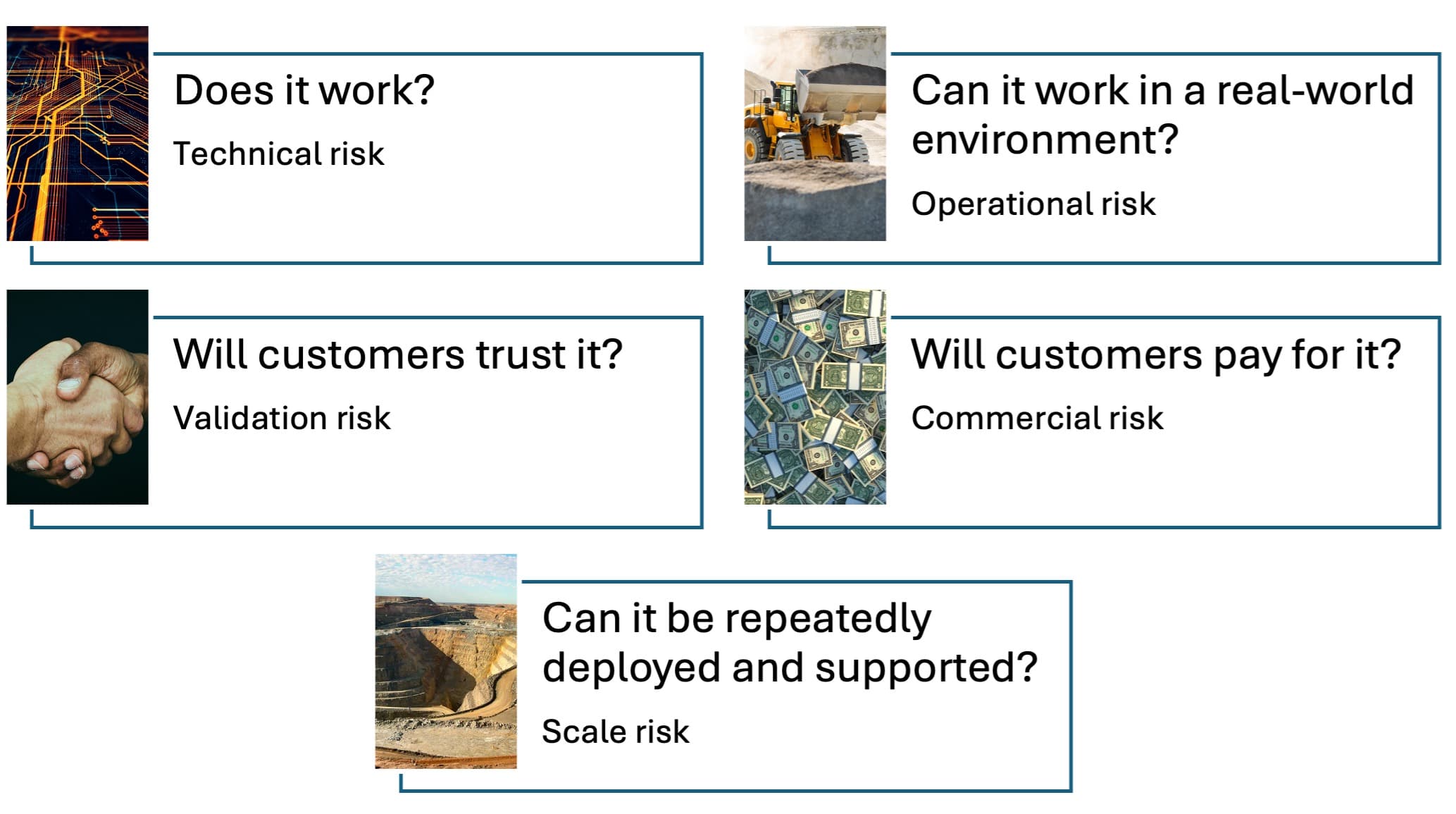
Investors are effectively financing the removal of these risks, one stage at a time.
Validation Has Become More Valuable Than Capital
One of the strongest themes emerging from the discussions was the growing importance of validation.
For industrial technology companies, endorsement from a major customer can be more influential than an investment cheque.
When a Tier 1 mining company, utility, manufacturer, or infrastructure owner pilots a technology, it provides external proof that the solution addresses a genuine operational challenge. This can significantly reduce perceived risk for investors who may not possess deep technical expertise in the sector.
In many cases, corporate venture capital has evolved into a bridge between innovation and investment. Strategic investors are increasingly seeking both financial returns and direct exposure to technologies that solve critical industry challenges. Their participation provides confidence not only through funding but also through operational validation.
This is particularly important in sectors where technologies must demonstrate performance under complex operating conditions before broader adoption becomes feasible.
Why Pilots Matter, But Pilots Aren’t Enough
Many industrial technology companies celebrate securing their first pilot. Yet the real challenge begins after the pilot concludes.
A successful pilot demonstrates that a technology can solve a specific problem. It does not necessarily prove that the solution can scale economically, integrate with existing systems, or achieve widespread adoption.
Several recurring lessons emerged:
- Customer discovery must happen early.
- The pathway to manufacturing and deployment should be considered during product design.
- Technologies must solve clearly defined operational problems.
- Total cost of ownership matters as much as technical performance.
- Internal champions alone are rarely enough; solutions often need support from finance, operations, IT, procurement, and executive stakeholders.
Perhaps most importantly, startups should avoid optimising solely for pilot success. The goal is not to win one site. The goal is to create a repeatable model that can be deployed across multiple sites, customers, and geographies.
Commercialisation Is an Ecosystem Challenge
Technology alone rarely determines success.
The most successful industrial technology companies build ecosystems around their innovation. These ecosystems may include manufacturing partners, systems integrators, pilot hosts, channel partners, strategic investors, and industry advocates.
Many founders underestimate the importance of these relationships. Yet as companies transition from pilot projects to broader deployment, ecosystem capabilities often become more important than incremental technical improvements.
The questions investors increasingly ask are:
- Can the company manufacture at scale?
- Can it integrate with customer environments?
- Can it support deployments globally?
- Does it have credible partners?
- Can it execute after the first purchase order arrives?
The answers often determine whether growth accelerates or stalls.
The New Commercialisation Playbook
Several best practices consistently emerged from the discussions:
Match Capital to Risk: Rather than raising the largest round possible, successful founders sequence capital according to key milestones. Each funding round should eliminate specific risks and create the foundation for the next stage of growth.
Think Beyond Technology: The strongest companies focus on customer outcomes rather than technical features. They understand the broader operational decision their technology influences and communicate value in those terms.
Start Commercialisation Planning Early: Commercialisation should not begin once a pilot succeeds. It should be embedded from the design stage. Manufacturing, deployment, integration, support, and sales models all need consideration long before large orders arrive.
Move Quickly From Site One to Site Two: The transition from first deployment to repeat deployment is often where long-term winners emerge. A technology that succeeds repeatedly generates confidence among customers, investors, and acquirers alike.
Looking Ahead
As industries pursue productivity gains, decarbonisation targets, workforce transformation, and operational resilience, demand for industrial innovation will continue to grow. The challenge is no longer generating promising technologies. The challenge is turning them into scalable businesses.
The winners of the next decade may not be the companies with the most advanced technology. They may be the organisations that most effectively combine innovation, validation, strategic partnerships, and disciplined commercial execution.
Successfully navigating the journey from pilot to scale is becoming the defining challenge of industrial innovation. It is also becoming one of the most significant growth opportunities.
Ready to Lead the Transformation?
- Schedule a Growth Strategy Dialog: Align your growth roadmap with Frost & Sullivan’s Visionary Growth Pipeline™ Dialog.
- Engage with Growth Experts: Co-design AI-enabled, data-driven operating models that scale industry-specific and commercial impact.
- Showcase Your Transformational Leadership: Position your organization as a transformation leader through Frost & Sullivan’s Transformational Growth Leadership platform.
- Join the Growth Council: Collaborate with industry leaders shaping the future of your ecosystem.
- Explore Best Practices Recognition: Be recognized for excellence in growth strategy, execution, and customer impact.
- Benchmark Your Industry Positioning on the Frost Radar™: Benchmark your growth performance and innovation strength against industry competitors.
- Tell Your Story: Accelerate awareness, engagement, and revenue growth through integrated brand and demand generation strategies.