This blog is based on Frost & Sullivan’s analyses, Top 10 Strategic Imperatives for Cloud Infrastructure, Global, 2026 and Top 10 Growth Opportunities in Cloud Infrastructure for 2026, authored by Growth Expert, Claudia Hochman, from the Cloud Business Solutions team.
Executive Summary
Cloud infrastructure is becoming a strategic determinant of AI competitiveness. As AI moves into production at scale; compute availability, network performance, power access, and workload economics are increasingly shaping where organizations invest and how providers differentiate. For C-suite leaders, the stakes are moving beyond infrastructure capacity toward strengthening the performance, cost, resilience, and deployment flexibility required to compete as AI reshapes the cloud ecosystem.
What Is Cloud Infrastructure?
Cloud infrastructure encompasses the compute, storage, networking, and supporting resources used to run applications, process data, support AI workloads, and deliver digital services through cloud environments. The scope is extending beyond traditional infrastructure to include orchestration, data mobility, and other capabilities that coordinate how increasingly data-intensive workloads operate efficiently across hybrid environments.
Cloud Infrastructure Is Evolving Fast
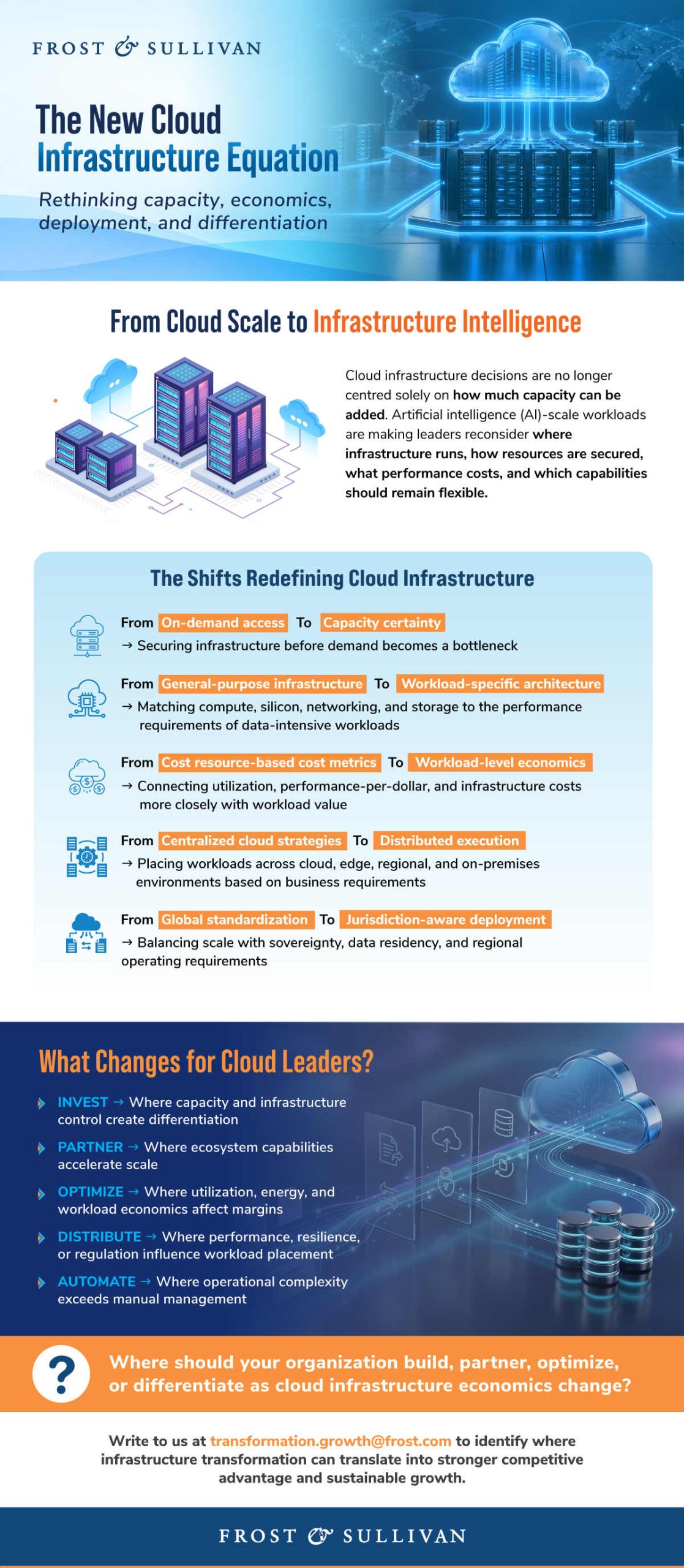
See where AI demand, infrastructure constraints, and distributed workloads are creating new priorities for cloud leaders.
Access the Cloud Infrastructure Whitepaper
As workloads become more distributed, hybrid cloud infrastructure is connecting cloud, edge, and on-premises environments more closely, giving organizations greater flexibility in where and how applications and data operate.
According to Frost & Sullivan, Cloud infrastructure is becoming more closely tied to the value organizations can generate from technology investments. Organizations that combine reliable capacity, consistent performance, and deployment flexibility are strengthening their ability to support high-value data-intensive workloads.
Strategic Imperatives Redefining Cloud Competitiveness
- Disruptive Technologies: AI-native Cloud Expansion at Inference Scale
AI is expanding the infrastructure benchmark beyond compute availability to sustained, predictable production performance Continuous inference is placing greater pressure on compute availability, latency consistency, and cost-per-query or token, making predictable performance and reliable access to capacity increasingly important as AI moves deeper into business operations.
- Geopolitical Chaos: Sovereign Cloud Becomes a Structural Market Access Requirement
Cloud strategy is becoming increasingly shaped by where infrastructure operates and who controls it. Data localization, national security requirements, and cross-border restrictions are influencing where workloads can be hosted, making sovereign cloud capabilities increasingly important for accessing regulated and nationally sensitive sectors.
- Transformative Megatrends: Power-constrained Cloud Scaling
Power availability is becoming a strategic constraint on infrastructure expansion. Higher-density AI workloads are increasing electricity and cooling requirements, bringing grid access, energy efficiency, and location strategy closer to decisions around capacity, investment, and long-term infrastructure resilience.
Business Implications to keep in mind
- Organizations that do not optimize infrastructure for sustained AI workloads may experience higher costs and inconsistent performance.
- Organizations that do not strengthen sovereign cloud capabilities may face restricted access to regulated and nationally sensitive sectors.
- Organizations that do not account for power availability in expansion plans may experience deployment delays, higher costs, and capacity constraints.
Are your infrastructure priorities keeping pace with the workloads, constraints, and competitive pressures shaping the cloud ecosystem?
Access Frost & Sullivan’s strategic whitepaper on Cloud Infrastructure for 2026 & beyond.
Understanding the Cloud Infrastructure Ecosystem
Do you have the tools to identify the best practices shaping cloud infrastructure transformation?
Listen to our Growth Podcast featuring Frost & Sullivan experts.
Key Growth Opportunities Transforming Cloud Infrastructure Strategy
- Dedicated AI Compute Clusters with Capacity Commitments
Leading providers are scaling dedicated high-performance AI compute clusters and capacity reservation models as enterprises seek greater certainty around workload continuity. Capacity-backed offerings are also creating long-term revenue opportunities around AI-driven, performance-sensitive workloads.
- Network-enabled Control Layers for Distributed Cloud Environments
As workloads operate across cloud, edge, and on-premises environments, network-driven control is becoming more closely connected to workload placement and data movement. Stronger cloud networking and orchestration capabilities are improving performance and coordination across distributed environments.
- Scaling and Operationalizing Proprietary Silicon
Cloud providers are integrating custom, workload-optimized silicon more deeply into their infrastructure to improve performance and reduce cost per workload. Tighter hardware-software integration is also strengthening supply resilience and creating greater differentiation for high-performance and AI-driven workloads.
- Real-time Cost and Utilization Optimization
Infrastructure cost management is moving closer to day-to-day operations as workload intensity increases. Providers are embedding real-time visibility and utilization optimization into infrastructure control layers, creating stronger foundations for cloud cost optimization solutions and more efficient resource allocation.
- Autonomous Infrastructure Operations Platforms
AI-assisted operations are increasingly combining observability, predictive management, resource optimization, and automated remediation. This evolution in cloud infrastructure automation is supporting greater operating efficiency and reliability as infrastructure environments become more complex.
How Cloud Leaders Are Differentiating
| Companies to Action | Strategic Focus |
| Amazon Web Services (AWS) | Scaling dedicated compute clusters and capacity-backed models to secure consistent performance for demanding AI workloads. |
| Microsoft Azure | Connecting AI infrastructure with global traffic management and localized deployment models for distributed and regulated environments. |
| Google Cloud | Leveraging Tensor Processing Units (TPU) infrastructure and cross-cloud networking to improve workload mobility and performance across environments. |
| Oracle Cloud Infrastructure (OCI) | Differentiating through predictable capacity, high-performance Graphics Processing Unit (GPU) infrastructure, and flexible deployment options for enterprise workloads. |
Future Outlook: Where Cloud Infrastructure Value Is Moving
Cloud infrastructure is evolving toward a more specialized and distributed ecosystem as AI changes where and how infrastructure is deployed. Compute, networking, energy, and workload placement are becoming more interconnected, while sovereignty requirements and infrastructure constraints are influencing investment decisions. Looking ahead, competitive differentiation will increasingly reflect how effectively providers translate these capabilities into reliable performance, sustainable economics, and greater flexibility for increasingly demanding workloads.
How are intelligent cloud applications turning infrastructure investments into measurable business value?
Ready to Lead the Transformation?
- Schedule a Growth Strategy Dialog: Align your growth roadmap with Frost & Sullivan’s Visionary Growth Pipeline™ Dialog.
- Engage with Growth Experts: Co-design AI-enabled, data-driven operating models that scale industry-specific and commercial impact.
- Showcase Your Transformational Leadership: Position your organization as a transformation leader through Frost & Sullivan’s Transformational Growth Leadership platform.
- Join the Growth Council: Collaborate with industry leaders shaping the future of your ecosystem.
- Explore Best Practices Recognition: Be recognized for excellence in growth strategy, execution, and customer impact.
- Benchmark Your Industry Positioning on the Frost Radar™: Benchmark your growth performance and innovation strength against industry competitors.
- Tell Your Story: Accelerate awareness, engagement, and revenue growth through integrated brand and demand generation strategies.
Frequently Asked Questions on Cloud Infrastructure
1. What is artificial intelligence infrastructure, and how is it different from traditional cloud infrastructure?
Artificial intelligence infrastructure is designed around the intensive compute, storage, networking, and data requirements of AI workloads. Unlike traditional environments supporting general-purpose applications, it is increasingly incorporating specialized processors, high-performance interconnects, AI-optimized storage, and workload orchestration to support training and real-time inference with more consistent performance and resource efficiency.
2. What is cloud networking, and why does it matter for distributed AI?
Cloud networking connects applications, data, and computing resources across cloud and distributed environments. For AI workloads, its role is becoming more important as training, inference, and data pipelines generate heavier traffic between infrastructure locations. High-bandwidth connectivity, predictable latency, and congestion management are supporting more consistent performance across increasingly distributed environments.
3. How is AI changing data center infrastructure design?
Data center infrastructure is adapting to higher rack densities and greater electricity and cooling requirements from AI workloads. Providers are increasingly considering advanced cooling, power availability, energy-efficient silicon, and high-density design together when planning new capacity. These requirements are also influencing site selection and where future infrastructure investment is being directed.
4. How can cloud cost optimization solutions support AI workloads?
Cloud cost optimization solutions are becoming more relevant as AI introduces volatile compute demand and persistent inference workloads. Greater visibility into utilization, workload scheduling, reserved capacity, and performance per dollar is helping organizations connect infrastructure consumption more closely with business demand while reducing underutilized capacity and improving predictability around technology spending.
5. How is cloud infrastructure automation changing cloud operations?
Cloud infrastructure automation is increasingly supporting workload placement, resource allocation, observability, and operational management across complex environments. As organizations operate across cloud, edge, and on-premises infrastructure, greater automation is helping teams manage distributed resources more consistently while reducing operational complexity and improving the responsiveness of infrastructure to changing workload requirements.