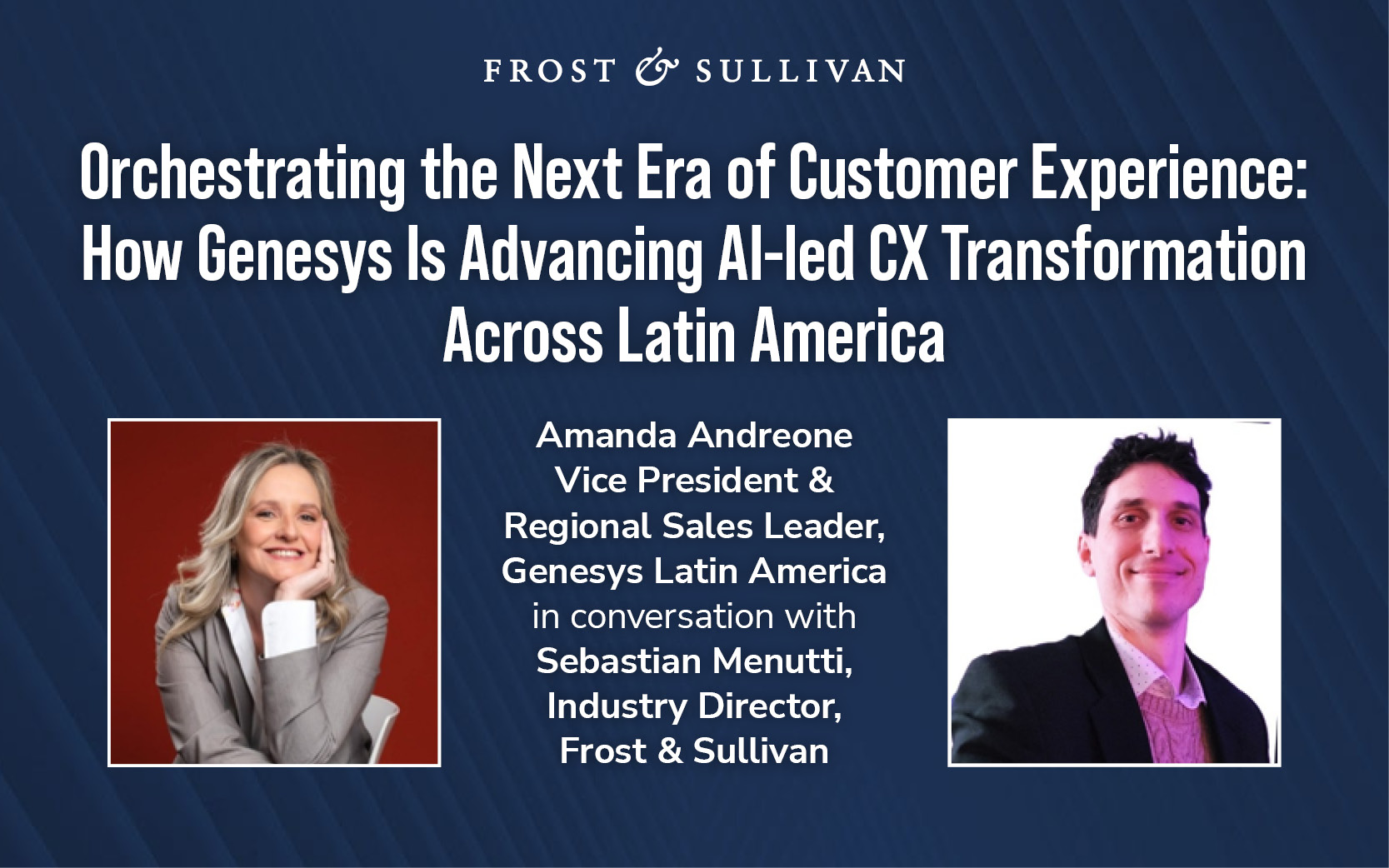
Amanda Andreone, Vice President & Regional Sales Leader of Genesys Latin America, in conversation with Sebastian Menutti, Industry Director, Frost & Sullivan
Download this Transformational Growth Leadership discussion with Amanda Andreone
Customer experience (CX) in Latin America is undergoing a significant transformation, driven by rising consumer expectations, accelerating artificial intelligence (AI) adoption, and the shift toward autonomous, outcome-driven customer journeys. As organizations move beyond fragmented channels and isolated AI deployments, the strategic priority is shifting toward orchestrating people, technology, and data to deliver measurable business value. For Amanda Andreone, Vice President & Regional Sales Leader of Genesys Latin America, this evolution represents an opportunity to redefine how enterprises engage customers, improve operational performance, and scale AI responsibly across the region.
In this Transformational Growth Leadership (TGL) conversation, Amanda Andreone speaks with Sebastian Menutti, Industry Director at Frost & Sullivan, about the evolution of experience orchestration, the growing role of agentic AI, and the challenges of scaling AI across Latin America. The discussion also explores how business outcomes, leadership readiness, and human-AI collaboration are shaping the next phase of CX transformation.
“The organizations that stand out will not necessarily be those with the most AI. They will be the ones that know how to orchestrate their capabilities most effectively: knowing when technology should act, when a person should intervene, and how to make that transition seamless for the customer.”
– Amanda Andreone, Vice President & Regional Sales Leader of Genesys Latin America
Redefining CX Through Evolving Consumer Expectations
Sebastian Menutti: Having worked in the industry across Latin America for many years, what are the most significant changes you have observed in the way people interact with brands?
Amanda Andreone: For me, the biggest change has not simply been the transition to digital. It has been the shift in what consumers expect from a good experience.
Latin America already has a strong conversational foundation for this next stage of customer experience. Today, 91% of CX organizations in the region use messaging applications. A few years ago, offering multiple channels was a differentiator. Now, consumers expect to start a conversation on one channel, continue it on another, and not have to repeat who they are or what they need.
Consumers in our region are also particularly open to technology when they perceive clear value. According to our State of CX in LATAM report, 86% of consumers believe AI will improve the quality and speed of customer service, compared to 76% globally. Additionally, 63% say they have a more positive perception of AI than they did two years ago, compared to 50% globally.
This creates an interesting dynamic. Latin American consumers are becoming sophisticated very quickly, and companies need to evolve at the same pace.
The conversation is no longer simply about which channels a company needs to offer or where it can implement AI. It is about connecting these capabilities, so they work together as a single customer experience ecosystem. That is where orchestration becomes fundamental.
Driving Business Value Through Intelligent Experience Orchestration
Sebastian Menutti: You have described how customer experience has moved beyond simply connecting channels. How has your vision of experience orchestration at Genesys evolved?
Amanda Andreone: I believe we are moving from orchestrating interactions to orchestrating outcomes.
Initially, the main challenge was connecting channels and avoiding fragmented experiences. Then we began integrating data, customer journeys, workforce capabilities, and AI to better understand context and anticipate customer needs.
Now, the complexity is changing again. Organizations are beginning to operate with multiple forms of AI at the same time. These may include capabilities developed internally, Genesys AI, partner technologies, business process outsourcing providers, and other technology providers. Increasingly, some of these technologies will also be able to act autonomously.
The question is no longer simply which AI a company should use. It is how to make all these capabilities work together around the customer and the outcome the organization wants to achieve.
Our vision of orchestration has evolved in this direction. The platform needs to understand intent and context, coordinate AI agents, systems, and employees, and determine the best next action without losing continuity throughout the customer journey.
This ecosystem will become increasingly complex. We may reach a point where companies orchestrate not only their own AI agents and employees, but also interact with AI agents acting on behalf of consumers. The more autonomous AI becomes, the more important orchestration will be.
Download this Transformational Growth Leadership discussion with Amanda Andreone
Scaling Agentic AI Across Connected Customer Journeys
Sebastian Menutti: Agentic AI is generating considerable interest for its disruptive potential in the customer experience industry. How is Genesys using agentic AI to improve the customer journey?
Amanda Andreone: I would start with an important distinction: agentic AI should not simply mean putting another AI agent in front of the customer.
What changes with agentic AI is the technology’s ability to understand a goal, consider the context, and determine which actions it needs to take to achieve an outcome, rather than simply following a predefined workflow.
This is not an abstract future for our region. Latin American organizations already have a strong digital foundation: 75% use chatbots or virtual assistants, and nearly half already use autonomous agents. The next challenge will be scaling that autonomy across real customer journeys.
An agent can independently handle certain requests, retrieve information from different systems, take action, and involve an employee when human judgment is needed. However, if departments implement AI agents that do not share context, we risk recreating the same fragmentation we have worked for years to eliminate across channels.
That is why autonomy and orchestration must evolve together. The opportunity is not simply to have smarter agents. It is about coordinating agents, systems, data, and people around a common goal, making all that complexity invisible to the customer.
Creating Competitive Differentiation Through AI-l ed Innovation
Sebastian Menutti: As organizations continue to invest in AI, the focus is increasingly shifting toward measurable business outcomes and operational efficiency. What is Genesys helping organizations achieve in these areas?
Amanda Andreone: This point is fundamental because AI adoption cannot be an objective in itself. The next measure of AI maturity will not be how much AI a company has implemented, but how much value that AI can generate.
For some time, much of the conversation about AI has focused on efficiency: automating more, reducing costs, and shortening handling times. That remains important, but it is only one part of the equation. The real opportunity lies in improving customer experience and business performance at the same time.
A good example is Riachuelo, one of Brazil’s largest fashion retailers. By transforming its customer experience with Genesys, the company achieved an 84% self-service resolution rate, increased customer satisfaction by 60%, and reduced its technology costs by 26%.
I like this example because it challenges the idea that efficiency and customer experience must be competing priorities. When AI, data, and customer journeys are properly orchestrated, organizations can simplify the experience for customers while making operations more efficient at the same time.
That is the change I consider most important: moving from asking, “How much can we automate?” to asking, “Which outcomes can we improve?” This focus on measurable value is also aligned with what Frost & Sullivan observes as AI moves from experimentation to enterprise-scale implementation.
Bridging the Gap Between AI Ambition and Enterprise Readiness
Sebastian Menutti: AI adoption is growing rapidly, but there is still a long way to go before it is scaled across organizations. What are the main obstacles you are currently seeing among companies in Latin America?
Amanda Andreone: I would say that today, the problem is less about ambition. It is more about readiness, and the ability to scale ambition.
In Latin America, we are seeing significant interest and experimentation around AI. But there is a major difference between developing a successful pilot and bringing AI into production at scale, interacting with thousands or millions of customers every day.
The data reflects this reality. 54% of business leaders in Latin America identify technical readiness to implement AI at scale as one of their main challenges, compared with 44% globally.
But I would broaden the definition of readiness. It is not just about infrastructure. Organizations need the right architecture, data, integration, processes, security, and governance.
I also believe there is another form of readiness that we do not talk about enough: leadership readiness.
As AI agents become more autonomous, leaders will increasingly manage capabilities rather than simply assign tasks. Some of those capabilities will reside in people, and others in AI. Leadership becomes the discipline of deciding what can be delegated, what requires human judgment, and where accountability ultimately lies.
Greater autonomy therefore requires greater accountability. The next stage of AI adoption will have much less to do with experimenting with technology and much more to do with building the technical and organizational conditions needed to operate it responsibly and at scale.
Download this Transformational Growth Leadership discussion with Amanda Andreone
Turning Latin America’s CX Opportunity into Sustainable Growth
Sebastian Menutti: Looking at the region, where do you see the greatest opportunity for Genesys, and what are you aiming to achieve in Latin America?
Amanda Andreone: I see a significant opportunity because Latin America combines two important characteristics: consumers who are highly receptive to digital experiences and organizations that are accelerating their investments in AI and transformation.
My ambition is for Genesys to help Latin American organizations move from AI adoption to creating value with AI, and to do so at enterprise scale.
That means helping our customers move beyond isolated projects, connect the investments they have already made, and incorporate new AI capabilities without losing context, trust, or the human element.
Frost & Sullivan’s most recent analysis also reflects the momentum behind this opportunity, recognizing Genesys for its growth and innovation in the region and highlighting that we have grown faster than the market for five consecutive years.
Brazil and Mexico are particularly important examples of markets where large organizations with sophisticated operations are moving forward rapidly. But the opportunity is regional. It involves combining our platform, local expertise, partners, and customer ecosystem to help organizations turn innovation into measurable business outcomes.
For Genesys, this means supporting customers through the next stage of transformation. It is not simply about offering more technology, but about helping them turn the technology they already have, along with the new capabilities they adopt, into better experiences, stronger relationships, and sustainable growth.
Preparing for a New Paradigm in Customer Experience Innovation
Sebastian Menutti: Give us a prediction for the CX industry: how will it change in the next five years?
Amanda Andreone: If I had to choose one transformation, I would say that the future of customer experience will be more autonomous, but also much more orchestrated.
I see three changes converging.
First, customer journeys will become increasingly autonomous as AI agents move from answering questions to making decisions and executing actions.
Second, work will become increasingly hybrid, with people and AI agents contributing different capabilities to achieve the same outcomes.
Third, these two worlds may begin to converge. We could reach a scenario in which AI operates on both sides of an interaction: a business AI agent on one side and an AI agent acting on behalf of the consumer on the other.
This raises a much more interesting question than simply where to implement AI: How do we preserve context, trust, and accountability when the interaction itself becomes increasingly autonomous?
It also means preserving the role of people working in customer experience operations. As AI takes on repetitive tasks and provides more context and intelligence, people will be able to focus on situations where judgment, creativity, empathy, and human connection create greater value.
The organizations that stand out will not necessarily be those with the most AI. They will be the ones that know how to orchestrate their capabilities most effectively: knowing when technology should act, when a person should intervene, and how to make that transition seamless for the customer.
If I had to summarize my prediction in a single sentence, I would say that greater autonomy will require greater orchestration.
Closing Reflection: Making Orchestration the Next CX Advantage
Customer experience in Latin America is moving beyond channel expansion and isolated AI deployments toward connected, outcome-driven experiences. As consumer expectations rise and organizations introduce more autonomous technologies, the ability to coordinate data, systems, AI agents, and employees will become increasingly important.
For Genesys, the opportunity lies in helping organizations translate AI adoption into measurable improvements in customer satisfaction and business performance. Doing so requires more than technology: enterprises must strengthen their data and integration foundations, establish effective governance, and prepare leaders to manage a hybrid environment in which people and AI share responsibilities.
Amanda Andreone’s vision points toward a future in which greater autonomy does not mean less human involvement or more fragmented technology. Instead, the organizations best positioned to advance will be those that orchestrate their capabilities around clear outcomes, preserve context and accountability, and ensure that technology and people work together to create better customer experiences.
Download this Transformational Growth Leadership discussion with Amanda Andreone

About Amanda Andreone
Vice President & Regional Sales Leader, Genesys Latin America
With over 25 years of experience in the technology industry, Amanda Andreone is a seasoned business leader driving customer experience (CX) transformation, AI-led innovation, and sustainable growth across Latin America. As Vice President of Genesys Latin America, she focuses on accelerating digital transformation, strengthening strategic partnerships, and helping enterprises leverage intelligent experience orchestration to deliver measurable business outcomes. Having held senior leadership roles at Claro Brasil and Embratel, Amanda brings extensive expertise in enterprise technology and business development. She is also an angel investor and business advisor, championing innovation, collaborative leadership, and the convergence of technology and human expertise.
Sebastian Menutti is an experienced industry analyst specializing in customer experience (CX), business process outsourcing (BPO), and communications technologies, with extensive expertise across Latin America. As Industry Director at Frost & Sullivan, he focuses on strategic planning, competitive intelligence, and emerging technology trends, helping organizations navigate industry transformation, identify growth opportunities, and strengthen their competitive positioning. His insights support business leaders in understanding evolving industry dynamics and making informed strategic decisions.

About Sebastian Menutti
Industry Director, Frost & Sullivan
Ready to Lead the Transformation?
- Schedule a Growth Strategy Dialog: Align your growth roadmap with Frost & Sullivan’s Visionary Growth Pipeline™ Dialog.
- Engage with Growth Experts: Co-design AI-enabled, data-driven operating models that scale industry-specific and commercial impact.
- Showcase Your Transformational Leadership: Position your organization as a transformation leader through Frost & Sullivan’s Transformational Growth Leadership platform.
- Join the Growth Council: Collaborate with industry leaders shaping the future of your ecosystem.
- Explore Best Practices Recognition: Be recognized for excellence in growth strategy, execution, and customer impact.
- Benchmark Your Industry Positioning on the Frost Radar™: Benchmark your growth performance and innovation strength against industry competitors.
- Tell Your Story: Accelerate awareness, engagement, and revenue growth through integrated brand and demand generation strategies.
Appendix: Advancing AI-driven Customer Experience Transformationd
As agentic AI, automation, and experience orchestration reshape customer engagement, organizations are moving beyond fragmented interactions toward more autonomous, connected, and outcome-driven CX ecosystems. This transformation is redefining how enterprises integrate AI agents, human expertise, data, and technology to deliver seamless customer journeys, improve operational performance, and create measurable business value.
To support organizations navigating this evolution, Frost & Sullivan provides the following analyses:
📌 Frost Radar™: Customer Experience Platforms in Latin America, 2026
📌 Frost Radar™: Intelligent Virtual Agents for Customer Experience, 2026
📌 Global Customer Experience Management Services, Forecast to 2030
📌 CX Unfiltered: Industry Trends Redefining Customer Obsession
These analyses complement the discussion, helping organizations navigate AI disruption, strengthen enterprise readiness, adopt best practices in experience orchestration, and identify growth opportunities through intelligent, human-centric CX transformation.
YOUR TRANSFORMATIONAL GROWTH JOURNEY STARTS HERE
Frost & Sullivan’s Growth Pipeline Engine, transformational strategies, and best-practice models drive the generation, evaluation, and implementation of powerful growth opportunities.
Is your company prepared to survive and thrive through the coming transformation?