Introduction
Contact Centers Are Evolving Fast
AI-driven solutions are rapidly becoming mainstream in contact centers. While AI agents excel at handling routine, high-volume interactions, human agents remain essential for complex, emotionally charged, and high-value customer engagements.
This shift presents a growing challenge for contact center leaders: balancing the lower cost of automation with the rising cost of hiring, training, and retaining skilled agents, while continuing to improve customer satisfaction and drive revenue growth.
The organizations that succeed won’t choose between AI and humans. They will deliberately optimize both.
The Best Organizations Don’t Replace Agents—They Reskill And Empower Them
A blended workforce, where AI and human agents work together, is the ideal model for delivering seamless, end-to-end customer experiences. However, reaching this ideal state is not easy.
Contact center leaders face intense pressure to “add AI” quickly, often without clarity on which technologies best support their agents, customers, or long-term customer experience (CX) strategy.
The most successful AI implementations on the technology side:
- Start small: Launch AI in one channel or for one process before expanding.
- Test relentlessly: Validate performance thoroughly before scaling.
- Build structured feedback loops: Gather input from agents, supervisors, and customers to understand what works—and what doesn’t.
- Integrate data end-to-end: Ensure AI and human agents have access to data across and outside of the company to attain a unified, holistic customer view.
AI should complement—not compete with—human agents, fostering a synergy that improves efficiency, quality, and customer satisfaction.
Driving Adoption Across Employees and Customers
On the human side, businesses must persuade employees and customers to embrace AI. That trust comes from transparency, inclusion, and listening. While companies often say AI is meant to “support, not replace” agents, the reality is that automation frequently leads to workforce reductions through natural attrition—until performance or customer metrics suffer.
By empowering employees, improving customer satisfaction, and creating memorable brand experiences, companies can foster loyalty, reduce turnover, increase revenue, and ultimately achieve sustained success. As businesses navigate a complex, dynamic landscape, integrating these three critical dimensions with AI capabilities will be essential to long-term viability and growth.
Why a Blended Workforce Matters
AI-First Approach with Human Support
The top CX priorities for 2025–2026 include:
- Delivering seamless omnichannel experiences
- Implementing a comprehensive data strategy to leverage AI fully
- Enabling proactive, predictive customer service
So, what’s standing in the way?
- Systems integration issues (37%)
- Lack of training on new processes/tasks/applications (36%)
- Customer unwillingness to adapt to new interaction methods (35%)
The earliest step is automating routine tasks, freeing agents to focus on complex problem-solving. But businesses must not lose sight of the bigger picture – without a fully integrated CX solution, AI cannot deliver seamless, holistic, and hyper-personalized customer journeys. An AI-first strategy means ensuring effective model training, incorporating all data, and securing buy-in from all users.
When these elements align, AI-infused CX solutions can deliver fast, consistent, and flexible interactions on the customer’s terms across any channel.
Human Agents Remain Critical
Despite rapid advances in AI, human agents are not disappearing. In fact, 80% of contact center leaders report that agent headcount remained steady or increased in 2025. Why? While bots work 24/7 and don’t call in sick, even the most sophisticated AI agents cannot handle nuanced, emotional, or high-value interactions.
In moments of frustration or vulnerability, customers want empathy, and empathy builds trust. And trust remains one of the strongest drivers of brand loyalty and long-term revenue growth.
Business Impact of a Blended Model
A thoughtfully implemented AI strategy delivers measurable benefits. It improves agent retention and morale by reducing repetitive work. The chart below shows a strong correlation between the number of CX solutions provided to agents and eNPS scores. In addition, 88% of respondents reported that AI implementations improved agent satisfaction.
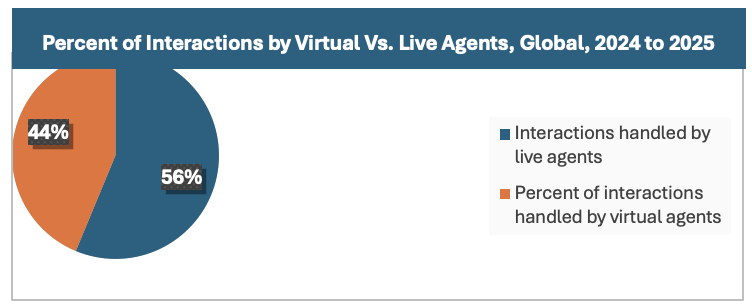
It’s no secret that happy agents = happy customers. But now we must add AI agents to this equation, so that happy agents + competent AI agents = brand loyalty, repeat business, and customer references. Companies can drive customer satisfaction only through personalized service, whether with a virtual or live agent, or often both.
On average, 39% of interactions that initiate with virtual agents reach live agents.
Rethinking Metrics and Key Performance Indicators (KPIs)
Move Beyond AHT (Average Handle Time)
Traditional contact center metrics often punish the very behaviors that drive loyalty. AHT rewards speed – not outcomes. An agent may resolve a case “quickly” by transferring it to another agent, leaving the customer frustrated. Meanwhile, agents who invest time in fully resolving issues, building rapport, or upselling responsibly may score worse.
Modern KPIs must focus on outcomes beyond customer satisfaction and first-contact resolution, including upsell/cross-sell success, sentiment scores, and customer effort. Alongside AI-driven analytics, these metrics identify ways to improve customer interactions with human or AI agents, as both are becoming increasingly complex and prone to error.
Predictive engagement is a robust KPI that measures how effectively a contact center anticipates customer needs and prevents issues before customers reach out. Rather than the reactive nature of traditional KPIs, predictive engagement measurements help avoid customer issues and even predict positive outcomes. Businesses can use data and analytics to engage customers for the right reasons and in the right way before they contact them.
The impact on contact center success rates can be significant with the following results:
- Reduced inbound contact volume
- Lower customer effort
- Improved customer satisfaction
- Lower operational costs
- Higher employee retention
- Strong brand loyalty
- More efficient use of human and AI agents
The next generation of AI-infused contact centers aligns CX goals with corporate objectives and sets KPIs that enable the company to operate toward achieving the same objectives.
Quality Management in a Blended Model
Holistic Monitoring Across the Customer Journey
Traditional QM programs are not purpose-built to monitor, evaluate, and improve performance for the new, expanded workforce. As the number of interactions handled by AI agents grows quickly, businesses must evolve their QM program to include them to maintain an accurate pulse on customer journeys. A truly valuable quality monitoring program must evaluate both AI and human interactions to ensure they consistently meet customer needs and remain balanced, serving customers when and how they want. This requires that the KPIs discussed above be created specifically for humans and for AI agents; some may be the same, while others will be distinct.
Discussions with CX leaders revealed that many contact centers have abundant data but lack a single, integrated source of truth across the organization. As a result, leaders misdiagnose performance issues, often blaming individual agents rather than identifying breakdowns in the customer journey and the root causes of customer dissatisfaction and agent underperformance.
The ability to monitor the entire journey enables businesses to use analytics and feedback not only to guide agents in real time with targeted coaching but also to improve automated processes continually. Consistency is key to improving outcomes. With the same quality standards applied to both, human and AI Agents, customers will have the same experience regardless of who they interact with.
Eliminating Blind Spots
Many contact centers lack visibility into all interactions (across every channel), listen to less than 2% of calls, focus on reducing call volume and AHT, and use CSAT or NPS scores ineffectively. These gaps prevent organizations from truly understanding customer intent—and from creating customers for life.
A lack of insight into AI agent interactions poses a new challenge for contact centers as AI agents handle more – and eventually most – interactions. Without deeper visibility into these interactions, CX leaders will be left to guess how well AI agents perform.
Traditional QM wasn’t designed to support the expanded workforce (AI and human agents), and using the same metrics as for live agents doesn’t work. This is a significant blind spot businesses must consider as they automate interactions.
Spotlight: Webex AI Quality Management for a Truly Blended CX Workforce
Cisco Webex exemplifies how to integrate human and AI agents by creating a unified CX ecosystem. This approach rests on three main components: the Webex AI Agent for customers, the Cisco AI Assistant for live agents, and Webex Workforce Optimization Quality Management. Here’s how these solutions work together to maintain that balance.
The Webex AI Agent offers a smooth self-service experience by integrating conversational intelligence across voice and digital channels with real-time automation. This allows for more natural, human-like, and seamless interactions.
Cisco’s AI Assistant serves as a Copilot for live agents. Once a call reaches a human, the AI transitions to providing support, reducing agents’ mental load so they can focus on empathy and handle complex issues more quickly and effectively. During live chats, AI offers real-time response suggestions to accelerate the process.
Real-time transcription allows agents to view a live text feed of the conversation, helping them better understand accents and avoid missing details amid background noise.
Average after-call work has increased or remained the same in 73% of contact centers, making wrap-up summaries a very effective tool. AI automatically generates notes and action items, significantly reducing time spent in “After Call Work” (ACW).
Webex AI Quality Management is where it all comes together with a unified platform where supervisors can score and coach both AI and human agents to ensure a consistent customer experience across channels by:
- Letting AI handle scale and speed
- Ensuring fast, intelligent escalation to humans
- Empowering agents with AI rather than replacing them
- Using analytics to fine-tune the mix continuously
With ease of use being the most critical factor for 51% of businesses when selecting a CX solution provider, and customer and employee resistance to adopting new technology a primary deterrent to reaching CX goals, Webex Customer Experience Solutions stands out with its valuable tools, such as AI Quality Management, that make implementing AI easier and more effective for contact center leaders.
- Evaluation scorecard designer – helps contact centers more easily build scorecards
- Automated interaction scoring – automatically evaluates the configured interactions
- Agent performance insights for supervisors – allows leaders to more effectively review human agent performance
- AI Agent performance insights – ensures AI agents are delivering positive experiences
- Personalized coaching recommendations – uses these insights to coach agents on the fly
- Screen recording – records the agent’s desktop, improving coaching across channels
- Sentiment Analysis – surfaces how the customer is feeling during a call
- Dashboard and reporting – provides reports related to the usage of QM
The result is a hybrid CX model where virtual agents increase efficiency and accessibility, while human agents deliver empathy, judgment, and brand-building experiences when it matters most.
The Last Word
The key takeaway for businesses is that AI is not here to replace agents—it’s here to amplify their impact. The future belongs to organizations that embrace a blended workforce and redefine success.
Benefits of a Blended Workforce
- For Customers
- Faster resolutions for simple queries via AI.
- Personalized, empathetic support for complex needs.
- For Agents
- Reduced stress and burnout.
- Opportunities for skill development and career growth.
- For Businesses
- Improved efficiency and scalability.
- Higher retention and customer lifetime value.
By aligning AI capabilities with human strengths, businesses can deliver experiences that are faster, smarter, and more human.
Call to Action
Relationships between people and brands are evolving. Success depends on predicting what matters to the future consumer today. Great customer experience doesn’t happen by chance — it requires planning, collaboration across teams, and a strong commitment to understanding your customers, not just responding to their questions quickly. Every customer is different and expects highly personalized interactions. Start integrating AI thoughtfully, invest in quality management, and redefine KPIs to align with modern customer expectations.