This blog is based on the analysis, Frost Radar™: Demand-side Platforms, 2026, authored by Frost & Sullivan’s Growth Expert, Manuel Albornoz, from the Digital Content Services team.
How do leading DSPs compare?
Discover the competitive strengths shaping leadership across the DSP ecosystem.
Executive Summary
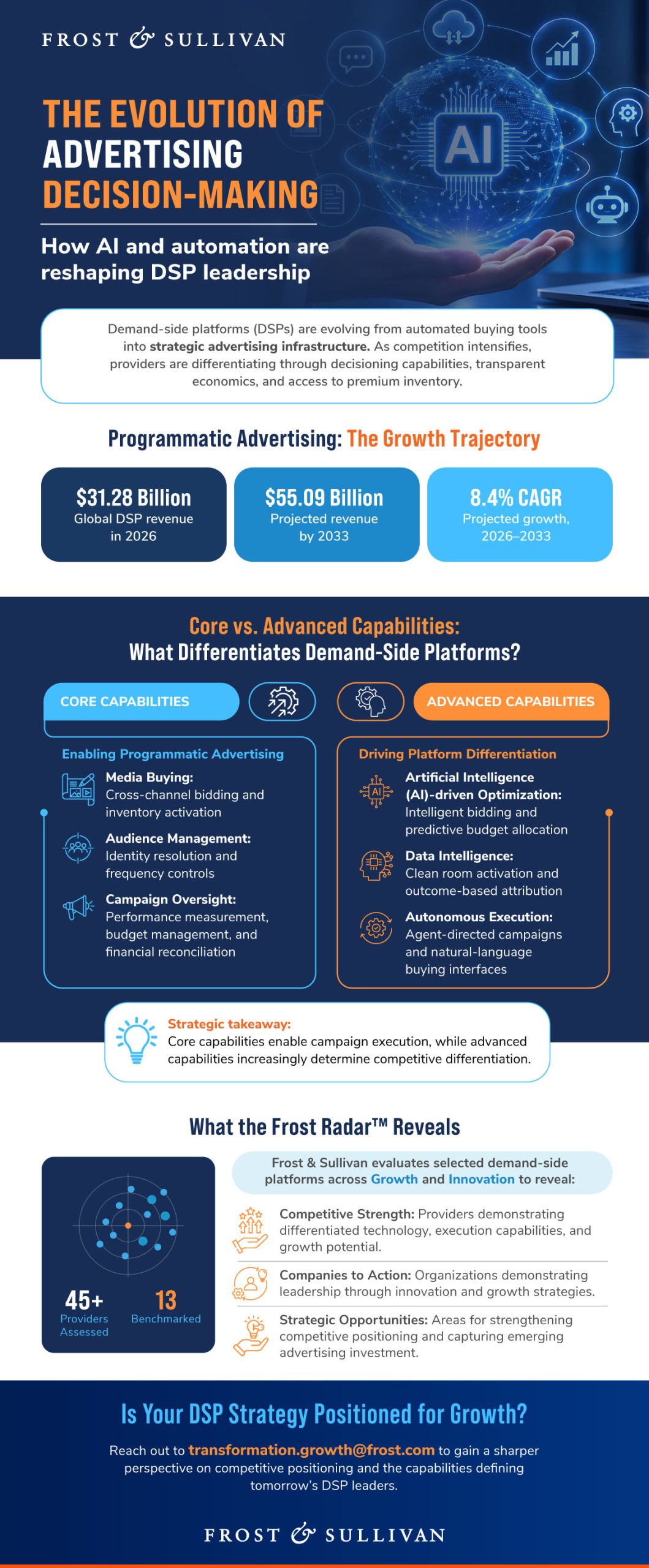
Demand-side platforms (DSPs) are becoming central to how advertisers allocate budgets, manage media investments, and measure business outcomes. As DSP advertising evolves beyond transaction execution, providers are competing through proprietary audience data, transparent economics, and AI-driven decisioning. Frost & Sullivan projects global revenue to reach $55.09 billion by 2033, up from $31.28 billion in 2026. Emerging programmatic advertising trends, including autonomous buying and connected television (CTV), are creating new revenue opportunities. For business leaders, sustained growth will depend on strengthening competitive differentiation, improving advertising efficiency, and capturing a greater share of digital advertising investment.
Top 3 Key Takeaways
- Integrated Demand Side Platform consolidation is reshaping competition: Advertisers are concentrating spending across integrated buying environments, increasing the importance of enterprise relationships and switching costs.
- Premium inventory is influencing revenue concentration: Exclusive data relationships and differentiated streaming supply are strengthening providers’ ability to attract advertising investment.
- Operational accessibility is opening new customer segments: Simplified campaign execution is extending sophisticated programmatic capabilities beyond specialist trading teams.
What are Demand-side Platforms?
Demand-side platforms (DSPs) are technology systems that enable advertisers and agencies to purchase digital advertising inventory programmatically across websites, mobile applications, video, connected television, audio, and other channels. They use audience data, real-time bidding, and optimization technologies to manage advertising campaigns through a centralized buying environment.
Frost & Sullivan Perspective
Demand-side platforms are evolving beyond campaign execution to become strategic decisioning systems. Their competitive value lies in how effectively they integrate audience identity, AI-driven optimization, premium inventory, and transparent measurement to improve automated media buying decisions.
Top Megatrends Reshaping Demand-side Platforms
- Navigating spending concentration: A small group of demand-side platforms captures most programmatic advertising investment, intensifying competition for advertiser budgets and long-term customer relationships.
- Strengthening decisioning quality: With abundant digital advertising inventory but limited audience attention, providers are prioritizing impression quality and relevance over transaction volume.
- Defining platform independence: Independent DSPs emphasize buying objectivity and advertiser control, while integrated providers leverage owned media and authenticated audiences to strengthen their competitive positions.
- Addressing fragmented audience reach: Declining third-party identifiers and disconnected CTV environments are creating challenges for targeting precision, frequency management, and cross-channel attribution.
- Restoring measurement credibility: Last-click attribution and platform self-measurement are creating performance inconsistencies, increasing demand for independent verification and reliable campaign evaluation.
- Managing intermediary costs: Opaque fees and complex advertising supply chains are increasing scrutiny of platform economics, making supply path optimization an important consideration for advertisers.
- Reducing operational complexity: The proliferation of advertising channels, measurement standards, and buying tools is outpacing specialist talent availability, creating barriers to efficient automated media buying.
- Enabling agentic interoperability: Open protocols such as the Model Context Protocol (MCP) are allowing external artificial intelligence (AI) agents to coordinate campaign planning, activation, and measurement across platforms, reducing dependence on proprietary buying interfaces.
- Responding to evolving buyer expectations: Advertisers are prioritizing return on ad spend (ROAS), cost per acquisition (CPA), execution speed, and flexibility in selecting data, identity, and measurement partners.
Top 3 Business Implications to Keep in Mind
- If organizations fail to address audience fragmentation and inconsistent attribution, they may experience declining targeting precision, unreliable performance measurement, and reduced returns on advertising investments.
- If organizations overlook platform economics and supply path transparency, they may face rising intermediary costs, limited visibility into media spending, and weaker control over advertising budgets.
- If organizations rely on fragmented buying systems without interoperability and governance, they may experience higher operational complexity, slower campaign execution, and limited flexibility in adopting agentic AI capabilities.
How is AI reshaping digital asset management across the content value chain?
How are emerging technologies redefining growth across the digital content ecosystem?
Companies to Action: Competitive Differentiation Across Demand-side Platforms
| Company | Strategic Differentiation |
| The Trade Desk | Combining independent buying infrastructure, transparent economics, and Kokai decisioning to strengthen advertiser control. |
| Amazon DSP | Leveraging authenticated commerce and streaming signals to connect premium media access with purchase measurement. |
| Google Display & Video 360 | Integrating extensive media inventory, enterprise data infrastructure, and AI-driven campaign optimization. |
| Yahoo DSP | Combining consent-based audience identity with an open architecture supporting advertiser-owned data and measurement. |
| Viant Technology | Advancing household-level identity and automated, outcome-based execution with a strong CTV focus. |
| Criteo | Connecting retailer transaction data with commerce media activation and purchase-level measurement. |
What is shaping the next phase of competition among demand-side platforms?
Top 3 Growth Opportunities in Demand-side Platforms
- Agentic AI Is Reshaping Programmatic Buying
Media buyers are shifting toward natural-language AI agents that plan, activate, and optimize campaigns. Demand-side platforms exposing planning, bidding, and measurement through open protocols such as MCP and agent-to-agent frameworks can capture spending from external AI workflows, positioning themselves as execution layers for automated media buying.
- CTV Is Evolving into a Performance Channel
With CTV accounting for over half of programmatic spending on many platforms, advertisers are prioritizing verified sales over audience reach alone. CTV programmatic advertising is helping advertisers connect streaming ads to actual purchases, creating opportunities to attract performance-focused advertising budgets.
- Autonomous Buying Is Expanding Advertiser Access
AI-powered campaign execution is reducing planning time from days to minutes, removing operational barriers traditionally associated with enterprise trading teams. DSP advertising solutions combining planning, activation, and optimization into low-touch autonomous products can attract spending from mid-sized businesses and performance-focused advertisers.
Top 3 Strategic Best Practices for DSP Leadership
- Building Unified, Consent-based Identity Infrastructure
Leading demand-side platforms are combining first-party, universal, and clean-room identifiers into unified identity graphs. Extending identity resolution across fragmented CTV and in-app environments strengthens targeting and measurement where traditional identifiers are becoming less reliable.
- Integrating Transparency and Prebid Quality Controls
Leading providers are embedding supply path optimization, log-level access, and pre-bid inventory quality signals directly into buying workflows. This allows advertisers to identify inefficient inventory and reduce wasted spending before auctions, rather than reconciling costs afterward.
- Prioritizing Auditable and Advertiser-controlled AI
As AI advances toward autonomous decisioning, leading platforms are incorporating human-defined guardrails, explainable bidding, and auditable decisions. Supporting advertiser-owned AI models further enables buyers to retain control over automated media buying rather than relying entirely on proprietary algorithms.
Future Outlook: A New Era of Advertising Decision-making
The next phase of DSP competition will increasingly center on who controls the advertising decision-making process. As AI agents reshape how campaigns are planned and executed, traditional platform interfaces may become less central to advertiser relationships. This shift could redefine revenue models, competitive positioning, and the value of proprietary technology. For business leaders, the challenge will be to protect existing revenue streams while identifying new opportunities across an increasingly interconnected advertising ecosystem. Providers that adapt their commercial strategies to changing buying behaviors will be better positioned to sustain growth and defend their competitive advantage.
How are digital experience platforms redefining the way enterprises engage with customers?
Ready to Lead the Transformation?
- Schedule a Growth Strategy Dialog: Align your programmatic advertising growth strategy with Frost & Sullivan’s Visionary Growth Pipeline™ Dialog.
- Engage with Growth Experts: Explore growth opportunities across demand-side platforms, DSP advertising, and AI-driven media buying.
- Showcase Your Transformational Leadership: Position your organization as a leader in programmatic advertising innovation and transformation.
- Join the Growth Council: Connect with executives shaping the evolution of digital advertising and media technology.
- Explore Best Practices Recognition: Gain recognition for excellence in advertising technology innovation, growth strategy, and execution.
- Benchmark Your Industry Positioning on the Frost Radar™: Evaluate your competitive positioning against leading demand-side platform providers based on growth and innovation.
- Tell Your Story: Strengthen brand visibility, customer engagement, and demand generation through integrated marketing strategies.
Frequently Asked Questions (FAQs) on Demand-side Platforms (DSPs)
1. What is the difference between a supply side platform vs demand side platform?
A demand side platform helps advertisers purchase digital advertising inventory, while a supply-side platform helps publishers sell available ad space. Both operate within the programmatic advertising ecosystem, connecting buyers and sellers through automated transactions. The primary distinction lies in whether the platform serves advertisers or publishers.
2. What is DSP advertising, and how does it work?
DSP advertising enables advertisers to purchase digital ad impressions automatically across websites, applications, and other channels. Advertisers define budgets, target audiences, and campaign objectives, while the platform evaluates available impressions and places bids. This reduces manual negotiations and simplifies advertising across multiple publishers.
3. What is CTV advertising, and how does it differ from traditional television advertising?
Connected TV (CTV) advertising delivers advertisements through internet-connected televisions and streaming services. Unlike traditional television advertising, which relies largely on scheduled placements, CTV supports audience-based targeting and digital campaign measurement. Advertisers can reach specific households rather than purchasing exposure across an entire television audience.
4. What is a commerce media network?
A commerce media network connects advertisers with consumers using shopping behavior, transaction data, and purchase-intent signals. Unlike retail media advertising, which primarily operates within retailers’ advertising environments, commerce media extends across industries such as travel and financial services, helping advertisers reach consumers closer to purchasing decisions.
5. What should advertisers consider when selecting a DSP provider?
Advertisers should evaluate inventory access, pricing transparency, audience targeting, and compatibility with existing technology. Other considerations include data ownership, customer support, reporting flexibility, and integration costs. Comparing these factors helps organizations select a DSP provider that aligns with their advertising objectives, budgets, and operational requirements.