This blog is based on the analyses titled, 10 Strategic Imperatives and 10 Growth Opportunities in Content Creation, Management, and Orchestration in 2026, authored by Frost & Sullivan’s growth expert, Alaa Saayed from the Digital Content Services team.
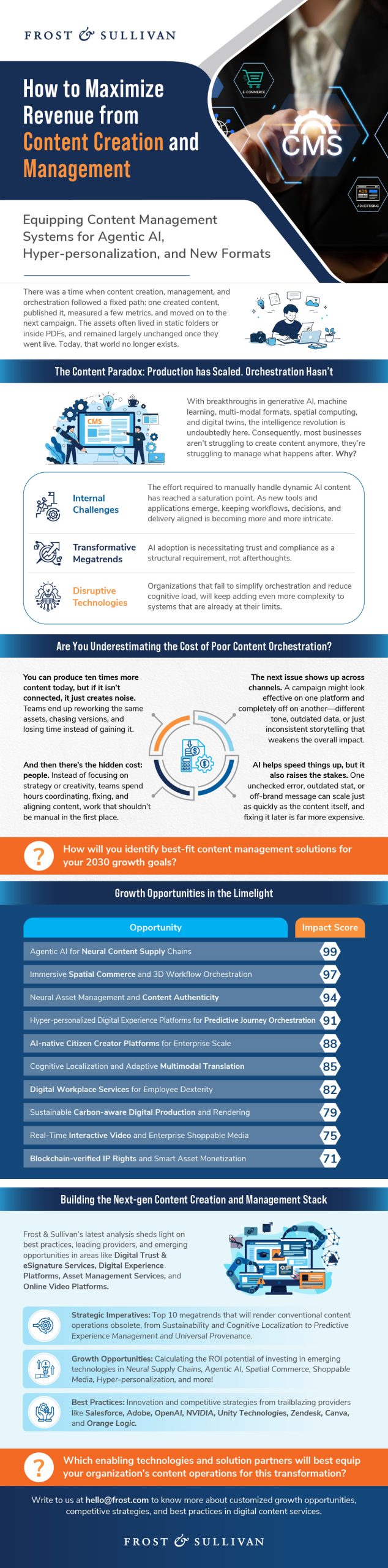
The intelligence revolution—driven by advances in AI, machine learning, neural content, and increasingly agentic systems—is reshaping how organizations approach content creation and management. What used to be only about producing and storing digital assets has become something far more demanding. Teams are now expected to deliver exponentially more content, without an increase in production time. That pressure is pushing content automation to the center of how businesses engage customers, run marketing campaigns, and personalize experiences. As a result, the entire content value chain is evolving, from static processes to dynamic ones that auto-sync across different channels, formats, and user contexts.
In parallel, the systems behind this are being pushed to their limits. Traditional workflows and legacy content management tools are no longer equipped to support the demands of AI, immersive technologies, and interoperability. This necessitates more resilient, intelligent, and hyper-automated content supply chains—where orchestration replaces manual execution, and systems are outcome-focused. The real question is: Which enabling technologies can prepare your organization’s content operations for this transformation?
Looking to Optimize Content Management?
In under 10 minutes, Frost & Sullivan’s latest growth podcast, can help you find new ways to modernize content operations in your organization.
to know more about neural content supply, immersive spatial commerce, carbon-aware digital production, adaptive multimodal translation.
6 Megatrends Disrupting Content Creation Services
Businesses that don’t adapt to the following megatrends risk not just inefficiency, but also rapid commoditization:
- Agentic Content Orchestration: Generative AI has removed the production bottleneck, but it has also created a new problem: humans have become the friction point in approvals and distribution. Moving towards greater autonomy, where AI agents run multi-step workflows and providers take on the role of workflow conductors is becoming critical.
- Spatial Content Liquidity: As spatial computing gains traction with high-fidelity headsets and mobile augmented reality (AR), volumetric content formats are picking up pace. But production is still too complex. Lowering this barrier through self-service 3D tools, digital twins, and cloud-edge rendering will unleash new opportunities.
- Content Authenticity and Provenance: With synthetic media and deepfakes becoming harder to detect, trust and authenticity services are now table stakes. Adopting standards like C2PA (Coalition for Content Provenance and Authenticity), with cryptographically signed metadata embedded directly into assets, is instrumental for future-proofing digital assets.
- Outcome-focused Monetization: Traditional per-seat pricing strategies are starting to feel outdated as customers demand higher value. Rethinking pricing around outcomes and quantifiable results—like content variants approved, meetings booked, or automated tickets resolved (rather than just access to tools)—is essential.
- Unified Content Operating Systems (cOS): The old way of separating content creation, management, and orchestration into different systems is breaking down. Treating content, documents, and collaboration as part of one connected ecosystem, with shared semantic layers is proving to be the more practical way forward.
- Algorithmic Sovereignty: The regulatory environment around AI remains fragmented across various regions. Ensuring transparency in training data, respecting copyright boundaries, and clearly labeling synthetic content in machine-readable ways is becoming more and more important.
Click Here to Know More About Intelligent Content Management Solutions.
Are Your Current Content Operations Missing These Opportunities?
🎧 Listen to Our Growth Podcast to Future-Proof Your Content Platforms! 🎧
Capitalizing on Growth Opportunities
Organizations can’t approach this transformation with standard playbooks or strategies. The scale of change is too high, and the risk of falling behind is real. This implies that growth now depends on:
- Agentic AI for Neural Content Supply Chains: The era of manual content handoffs is fading. What’s taking its place is a neural content supply chain where AI agents move content from brief to ideation, 3D modelling, and final delivery with minimal human intervention. The real opportunity is in building systems where this loop runs continuously, not in isolated steps.
- Immersive Spatial Commerce and 3D Orchestration: As spatial computing becomes more common, content is no longer just something you view—it’s something you interact with through digital twins. The challenge is still production complexity, so the upside lies in making 3D creation faster, reusable, and easier to deploy across platforms.
- Neural Asset Management and Authenticity (C2PA): Traditional digital asset management (DAM) systems weren’t built for what’s coming. With synthetic content everywhere, the value shifts to proving what’s real. Systems that embed provenance directly into assets—and track how content was created and modified—become central to both trust and performance.
- Predictive DXP and Journey Orchestration: Digital experience platforms (DXPs) are changing roles too. Instead of serving fixed pages, they’re starting to assemble experiences in real time—pulling the right content, layout, and message based on user intent in that moment. The opportunity is in reducing the distance between interest and action.
- AI-native Citizen Creator Platforms: Content creation is no longer limited to creative teams. With AI-native platforms, people across sales, HR, and support can generate content using simple prompts—but within brand guardrails. The real value comes from balancing that freedom with centralized control.
Do you have to analytical tools to measure the ROI potential of these growth opportunities?
Best Practices to Up Your Content Creation, Management, and Orchestration Game
Knowing where the opportunity is doesn’t guarantee results. Most organizations struggle not because they lack strategy, but because execution doesn’t keep up.
- Optimizing the Content Value Chain: As customer journeys get shorter, content cycles have to adapt as well. The focus is on removing the friction of manual edits, file conversions, and handoffs—so that assets move faster from planning to live interaction.
- Building for a 3D-first World: For many products, spatial content is becoming the default way people explore and evaluate. That forces a pivot in how content is stored and managed, moving from simple image libraries to more complex, structured environments.
- Embedding Trust into the System: With synthetic media getting harder to detect, trust can’t be handled at the edges. It has to be built into the system itself—where every asset carries a clear record of its origin, edits, and usage.
- Designing for Predictive Experiences: Customers don’t want to search, they expect to be guided. That’s pushing organizations to move away from static journeys toward systems that anticipate intent and adjust content in real time.
How will you strategize to implement these best practices in your content workflows?
Click Here to Modernize Content Operations in Your Organization.
Ready to Lead the Transformation?
The next frontier isn’t more content—it’s smarter coordination. Businesses that master decision intelligence within content workflows will outperform those still focused on volume-driven strategies. What can you do to thrive through this transformation?
- Book a Growth Dialog:Align your content and digital asset management strategy for 2026 and beyond with Frost & Sullivan’s Growth Pipeline™ Dialog.
- Engage with Growth Experts:Co-design AI-enabled, data-driven content automation solutions that scale commercial impact.
- Share Your Transformation Story: Position your organization as a transformation leader in content creation, management, and orchestration through Frost & Sullivan’s Transformational Growth Leadership program.
- Join the Growth Council:Collaborate with digital content services leaders shaping future ICT ecosystems.
- Nominate for Best Practices Recognition:Be recognized for excellence in content strategy, 3D modelling, content provenance, experience design, and customer impact.
- See Industry Positioning on the Frost Radar™:Benchmark your growth performance and innovation strength against your top competitors.
- Activate Brand & Demand Growth: Accelerate awareness, engagement, and revenue growth through integrated brand and demand generation strategies.
Content Creation and Management: Frequently Asked Questions (FAQs)
- How can organizations measure the ROI of AI-driven content creation?
Measuring ROI requires aligning content outputs with business outcomes like conversion rates, engagement depth, and revenue attribution. Advanced analytics platforms now integrate AI to track content performance across channels in real time. Organizations are increasingly using predictive modeling and attribution frameworks to understand which content elements drive value, helping refine strategies continuously rather than relying on static performance metrics.
- What skills are required for teams embracing AI-powered content ecosystems?
Teams need a blend of creative, technical, and analytical skills. Prompt engineering, data interpretation, and AI tool governance are becoming essential alongside traditional content expertise. Additionally, understanding automation workflows and ethical AI use is critical. Organizations are also investing in cross-functional training to ensure employees can collaborate effectively within AI-augmented environments and manage intelligent systems responsibly.
- How does AI impact content governance and compliance?
AI introduces both opportunities and risks in governance. Automated compliance checks, content moderation, and policy enforcement improve efficiency. However, organizations must establish clear guidelines for data usage, bias mitigation, and content transparency. Regulatory frameworks are evolving, making it essential to adopt governance models that ensure accountability, traceability, and adherence to regional and global compliance standards.
- What challenges do organizations face when integrating AI into legacy systems?
Legacy systems often lack the flexibility and interoperability required for AI integration. Challenges include data silos, outdated infrastructure, and limited API capabilities. Organizations must invest in modernization strategies, such as adopting cloud-based platforms and middleware solutions, to enable seamless integration and unlock the full potential of AI-driven content operations.
🎧 Listen to Our Growth Podcast on Content Management Know More! 🎧