This blog is based on the analysis, Frost Radar™: Integrated Cloud Communications Platforms, 2026, authored by Frost & Sullivan’s growth expert Elka Popova from the Unified Communications Solutions team.
Executive Summary
As enterprises accelerate digital transformation and prioritize operational resilience, new growth opportunities are emerging across the integrated cloud communications landscape, reshaping how organizations collaborate, engage customers, and execute business processes. Organizations that adopt integrated communications platforms will be better positioned to modernize business processes and create sustainable competitive advantage.
What are Integrated Cloud Communications Platforms?
Integrated cloud communications platforms combine Unified Communications as a Service (UCaaS), Contact Center as a Service (CCaaS), and Communications Platform as a Service (CPaaS) into a single environment that supports employee collaboration, customer engagement, and Application Programming Interface (API)-driven communications. Rather than evaluating them as separate technology domains, organizations increasingly seek cloud communications platforms that integrate these capabilities while supporting workflow automation, customer experience (CX) and employee experience (EX), analytics, and broader integrated services. This convergence is enabling organizations to modernize enterprise communications while embedding communications directly into business processes.
Benchmark the Future of Integrated Cloud Communications Platforms
Explore the competitive strategies, and best practices shaping the next generation of cloud communications platforms.
Why Integrated Cloud Communications Is Entering a New Growth Phase
While digital transformation continues to support long-term adoption, organizations are making technology investments more selectively amid geopolitical uncertainty, evolving trade policies, and heightened budget scrutiny. As enterprises reassess communications strategies, investments are increasingly shifting toward platforms that modernize customer experience, strengthen cybersecurity, and deliver measurable business outcomes. At the same time, changing workplace models, mobile-first communications, and AI-driven collaboration are accelerating demand for integrated cloud communications platforms.
Top 3 Strategic Imperatives Shaping Integrated Cloud Communications Platforms
- Disruptive Technologies: Agentic AI Reshapes Cloud Communications
Artificial intelligence (AI) and agentic AI are rapidly reshaping communications workflows, raising customer expectations for automation and integrated intelligence. Providers must evolve AI from standalone features into orchestrated, outcome-driven experiences by closing automation gaps, embedding structured adoption frameworks, and demonstrating measurable business value.
- Industry Convergence: Integrated Platforms Become the Growth Engine
As core cloud communications ecosystems mature, growth increasingly depends on expanding beyond traditional communications into broader digital workplace solutions, customer engagement, workflow automation, and employee experience. Providers must assemble integrated portfolios, leverage partner ecosystems, and deliver curated integrations and lifecycle services to increase customer value and strengthen long-term account ownership.
- Innovative Business Models: Delivering Measurable Business Outcomes
Providers must evolve from product sellers into transformation partners by combining managed services, cloud migration, analytics, flexible APIs, and customer success programs. Outcome accountability, repeatable adoption services, and ROI-backed renewals will become critical differentiators for growth, retention, and competitive positioning.
Frost & Sullivan Perspective
Frost & Sullivan believes that long-term success will require providers to move beyond feature-led innovation by operationalizing agentic AI, building integrated platform ecosystems, and delivering measurable customer outcomes. Organizations that execute consistently across these strategic imperatives will be best positioned to drive differentiation and sustainable growth.
What Will Differentiate Tomorrow’s Integrated Cloud Communications Leaders?
Business Implications to Keep in Mind
- Organizations that continue managing enterprise communications, customer engagement, and business workflows in silos will struggle to deliver the seamless experiences employees and customers increasingly expect.
- Providers that do not embed AI, programmable capabilities, and trusted governance into their platforms risk commoditization as enterprise buyers prioritize measurable outcomes over standalone features.
- Organizations that delay expanding beyond core communications services into lifecycle support, business integration, and outcome-driven engagement will find it increasingly difficult to strengthen customer loyalty, grow share of wallet, and sustain long-term competitive advantage.
Building Tomorrow’s Integrated Cloud Communications Platforms
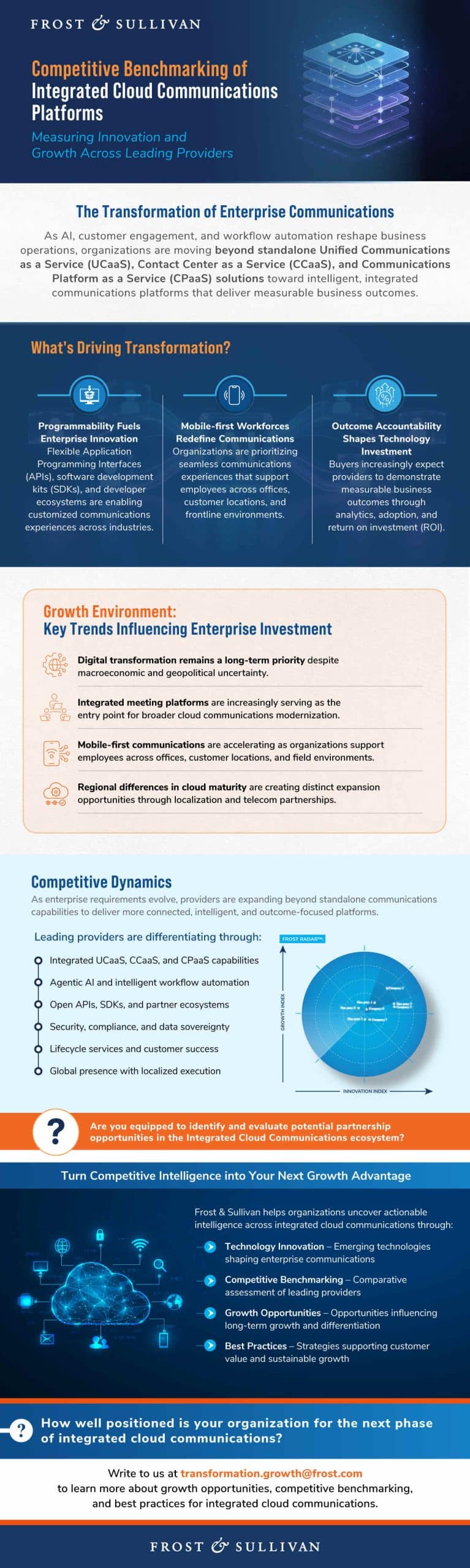
Is your organization prepared to capitalize on the next phase of communications transformation?
🎧 Tune in to our Growth Podcast for expert perspectives today!
Integrated Cloud Communications: Growth Potential
| Area | Key Insight |
| Macroeconomic Outlook | • Geopolitical uncertainty, budget scrutiny, and evolving trade policies are prompting organizations to prioritize technology investments with measurable business outcomes. |
| Regional Momentum |
• Mature regions, including the United States, United Kingdom, Nordics, and Benelux, emphasize platform consolidation and multiservice adoption. • Canada, Asia-Pacific, Latin America, and Central & Eastern Europe present significant expansion opportunities due to lower cloud communications penetration. |
| Companies to Action |
– Cisco – Enterprise communications leadership. – Microsoft – Integrated collaboration ecosystem. – RingCentral – Unified communications innovation. – Zoom – AI-powered collaboration platform. |
Looking to explore the broader transformation shaping cloud communications?
Top 3 Growth Opportunities Across Integrated Cloud Communications Platforms
- Agentic AI Becomes the Intelligent Orchestrator
Agentic AI acts as an intelligent orchestrator that embeds automation, analytics, and contextual decision-making across communications workflows. Success will depend on vertical-specific AI agents, outcome-based positioning, structured training, and change management that accelerate adoption while overcoming skills gaps and organizational resistance.
- Programmable Communications Drive Business Value
Programmable communications are becoming foundational to modern cloud communications strategies as organizations increasingly embed communications into business applications. Growth will be driven by flexible APIs, low-code development tools, software development kits (SDKs), and industry-specific templates that simplify deployment while enabling new revenue opportunities, and greater platform stickiness.
- Platform Convergence Creates New Revenue Opportunities
Organizations increasingly prioritize integrated cloud communications platforms that unify UCaaS, CCaaS, and CPaaS. By orchestrating end-to-end employee and customer workflows, providers can evolve from communications vendors into digital process enablers, unlocking higher-value use cases, stronger differentiation, and sustainable revenue growth.
Frost & Sullivan Perspective
Frost & Sullivan believes that the greatest opportunities in integrated cloud communications will come from providers that combine intelligent orchestration, programmable platforms, and integrated portfolios to deliver measurable business outcomes. As regional adoption patterns diverge and competitive intensity increases, scalable execution and differentiated customer value will be the defining drivers of long-term growth.
Best Practices Leveraged by Leading Cloud Communications Providers
- Embed Agentic AI into High-impact Workflows First
Rather than deploying generic AI capabilities, organizations should embed agentic AI into high-impact workflows before scaling adoption. Pilot programs with defined KPIs, structured adoption frameworks, AI marketplaces, and change management help reduce implementation risk, demonstrate business value, and accelerate deployment.
- Build Open, API-first Platforms
Leading providers prioritize open, API-first architectures and developer ecosystems that extend platform capabilities. Flexible APIs, software development kits (SDKs), low-code tools, and curated integrations embed communications into business workflows, accelerate innovation, strengthen platform stickiness, and expand partner-led value creation.
- Standardize the Customer Lifecycle
Organizations should standardize and monetize the customer lifecycle; from migration and onboarding to adoption, optimization, and renewal. Repeatable playbooks, automation, analytics, and customer success dashboards connect implementation to measurable outcomes, improving retention while creating new revenue opportunities.
Explore Key Megatrends Shaping the Integrated Cloud Communications Ecosystem
Future Outlook on Integrated Cloud Communications
According to Frost & Sullivan, organizations that invest early in AI-powered communications platforms, open and interoperable ecosystems, and outcome-driven service models will be better positioned to improve workforce productivity, enhance customer engagement, strengthen operational resilience, and establish a sustainable competitive advantage in the next era of enterprise communications.
Listen to our growth podcast featuring Frost & Sullivan experts.
Ready to Lead the Transformation?
- Schedule a Growth Strategy Dialog: Align your growth roadmap with Frost & Sullivan’s Visionary Growth Pipeline™ Dialog.
- Engage with Growth Experts: Co-design AI-enabled, data-driven operating models that scale industry-specific and commercial impact.
- Showcase Your Transformational Leadership: Position your organization as a transformation leader through Frost & Sullivan’s Transformational Growth Leadership platform.
- Join the Growth Council: Collaborate with industry leaders shaping the future of your ecosystem.
- Explore Best Practices Recognition: Be recognized for excellence in growth strategy, execution, and customer impact.
- Benchmark Your Industry Positioning on the Frost Radar™: Benchmark your growth performance and innovation strength against industry competitors.
- Tell Your Story: Accelerate awareness, engagement, and revenue growth through integrated brand and demand generation strategies.
Frequently Asked Questions on Integrated Cloud Communications Platforms
1. What is the difference between UCaaS, CCaaS, and CPaaS?
UCaaS (Unified Communications as a Service) enables employee collaboration through voice, messaging, meetings, and video. CCaaS (Contact Center as a Service) focuses on customer service and contact center operations, while CPaaS (Communications Platform as a Service) provides Application Programming Interfaces (APIs) that allow developers to embed communications into business applications. Many organizations now prefer integrated cloud communications platforms that combine all three capabilities into a unified environment.
2. Why are organizations investing in integrated cloud communications platforms?
Organizations are increasingly replacing disconnected communications tools with integrated platforms to simplify IT management, improve collaboration, enhance customer experiences, and reduce operational complexity. Consolidated platforms also make it easier to support hybrid workforces while improving scalability, security, and governance across enterprise communications.
3. How do APIs improve cloud communications platforms?
Application Programming Interfaces (APIs) allow organizations to integrate voice, messaging, video, and notifications directly into existing business applications such as Customer Relationship Management (CRM), Enterprise Resource Planning (ERP), and workflow platforms. This enables faster automation, improves user experiences, reduces manual processes, and creates more flexible communications environments that can evolve with business needs.
4. What should organizations consider before migrating to a cloud communications platform?
Organizations should evaluate integration capabilities, security and compliance requirements, scalability, vendor ecosystem strength, migration complexity, customer support, and long-term adoption strategies. Selecting a platform that aligns with business processes and future growth objectives helps maximize return on investment while minimizing implementation risks.
5. What trends are shaping the future of enterprise communications?
Enterprise communications is evolving toward AI-enabled collaboration, intelligent workflow automation, unified employee and customer experiences, Application Programming Interface (API)-driven integrations, and platform consolidation. Organizations are also prioritizing measurable business outcomes, stronger security, and flexible deployment models as they modernize communications infrastructure.