This blog is based on the analysis titled, Growth Opportunities in the Global UCaaS Landscape (2024–2031), authored by Frost & Sullivan’s growth expert, Elka Popova from the Unified Communications team.
The Unified Communications-as-a-Service (UCaaS) ecosystem is undergoing its most profound shift in a decade—and AI is the catalyst. What began as a migration from desk phones to cloud platforms is now becoming a race to harness intelligence, automation, and real‑time insights across every conversation and workflow.
Providers that infuse their platforms with advanced analytics, automation, and agentic AI are unlocking productivity gains and transforming employee and customer experiences. As hybrid work stabilizes and organizations seek measurable ROI from digital investments, AI‑enhanced UCaaS is becoming the strategic backbone of modern communications—fueling a landscape expected to reach $45.01 billion by 2031.
UCaaS: Press Play on Growth
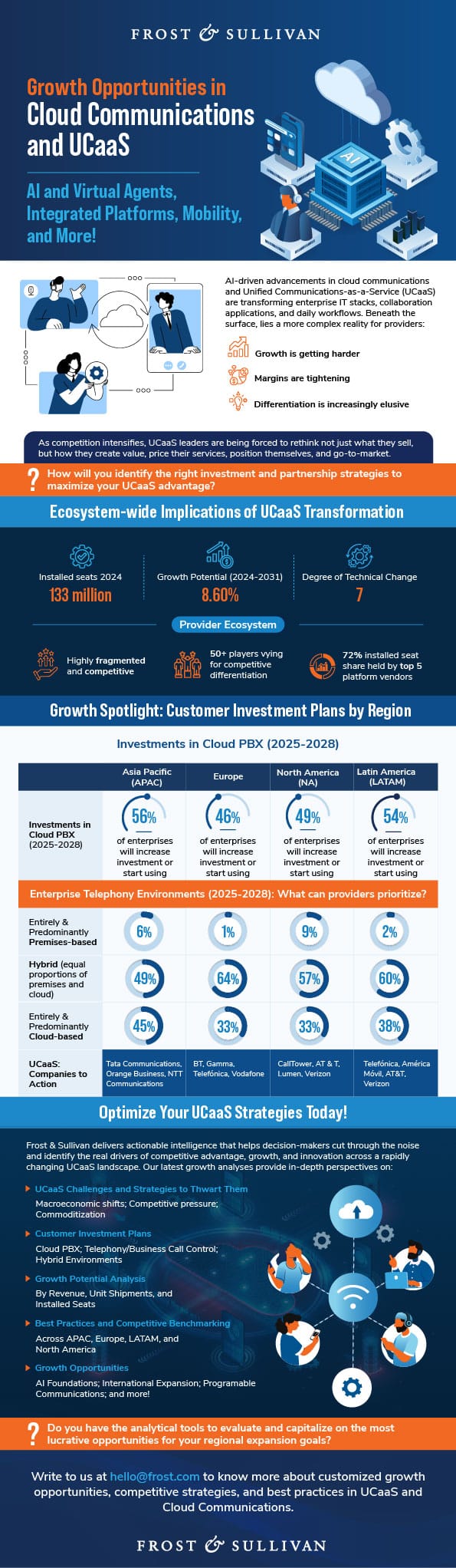
Frost & Sullivan’s analysis of the UCaaS ecosystem reveals high-value growth segments, emerging technologies, transformation drivers, and competitive strategies across 4 regions: Asia-Pacific, Europe, Latin America, and North America. This analysis also highlights best practices from leading providers like Cisco, Microsoft, Zoom, and more!
to know more about frontline worker enablement, mobile-first strategies, and sustainability-driven UCaaS models
The real question is — How will you identify the right investment and partnership strategies to bring home the UCaaS advantage?
What lies ahead is rapid innovation, verticalization, and new features brought on by:
- Collaboration-led Enterprise Communications: Acknowledging the increased value of video meetings, group chat, and team spaces in tomorrow’s highly distributed workplace, organizations are fast adopting collaboration platforms (like Microsoft Teams, Zoom Workplace, and Cisco Webex), then extending those environments with cloud private branch exchange (PBX), thereby reversing the traditional PBX-led communications upgrade cycle.
- AI‑Infused Workflows: As AI becomes a core expectation rather than a premium feature, organizations are embracing UCaaS platforms that embed transcription, translation, smart summaries, copilots, and agentic automation directly into everyday workflows. This shift is redefining the UCaaS value proposition—from delivering voice and collaboration tools to enabling proactive knowledge management, faster decision‑making, and predictive insights that optimize both knowledge‑worker and frontline productivity.
- Vertical‑integrated and Frontline‑optimized Solutions: Organizations across industries—from healthcare to manufacturing to retail—are augmenting generic communications tools with vertical‑specific solutions that integrate directly into vertical apps, systems of record, and mobile workflows. This transformation is driven by the need to empower underserved deskless frontline workers with ruggedized, mobile‑ready, context‑aware tools that combine voice, messaging, video, and automation, enabling real‑time decision‑making and streamlined field operations.
- Mobile-first Solution Strategies: With mobile devices as the primary endpoint for frontline, remote, and hybrid teams, providers feel the pressure to deliver secure, feature-rich experiences across smartphones, tablets, laptops, and other connected devices. This necessitates strategic investments in native mobile dialers, softphones, and 5G.
- Hybrid‑anchored Modernization: Hybrid telephony environments are emerging as a durable long‑term model, as organizations continue balancing cloud flexibility with on‑premises control to meet compliance, integration, and investment‑protection needs. For communications providers, this mandates dual‑track strategies that support both cloud migration and hybrid continuity—delivering integrated, secure, and interoperable solutions that accommodate gradual modernization rather than all‑at‑once PBX replacement.
🎧 Listen to Our Growth Podcast on UCaaS and Cloud Communications to Know More!
Turning Regional UCaaS Megatrends Into Revenue Opportunities
Download Sample Analysis for Detailed Opportunity Analytics!
Strategic Imperatives Transforming UCaaS
- Disruptive Technologies: Tapping into proprietary and third-party large language models (LLMs) and generative pre-trained transformers (GPTs) to deliver intelligent features that boost team productivity, simplify knowledge management, and automate workflows—turning AI into something customers can actually see, use, and pay for.
- Transformative Megatrends: With hybrid work here to stay, expanding cloud-based services, mobile access, and collaboration tools that help teams collaborate from anywhere, without compromising security or performance. Additionally, developing innovative business models that support customers’ sustainability, employee equity, and diversity targets.
- Competitive Intensity: Combating industry fragmentation and market maturity with new strategies that focus on M&A, UCaaS-enablement services, international expansion, and coopetition.
Is your organization equipped to adapt growth strategies in keeping with these headwinds?
Why is Regionalization Important?
One UCaaS strategy doesn’t fit all geographies. Why? North America (NA) and Western Europe are highly competitive regions where pricing pressure is intense. Asia-Pacific (APAC) tells a different story, with mobile-first adoption. Latin America (LATAM) on the other hand represents economic and regulatory hurdles. Consequently, providers who prepare to regionalize their portfolios will stand to win long-term advantages.
- APAC: Pursuing wholesale and co-innovation models with regional telecom operators to maximize reach.
- Europe: Leveraging partnerships with national and pan-European telcos to scale faster amid heavy regulatory complexity.
- LATAM: Collaborating with dominant national telecom operators to navigate regulatory hurdles and deliver localized compliance-ready solutions, amid economic volatility.
- NA: Differentiating beyond price by bundling UCaaS with AI-first features, Communications Platform as a Service (CPaaS) integrations, and vertical-specific capabilities.
Which benchmarking tools will help you identify best-fit regional partners for your UCaaS goals?
View Sample Analysis for Instant Access to UCaaS Best Practices.
Revealed: Top Growth Opportunities
Going forward, these avenues represent lucrative opportunities for providers:
- AI Foundation: With 37% of enterprise buyers willing to pay a premium for AI-enabled capabilities, this is emerging as a key differentiator and monetization opportunity for UCaaS providers. Agentic AI enables contextual, real-time insights, while AI assistants, predictive analytics, and workflow automation boost productivity. Features such as meeting transcription, translation, and intelligent summaries further strengthen the AI value proposition.
- International Expansion: As adoption matures, growth is shifting toward underpenetrated regions and multi-country enterprises seeking consistency at scale. Providers can unlock new revenue through targeted geographic expansion to deliver compliant, cost-efficient services with global plans that scale seamlessly across borders.
Explore the Opportunity Universe: UCaaS and Cloud Communications
Read on about regional best practices and growth strategies here:
- Programmable Communications: As enterprises demand greater flexibility and industry alignment, using Application Programming Interfaces APIs, Software Development Kits (SDKs), and CPaaS platforms allows providers to embed voice, video, and messaging directly into business workflows, enabling vertical-specific use cases, automation, and differentiated experiences (which command premium pricing).
- Vertical Strategies and Frontline Focus: While UCaaS has long cantered on desk-based workers, the next growth frontier lies with frontline and field teams. By embedding communications into industry workflows and mobile environments, providers can address unmet needs in sectors like healthcare, retail, logistics, and manufacturing—unlocking new value through vertical-specific, productivity-driven UCaaS.
What other UCaaS opportunities could your teams be overlooking?
Ready to Lead the Transformation?
- Book a Growth Dialog:Align your 2026 UCaaS strategy with Frost & Sullivan’s Growth Pipeline™ Dialog.
- Engage with Growth Experts:Co-design AI-enabled, data-driven communication tools that scale commercial impact.
- Share Your Transformation Story: Position your organization as a transformation leader in work communications platforms through Frost & Sullivan’s Transformational Growth Leadership program.
- Join the Growth Council:Collaborate with UCaaS and cloud PBX leaders shaping future ICT ecosystems.
- Nominate for Best Practices Recognition:Be recognized for excellence in UCaaS growth strategy, execution, and customer impact.
- Demonstrate Industry Positioning on the Frost Radar™:Benchmark your growth performance and innovation strength against your top competitors.
- Activate Brand & Demand Growth: Accelerate awareness, engagement, and revenue growth through integrated brand and demand generation strategies.
UCaaS: Frequently Asked Questions
- What forces propel growth in Unified Communication as a Service (UCaaS) in 2026?
UCaaS growth is driven by the proliferation of hybrid work, cloud migration initiatives, the demand for scalable collaboration platforms, cost optimization, and the integration of AI-powered communication features in workflows.
- How competitive is the UCaaS ecosystem and how can providers differentiate themselves?
The UCaaS landscape is extremely competitive, with a fragmented service-provider landscape and a highly concentrated platform vendor segment, resulting in strong pricing pressure and frequent customer switching. Providers that infuse their platforms with advanced analytics, automation, and agentic AI can unlock productivity gains and optimize customer experiences.
- Which end-user and customer segments drive UCaaS demand?
Demand is driven by small and mid-sized businesses, large enterprises, and frontline workers across industries such as IT & telecom, Banking, Financial Services, and Insurance (BFSI), healthcare, retail, education, manufacturing, and the public sector.
- How can businesses migrate from legacy PBX to UCaaS?
Successful migration involves phased transitions, hybrid deployments, and minimal service disruption. Working with experienced providers ensures smooth integration, staff training, and system optimization.
🎧 Listen to Our Growth Podcast on UCaaS and Cloud Communications to Know More!