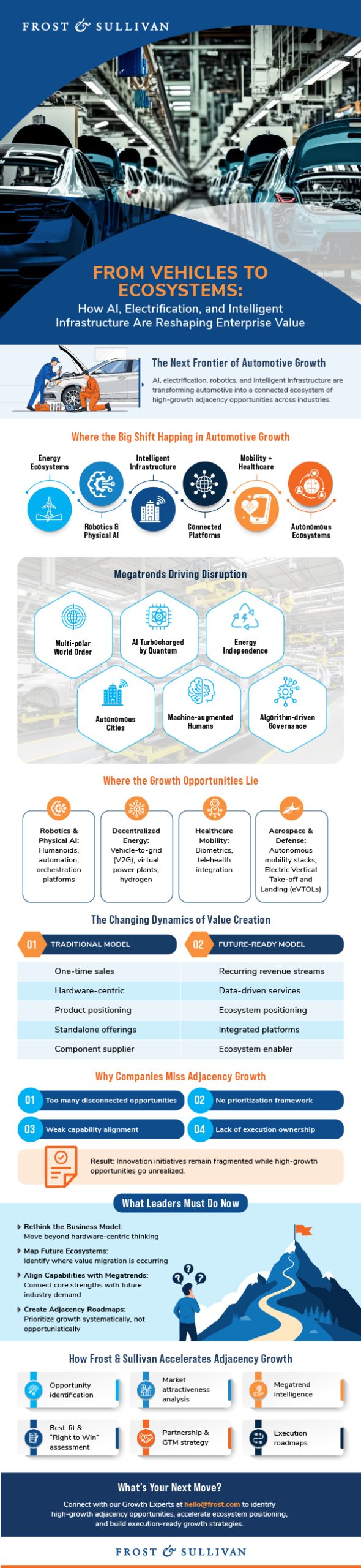
The automotive industry is being shaped by AI, electrification, robotics, intelligent infrastructure, and digital ecosystems. What was once centered primarily on vehicle manufacturing is expanding into a broader, interconnected ecosystem spanning mobility, energy, healthcare, aerospace, and industrial automation. This convergence is creating new growth opportunities for organizations to develop future-ready business models.
Discover Adjacency Growth Opportunities Across Mobility and Industrial Ecosystems
Is your organization prepared to identify where the next wave of automotive growth will emerge?
The Expanding Role of Automotive Within Connected Ecosystems
Historically, automotive companies operated within relatively well-defined industry boundaries focused on supplying products into OEM-driven value chains. Today, rapid advancements in AI, connected infrastructure, autonomous systems, and decentralized energy are expanding the role of vehicles within broader ecosystems.
Vehicles are evolving into:
- Intelligent computing platforms
- Connected service ecosystems
- Energy assets within decentralized grids
- Real-time data generation hubs
At the same time, customers are seeking integrated, intelligent, and service-driven experiences that extend beyond standalone products. This evolution is accelerating convergence between automotive and adjacent industries such as energy, robotics, healthcare, aerospace, and digital infrastructure.
Megatrends Reshaping the Future of Enterprise Value Creation
- AI and Intelligent Automation: AI is embedding intelligence into mobility platforms, infrastructure, industrial systems, and connected services, enabling predictive capabilities, autonomous operations, and real-time decision-making.
- Energy Transition and Electrification: The acceleration of electrification, decentralized energy systems, hydrogen ecosystems, and vehicle-to-grid (V2G) infrastructure is reshaping energy and mobility markets simultaneously.
- Autonomous and Connected Ecosystems: Autonomous cities, connected transportation networks, and intelligent infrastructure ecosystems are driving demand for integrated digital platforms and orchestration systems.
- Geopolitical and Supply Chain Realignment: Regionalization, energy security priorities, and supply chain resiliency initiatives are influencing investment strategies and ecosystem development across industries.
- Demographic and Lifestyle Shifts: Urbanization, aging populations, and evolving mobility expectations are driving growth opportunities across integrated mobility and healthcare ecosystems.
Learn how megatrends across AI, electrification, and connected ecosystems are transforming growth opportunities. Download the whitepaper.
Emerging Adjacency Opportunities Across High-growth Ecosystems
Robotics and Physical AI
Capabilities developed within automotive manufacturing, embedded systems, and automation are applicable to humanoid robotics, industrial automation, intelligent orchestration platforms, and autonomous systems.
Decentralized Energy Ecosystems
Growth opportunities are expanding across V2G ecosystems, virtual power plants, battery energy storage systems, hydrogen infrastructure, and intelligent energy management platforms.
AI and Intelligent Infrastructure
Connected ecosystems are generating increasing demand for edge AI, digital twins, vehicle-to-everything (V2X) communication platforms, and intelligent infrastructure management solutions.
Healthcare and Mobility Convergence
Telehealth integration, biometric monitoring, and mobility-as-a-service solutions tailored to aging populations are creating new opportunities at the intersection of healthcare and mobility.
Aerospace and Autonomous Mobility
Autonomous mobility stacks, unmanned systems, and electric vertical take-off and landing (eVTOL) ecosystems are emerging as high-potential growth areas leveraging technologies developed within automotive ecosystems.
Organizations that align their capabilities with these adjacency ecosystems can lead to stronger growth potential, recurring revenue opportunities, and expanded ecosystem influence.
Download the whitepaper to explore high-growth adjacency opportunities shaping the future of mobility and industrial ecosystems.
The Strategic Challenges Limiting Adjacency Growth
Although many organizations recognize adjacency opportunities, execution remains a significant challenge. The gap between opportunity identification and implementation continues to limit growth outcomes across the industry.
Common challenges include:
- Fragmented innovation initiatives
- Lack of prioritization frameworks
- Misalignment between opportunities and internal capabilities
- Limited visibility into industry attractiveness and competition
- Weak governance and execution ownership
Without structured frameworks, organizations often struggle to convert broad opportunity landscapes into actionable and scalable growth strategies.
A Structured Framework for Adjacency-led Growth
Capturing adjacency opportunities requires a disciplined approach that connects strategic insight with operational execution. Leading organizations are adopting structured growth frameworks to improve prioritization, resilience, and execution readiness.
Key elements of a structured adjacency growth strategy include:
- Opportunity Identification: Mapping emerging growth areas across converging ecosystems and megatrend-driven markets.
- Megatrend Translation: Converting macroeconomic and technology trends into actionable use cases and monetization opportunities.
- Best-fit and Capability Alignment: Evaluating opportunities based on internal strengths, strategic positioning, and competitive differentiation.
- Scenario-based Strategic Planning: Stress-testing opportunities across future scenarios involving AI acceleration, energy transition, geopolitical shifts, and supply chain disruptions.
- Industry and Competitive Evaluation: Assessing growth potential, market concentration, value-chain positioning, and ecosystem maturity.
- Execution Planning: Developing go-to-market (GTM) strategies, partnership ecosystems, investment roadmaps, and implementation timelines.
Is your organization equipped to turn adjacency opportunities into scalable growth strategies?
How Frost & Sullivan Helps Organizations Accelerate Adjacency Growth
At Frost & Sullivan, we help organizations navigate the complexity of adjacency-led growth by combining megatrend intelligence, cross-industry visibility, and execution-focused advisory support.
Our approach helps organizations:
- Identify emerging growth pools across converging ecosystems
- Evaluate market attractiveness and competitive intensity
- Align opportunities with internal capabilities and strategic priorities
- Stress-test growth strategies across future market scenarios
- Develop execution-ready GTM and partnership strategies
- Build scalable roadmaps for long-term ecosystem participation
Additionally, click here to connect with Frost & Sullivan’s growth experts to explore emerging adjacency opportunities shaping the future of mobility, AI, energy, intelligent infrastructure, and connected industrial ecosystems.
Frequently Asked Questions (FAQs):
- What is the adjacency growth strategy and how does it work?
An adjacency growth strategy helps organizations expand into high-growth markets and ecosystems closely aligned with their existing capabilities, technologies, and industry expertise. It works by identifying emerging opportunities across adjacent sectors, evaluating strategic fit and market attractiveness, and developing execution-ready growth roadmaps supported by partnerships, GTM strategies, and long-term monetization models.
- What are the key trends and opportunities in the future of mobility?
The future of mobility is being shaped by AI, electrification, autonomous systems, connected infrastructure, decentralized energy, and digital ecosystems. Key growth opportunities are emerging across robotics and physical AI, V2G ecosystems, intelligent infrastructure, healthcare mobility, autonomous transportation, digital services, and advanced energy platforms.
- Why are automotive companies exploring adjacent ecosystems?
Automotive companies are exploring adjacent ecosystems to diversify revenue streams, reduce dependence on traditional automotive markets, and capture high-growth opportunities driven by ecosystem convergence. Expanding into adjacent industries also enables organizations to leverage existing capabilities across emerging sectors such as energy, AI, robotics, healthcare, and intelligent infrastructure.
- How are AI and electrification reshaping automotive growth?
AI and electrification are transforming vehicles into intelligent, connected platforms capable of supporting autonomous operations, predictive services, real-time data generation, and decentralized energy participation. These technologies are also creating new business models across digital services, intelligent infrastructure, energy ecosystems, and connected mobility platforms.
- What challenges do organizations face in executing adjacency growth strategies?
Organizations often face challenges such as fragmented innovation initiatives, lack of prioritization frameworks, weak alignment between opportunities and internal capabilities, limited market visibility, and insufficient execution governance. Without a structured approach, many companies struggle to translate emerging opportunities into scalable and execution-ready growth strategies.
Ready to Lead the Transformation?
- Book a Growth Strategy Session: Align your growth roadmap with Frost & Sullivan’s visionary Growth Pipeline™ Dialog.
- Engage with Growth Experts: Co-design AI-enabled, data-driven operating models that scale industry-specific and commercial impact.
- Share Your Transformation Story: Position your organization as a transformation leader through Frost & Sullivan’s Transformational Growth Leadership platform.
- Join the Growth Council: Collaborate with industry leaders shaping the future of your ecosystem.
- Nominate for the Best Practices Recognition: Be recognized for excellence in growth strategy, execution, and customer impact.
- Demonstrate Industry Positioning on the Frost Radar™: Benchmark your growth performance and innovation strength against industry competitors.
- Activate Brand & Demand Growth: Accelerate awareness, engagement, and revenue growth through integrated brand and demand generation strategies.