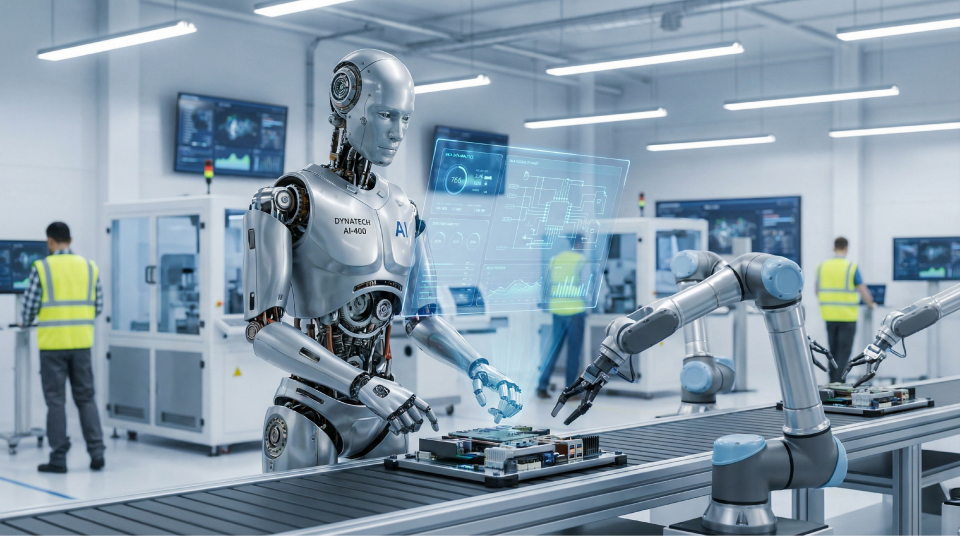
This blog is based on Frost & Sullivan’s recent analysis, Knowledge Economy Transformations, 2025–2035, authored by lead analyst Rituparna Majumder from the Economic Analytics Practice Area.
Executive Summary
AI could create 272.5 million skill-based jobs by 2030 while making 62.2 million labor-intensive roles redundant. The gains will go to economies and firms that can supply the skills. Frost & Sullivan’s proprietary Human Intelligence, Digital Intelligence, and Artificial Intelligence (HiDiAi) framework connects Human Intelligence, Digital Intelligence, and AI to assess how knowledge capabilities move from development to industry application. Across 12 sectors and more than 60 sub-industries, differences in skills, connectivity, research capacity, and technology adoption are creating distinct conditions for industry competitiveness through 2035. Three selected growth opportunities stand out: Smart Manufacturing & Embedded Intelligence, Platformization of Professional Services, and Data Commercialization & Knowledge IP Markets. Together, these opportunities illustrate how organizations can convert specialized knowledge, digital capabilities, and AI into scalable products, services, and revenue models.
Key Takeaways:
- AI-assisted knowledge delivery: Generative AI (GenAI) is expected to automate up to 30% of knowledge-worker tasks by 2030, changing how research, legal, education, design, and other knowledge-intensive services are being delivered across industries and geographies.
- Skills gaps are limiting workforce readiness: 59% of workers globally will require new skills by 2030, while only 28% of the global workforce has tertiary education or formal digital skills. This gap is limiting knowledge-workforce readiness, while demand is rising for AI, data, cloud, and other specialized capabilities.
- The digital divide is restricting knowledge access: As of 2023, 2.6 billion people remained offline, limiting access to digital education, services, and economic participation, particularly across Sub-Saharan Africa, South Asia, and rural regions globally.
- Knowledge assets are becoming revenue streams: Intangible assets such as software, patents, data, and brand equity now account for more than 55% of global corporate value, while licensing, data marketplaces, and secure data-sharing models are creating new routes to commercialize these assets.
What Is the Knowledge Economy?
The knowledge economy is an economic system in which value creation comes from the combination of human intelligence, digital intelligence, and artificial intelligence. Together, these capabilities are supporting how knowledge is developed and applied across industries and economies.
What Is HiDiAi?
HiDiAi brings together three intelligence capabilities:
- Human Intelligence: Domain expertise, research capabilities, and specialized skills support innovation, intellectual property development, and differentiated offerings.
- Digital Intelligence: Connectivity, data ecosystems, and digital platforms extend knowledge access, collaboration, and scalable service delivery.
- Artificial Intelligence: Predictive analytics, automation, and machine learning extend the application of knowledge across operational decisions and technology-enabled services.
The framework is built around four areas of convergence:
- Hi × Di – Augmented decision-making: Real-time data combines with human judgment to strengthen decision-making.
- Hi × Ai – Human-in-the-loop innovation: Human expertise remains central to AI-supported decisions, reinforcing explainability and ethical outcomes.
- Di × Ai – Intelligent automation: Digital systems and data-driven algorithms enable automated analysis, prediction, and decision-making.
- Hi × Di × Ai – Full convergence: Human expertise, digital systems, and AI combine to support transformative productivity and innovation.
Why Is Knowledge Intensity Becoming a Growth Differentiator Through 2035?
Knowledge-based growth is spreading beyond research and high-skill services into manufacturing, supply chains, finance, healthcare, and education. GenAI is expected to automate up to 30% of knowledge-worker tasks by 2030, increasing the value of roles that combine domain expertise with digital and AI capabilities. Specialized skill gaps are also making workforce readiness a larger factor in how quickly new technologies can scale.
Which Knowledge-intensive Sectors Are Best Positioned for Growth?
Assess how talent, digital infrastructure, and AI are influencing sector readiness, investment potential, and market positioning.
[Download the Strategic Analysis]
This shift is changing the basis of competition across sectors. Smart manufacturing is increasing the role of embedded intelligence, supply chains are relying more on predictive data and visibility, and professional services are moving toward platform-based delivery. Markets with stronger talent pools, digital infrastructure, and AI readiness are better positioned to attract investment and scale knowledge-intensive activity. Business leaders and investors are weighing access to skilled talent, digital infrastructure, and AI capabilities more heavily in market-entry, partnership, and long-term investment decisions.

Top Three Strategic Imperatives Redefining Knowledge Economy Growth
- Disruptive Technologies: AI, automation, cloud infrastructure, and blockchain are accelerating knowledge creation, distribution, and commercialization. Enterprise AI adoption rose from 20% in 2019 to over 50% in 2023, underscoring the pace at which these technologies are entering business operations. Across research, professional services, healthcare, education, and industry, differentiation is moving toward proprietary applications, sector-specific use cases, and stronger digital capability.
- Geopolitical Chaos: Data localization rules, protectionism, and tighter talent mobility are fragmenting global knowledge flows. More than 70 countries have enacted or drafted cross-border data regulations, adding complexity to how knowledge and digital services move across jurisdictions. Regional cloud capacity, distributed innovation hubs, and resilient digital infrastructure are gaining greater commercial relevance as businesses manage data access, regulatory exposure, and cross-border continuity.
- Customer Value Chain Compression: AI-assisted platforms and digital self-service models are reducing intermediary layers across consulting, legal, education, research, and other knowledge services. Faster access to expertise and modular service delivery are supporting platform-based business models and technology-enabled professional services. According to the Organisation for Economic Co-operation and Development (OECD), firms investing in R&D and digital upskilling report 30–50% higher productivity gains over five years.
Frost & Sullivan Perspective
According to Frost & Sullivan, knowledge-economy competitiveness depends on how human expertise, digital systems, and AI are combined within specific industry applications. Research capability creates potential, but commercial scale depends on the ability to distribute knowledge, apply it to customer needs, and package it into reliable and repeatable offerings.
This creates an important distinction for business leaders: knowledge capability does not automatically translate into commercial opportunity. The ability to connect capabilities with industry requirements determines where supplier participation and revenue opportunities can emerge.
Policy Priorities for Knowledge-economy Growth
For governments and economic development agencies, the policy agenda spans STEM (science, technology, engineering, and mathematics) and reskilling pipelines, digital public infrastructure, research and development (R&D) funding, AI governance, and industry-university links. Coordination across these areas is strengthening the talent, infrastructure, and research base behind knowledge-intensive investment and innovation.
How Do Skills, Digital Access, and R&D Investment Affect Knowledge-led Growth?
Country-level capability differences affect the economics of knowledge-intensive investment. Three factors are particularly important: workforce capability, digital access, and research investment.
| Growth Pressure | Supporting Evidence | Commercial Implication |
| Workforce capability | An estimated 59% of workers globally will require new skills by 2030. | Skills shortages support demand for specialized training, reskilling, and industry-linked talent development. |
| Digital access | Internet penetration in 2024 was 93.4% in high-income economies versus 26.5% in low-income economies. | Connectivity gaps restrict service reach and create opportunities for digital infrastructure and platforms. |
| Research investment | High-income economies spend more than 2.5% of GDP on R&D, compared with less than 0.5% in low-income economies. | Differences in research funding affect innovation capacity and requirements for technology development and partnerships. |
These differences influence how quickly knowledge-intensive capabilities can be developed, deployed, and commercialized. For companies evaluating expansion or partnerships, country readiness therefore needs to be considered alongside demand potential. For governments and economic development agencies, the same gaps are informing priorities for skills programs, digital infrastructure investment, and R&D support.
Companies Adopting this Shift:
- Amazon invested USD 1.2 billion in its Upskilling 2025 program to retrain 300,000 employees for high-tech roles, reinforcing the link between workforce capability and technology readiness.
- Siemens is linking digital training with automation, AI, and industrial Internet of Things capabilities through its Xcelerator Academy, connecting workforce development with industrial deployment.
- SAP has expanded regional cloud capacity to support data-localization requirements across markets including the European Union, India, and the Middle East.
Business Implication: Knowledge-led growth is gaining strength where skills, digital capacity, and AI readiness are progressing together. Markets with stronger capability overlap are offering clearer conditions for technology deployment, service expansion, and higher-value investment.
Have you evaluated your organization’s technology and digital capabilities to support future growth initiatives?
Top Three Growth Opportunities Converting Knowledge Capability into Commercial Value
- Smart Manufacturing & Embedded Intelligence
AI, Industrial Internet of Things (IIoT), edge computing, and analytics are bringing real-time intelligence into factory operations. Predictive automation, digital twins, and industrial software are extending smart manufacturing across production, maintenance, and quality.
Business implication: Commercial value spans industrial software, automation, systems integration, analytics, and workforce enablement as manufacturers scale intelligent operations.
- Knowledge-driven Supply Chains
Real-time data, predictive analytics, and shared intelligence are improving visibility across sourcing, production, and logistics. Digital supply-chain investment has tripled since 2020, increasing demand for traceability, risk mapping, and connected supply-chain systems.
Business implication: Stronger supply chain visibility is widening opportunities across data integration, predictive intelligence, compliance, and resilience services.
- Data Commercialization & Knowledge IP Markets
Data is gaining value beyond internal operations as licensing, secure exchange, and data-sharing models expand. Intangible assets, including software, patents, data, and brand equity, now represent more than 55% of global corporate value, strengthening their role in the digital economy.
Business implication: Data monetization is opening revenue pathways across proprietary datasets, secure data exchanges, Application Programming Interfaces (APIs), and knowledge-based intellectual property, with governance influencing scalability.
How well do you think your organization is positioned to capitalize on emerging growth opportunities in your industry?
Future Outlook: Knowledge Intensity Will Shape Growth Through 2035
By 2035, knowledge intensity will carry more weight in sector competitiveness and investment appeal. Information and Communications Technology (ICT), semiconductors, and pharmaceuticals already lead, while automotive and finance are gaining ground as research and development (R&D), software, data, and AI take a larger role in value creation. In automotive, software and electronics could account for more than 50% of vehicle value by 2030, up from about 30% today, illustrating how value is shifting toward software-led and knowledge-intensive capabilities.
According to Frost & Sullivan, commercial advantage will rest on how effectively human expertise, digital infrastructure, and AI are combined within industry applications. Stronger alignment across these capabilities can accelerate commercialization and support scalable knowledge-based services. For investors and business leaders, knowledge intensity provides a clearer basis for comparing sector readiness, partnership potential, and long-term growth through 2035. For governments and economic development agencies, policy choices around skills, R&D funding, digital infrastructure, and AI governance are setting the conditions for knowledge-intensive investment and innovation.
Do you prioritize investments in research and development or strategic partnerships to create a pipeline of growth opportunities?
Ready to Lead the Transformation?
- Schedule a Growth Strategy Dialog: Align your growth roadmap with Frost & Sullivan’s Visionary Growth Pipeline™ Dialog.
- Engage with Growth Experts: Co-design AI-enabled, data-driven operating models that scale industry-specific and commercial impact.
- Showcase Your Transformational Leadership: Position your organization as a transformation leader through Frost & Sullivan’s Transformational Growth Leadership platform.
- Join the Growth Council: Collaborate with industry leaders shaping the future of your ecosystem.
- Explore Best Practices Recognition: Be recognized for excellence in growth strategy, execution, and customer impact.
- Benchmark Your Industry Positioning on the Frost Radar™: Benchmark your growth performance and innovation strength against industry competitors.
- Tell Your Story: Accelerate awareness, engagement, and revenue growth through integrated brand and demand generation strategies.
Connect with our growth experts at [email protected].
FAQs
1. What is the knowledge economy?
The knowledge economy is an economic system where value creation depends on how knowledge is generated, distributed, and applied. Frost & Sullivan’s HiDiAi framework connects human expertise, digital infrastructure, and artificial intelligence (AI) to explain how these capabilities support knowledge creation and application across industries and economies.
2. What is knowledge intensity?
Knowledge intensity refers to the extent to which an industry depends on specialized expertise, R&D, digital capabilities, data, intellectual property, and advanced technologies to create value.
3. Why is human capital important to knowledge-economy growth?
Human capital provides the specialized expertise and technical skills needed to develop, deploy, and scale advanced technologies. With an estimated 59% of workers globally expected to require new skills by 2030, workforce capability is becoming an important factor in technology readiness.
4. How does digital infrastructure support the knowledge economy?
Digital infrastructure supports the knowledge economy by enabling connectivity, access to data, cloud-based services, collaboration, and scalable digital delivery. Differences in digital access can therefore influence how quickly knowledge-intensive services and technologies can expand.
5. Which industries are most knowledge-intensive?
ICT, semiconductors, and pharmaceuticals are among the most knowledge-intensive sectors, while automotive and finance are increasing their reliance on software, data, AI, and R&D. Frost & Sullivan benchmarks 12 sectors and more than 60 sub-industries to assess these differences.
6. What are the biggest growth opportunities in the knowledge economy?
Five selected growth opportunities are Smart Manufacturing & Embedded Intelligence, Platformization of Professional Services, and Data Commercialization & Knowledge IP Markets. These opportunities connect specialized capabilities with scalable products, services, and revenue models.
7. How is AI changing knowledge-based business models?
AI is expanding how knowledge can be analyzed, automated, distributed, and applied. Commercial value is strongest when AI is combined with domain expertise, reliable data, and digital infrastructure to address specific industry and customer requirements.
8. Which factors determine knowledge-economy readiness?
Knowledge-economy readiness depends on workforce capability, digital access, research investment, technology adoption, data availability, and regulatory conditions. The combination of these factors influences how quickly knowledge-intensive capabilities can be developed and commercialized.
9. How can policymakers strengthen knowledge-economy readiness?
Policy priorities span STEM (science, technology, engineering, and mathematics) and reskilling pipelines, digital public infrastructure, R&D funding, AI governance, and industry-university collaboration. Frost & Sullivan’s HiDiAi framework is helping policymakers assess gaps across human, digital, and AI capabilities and identify where policy support can strengthen knowledge-intensive growth.