This blog is based on a recent analysis, “Automotive Production Trends and Insights, Global, 2025–2030,” authored by Dorothy Amy, Frost & Sullivan’s Mobility Growth Expert.
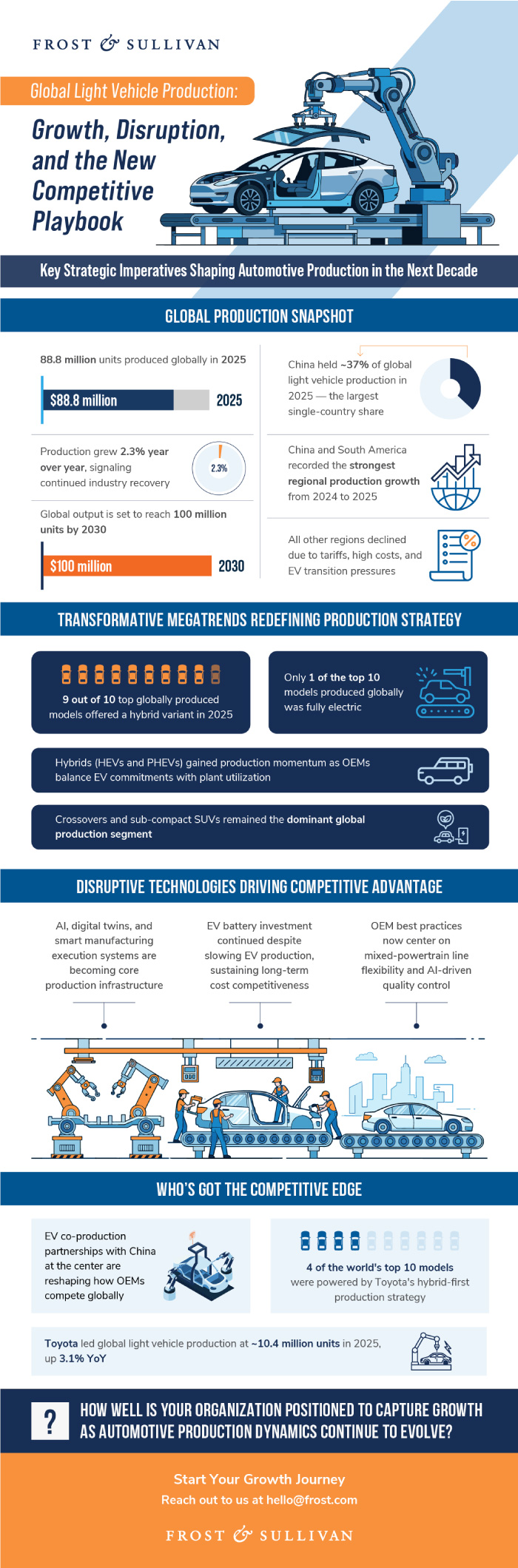
The defining shift in automotive production is not which powertrain wins; it is how OEMs are choosing to manage capital, complexity, and risk simultaneously. Scale-driven expansion has given way to precision manufacturing, where plant utilization, supplier proximity, and geopolitical exposure are as important as output volumes.
Leading OEM groups are maintaining global dominance by sustaining strong internal combustion engine (ICE) output while running diversified hybrid and electric portfolios in parallel.
Are your manufacturing investments aligned for sustainable growth across powertrain transitions?
How Each Region Is Performing
Asia-Pacific (excluding China)
- Production declined modestly in 2025, with OEMs consciously prioritizing stable plant utilization over volume growth.
- Sports Utility Vehicles (SUVs) are dominating output across the region, reflecting both consumer demand and platform economics.
- India continues to function as the primary capacity expansion and export hub, attracting investment that other Asia-Pacific (APAC) regions are not capturing at the same scale.
North America
- Electric Vehicle (EV)-only plants in the United States are recording lower utilization rates, prompting OEMs to reconfigure output toward hybrids, SUVs, and pickups; segments that are sustaining both volume and margin.
- Tariffs and political exposure are now active inputs in plant allocation decisions, sitting alongside traditional cost and demand modeling.
- Mexico continues operating as a high-volume ICE and SUV production hub, functioning within a risk-adjusted trade framework.
South America
- Brazil is deepening its export relationship with Argentina while simultaneously recording record EV penetration levels.
- High interest rates are tempering aggressive capacity expansion, keeping investment disciplined rather than speculative.
Europe
- Weak consumer demand and rising unsold inventory are the primary brakes on European production — not Chinese imports, which are still attempting to gain share despite facing active tariff barriers.
- The European Union (EU)’s relaxation of its 2035 ICE phase-out targets is reopening investment headroom for ICE production, reflecting how difficult the region’s EV transition has proven to execute at manufacturing scale.
How well does your production footprint support sustainable growth across regional demand and policy change?
Top Growth Opportunities
- Regionalizing Platform Architectures for Tariff-Resilient Growth: Rising tariff uncertainty is pushing OEMs to rethink global production, shifting toward regionalized, flexible manufacturing models. Localizing platforms and supplier ecosystems helps ensure continuity, reduce cost exposure, and improve responsiveness. Automakers are increasingly prioritizing local sourcing and tariff-aligned product strategies, while building regional platform hubs to enable faster production shifts without disrupting model life cycles.
- Using mixed-powertrain flexibility to manage uneven electrification: Uneven electrification across regions is driving OEMs toward flexible, mixed-powertrain production strategies. Relying solely on EV-dedicated plants increases utilization risk, while single-powertrain setups limit responsiveness. Mixed-model lines, shared architectures, and adaptable systems enable smoother transitions between ICE, hybrid, and EV production. Hybrids help stabilize volumes and margins, allowing automakers to maintain profitability while gradually scaling full electrification.
Growth Restraints Compressing OEM Margins
Rising Production Costs
Inflation in labor, energy, logistics, and compliance costs is compressing manufacturing margins across segments. OEMs are largely unable to pass these cost increases on to consumers in price-sensitive mass-market vehicles, which is directly limiting expansion plans.
Supply Chain Volatility
- Semiconductors, battery materials, rare earths, and critical metals remain structurally exposed to disruption.
- Despite active supplier diversification, meaningful dependencies on Chinese upstream capacity continue to constrain production scalability and planning certainty.
Multi-Powertrain Complexity
Running ICE, hybrid, and EV models simultaneously across the same production ecosystem is raising capex intensity, increasing line changeover costs, and reducing the operational efficiencies that large-scale manufacturing typically generates.
How are you addressing these restraints to stay competitive across diverse regional dynamics?
Strategic Partnerships Are Powering the Next Phase of EV Manufacturing
OEMs are sharing platforms, battery technologies, regional manufacturing capacity, and electrification roadmaps to reduce individual risk, lower development costs, and maintain pace with the transition to electrified production. Key patterns emerging across the global partnership landscape include:
- EV co-production is the most active theme, with OEMs pooling platform investments to make electrification economics work at scale.
- China is operating as the most active automotive OEM partnerships hub, with domestic and global manufacturers using the country’s manufacturing density and supplier depth to co-develop new energy vehicle programs.
- Battery alliances are central to most new production agreements, reflecting how critical cell supply security has become to any credible electrification roadmap.
- Fuel cell collaborations remain limited in number but are increasingly global in scope, with select OEMs treating hydrogen as a serious long-range powertrain option rather than a distant experiment.
- Regional manufacturing partnerships are scaling, particularly in markets where individual OEM footprints cannot justify standalone investment in electrified production at the required speed.
Closing Thoughts
The consistent direction is toward shared capability development, with solo platform strategies becoming rare in segments where electrification demands sustained, large-scale capital commitment. Organizations need to leverage the right partnership frameworks to share electrification costs, accelerate production timelines, and build regional manufacturing resilience.
Frequently Asked Questions
What is shaping global automotive production trends?
Capital discipline, localization depth, and geopolitical risk management are now the primary production strategy inputs. OEMs are moving away from pure scale expansion toward flexible, regionally resilient manufacturing models.
Why are EV-only plants facing utilization challenges?
Uneven EV demand across regions and price points means dedicated EV plants are not running at optimal volumes. OEMs in North America are reconfiguring toward hybrid, SUV, and pickup output to sustain plant economics.
Why is European production slowing?
Weak consumer demand and rising unsold inventory are the primary factors. The difficult EV transition among European automakers, not Chinese import competition, is the main constraint on production growth.
How are OEMs managing production risk across multiple powertrain transitions?
OEMs are using flexible plant strategies, shared platforms, and partnerships to stay profitable while balancing ICE, hybrid, and EV production.
Ready to Lead the Transformation?
- Book a Growth Strategy Session: Align your growth roadmap with Frost & Sullivan’s Visionary Growth Pipeline™ Dialog.
- Engage with Growth Experts: Co-design AI-enabled, data-driven operating models that scale industry-specific and commercial impact.
- Share Your Transformation Story: Position your organization as a transformation leader through Frost & Sullivan’s Transformational Growth Leadership platform.
- Join the Growth Council: Collaborate with industry leaders shaping the future of your ecosystem.
- Nominate for the Best Practices Recognition: Be recognized for excellence in growth strategy, execution, and customer impact.
- Demonstrate Industry Positioning on the Frost Radar™: Benchmark your growth performance and innovation strength against industry competitors.
- Activate Brand & Demand Growth: Accelerate awareness, engagement, and revenue growth through integrated brand and demand generation strategies.