This blog is based on Frost & Sullivan’s analyses, “Email Security Market, Global, 2023–2028” and “Frost Radar™: Email Security, 2026,” authored by Jarad Carleton and Claudio Stahnke from Frost & Sullivan’s Security Practice.
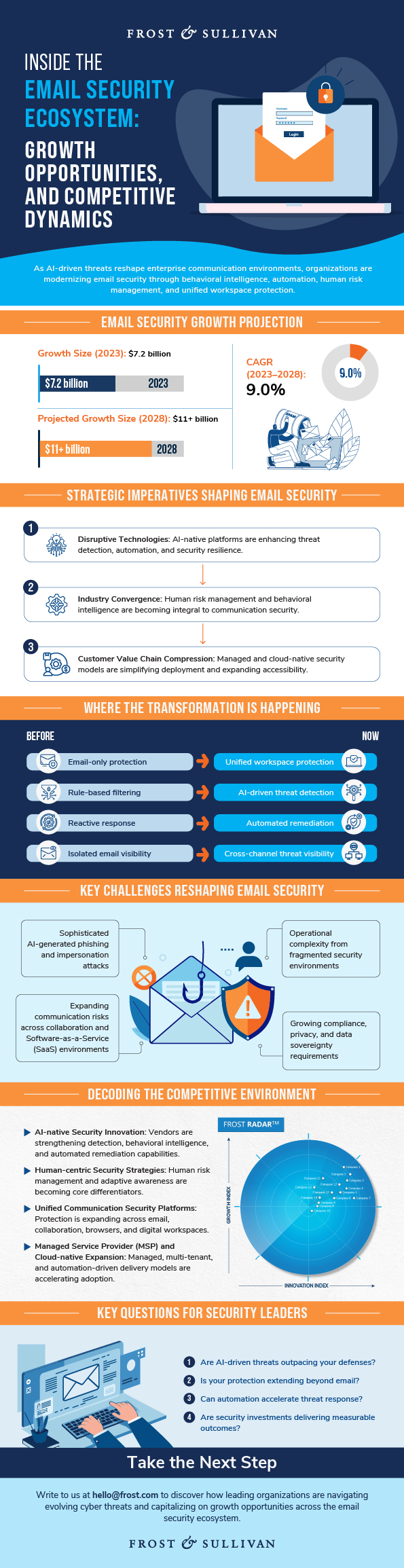
Enterprise communication ecosystems are evolving as hybrid work, cloud collaboration, and Software-as-a-Service (SaaS) adoption are becoming increasingly central to business operations. Email now operates alongside collaboration platforms, cloud applications, browsers, and digital workspaces, creating a broader and more interconnected communication environment.
At the same time, cybercriminals are leveraging artificial AI to enhance phishing, business email compromise (BEC), impersonation, and social engineering attacks that exploit digital identities, communication trust, and user behavior. These threats are prompting organizations to rethink traditional security approaches and adopt more adaptive communication security strategies.
What growth opportunities exist to modernize email security while improving visibility, efficiency, and risk management outcomes?
To Explore:
– Strategic Priorities
– Regional Adoption Pattern
– Competitive Benchmarking
How is your organization adapting email security to address evolving AI-driven threats and communication risks?
Listen to our podcast episode on growth opportunities reshaping the email security ecosystem.
Key Growth Drivers Accelerating Email Security Adoption
- Convergence of Communication Security: Organizations are seeking unified protection across email, collaboration platforms, browsers, and file-sharing environments to improve visibility and reduce cross-channel risks.
- Regulatory and Data Governance Requirements: Growing compliance, privacy, and data sovereignty mandates are increasing demand for transparent, audit-ready, and privacy-centric security architectures.
- Flexible Deployment Models: Hybrid and Application Programming Interface (API)-based security architectures are simplifying deployment, accelerating adoption, and supporting security modernization initiatives.
- Platform Consolidation and Outcome-driven Investments: Enterprises are consolidating security capabilities into integrated platforms while prioritizing solutions that deliver measurable improvements in risk reduction and operational efficiency.
Technology Enablers Strengthening Email Security
- AI-driven Threat Detection and Behavioral Intelligence: AI-powered analytics and behavioral intelligence are improving the detection of sophisticated phishing, impersonation, and social engineering attacks.
- Autonomous Remediation and Security Automation: Automated investigation and response capabilities are helping organizations accelerate remediation and improve operational efficiency.
- Human Risk Management: Behavioral monitoring and adaptive awareness programs are becoming essential for reducing identity-driven and human-centric cyber risks.
- Unified Workspace Protection: Security strategies are extending beyond email to protect collaboration platforms, browsers, Software-as-a-Service (SaaS) applications, and digital workspaces through integrated security architectures.
Growth Opportunities Shaping the Email Security Ecosystem
Unified Email and Workspace Security Platforms
Organizations are prioritizing integrated platforms that provide consistent protection across email, collaboration applications, browsers, and cloud environments. Vendors that can unify visibility, policy management, and threat detection across communication channels will be well positioned to capitalize on long-term growth opportunities.
Multimodal AI and Autonomous Threat Defense
The rise of AI-generated phishing, deepfake-enabled impersonation, and payload-less attacks is creating demand for advanced detection systems capable of analyzing behavioral, contextual, and communication-based threat indicators while supporting autonomous remediation.
MSP-led and SMB-focused Security Delivery Models
Growing demand from resource-constrained organizations is creating opportunities for vendors that offer cloud-native, multi-tenant, and automation-driven platforms optimized for managed service providers (MSPs) and small and medium-sized business (SMB) customers.
Download the sample analysis to gain deeper understanding into the growth opportunities shaping email security landscape.
Leading Companies Shaping the Email Security Industry
- Proofpoint is leading the market through its human-centric security strategy, combining behavioral intelligence and human risk management to strengthen protection against phishing, BEC, and social engineering attacks.
- Cisco is advancing enterprise communication security through cloud-native architectures, AI-driven threat detection, and integrated threat intelligence capabilities that enhance visibility and resilience.
- Check Point is differentiating through integrated workspace security, API-based protection models, and automated remediation capabilities designed for modern digital environments.
- Mimecast is expanding its value proposition beyond email security through human risk management, collaboration security, and insider risk mitigation solutions.
- Fortinet is strengthening its position through integrated security platforms, flexible deployment models, and unified communication and workspace protection capabilities that support security consolidation initiatives.
Best Practices for Security Leaders Navigating Email Security Landscape
- Adopting AI-native security architectures that leverage behavioral intelligence, contextual analysis, and automated response capabilities to strengthen protection against evolving cyber threats.
- Extending email security services by implementing integrated protection across collaboration platforms, browsers, cloud applications, and digital workspaces to address emerging communication risks.
- Embedding human risk management into cybersecurity strategies through adaptive awareness programs, behavioral analytics, and user-centric protection frameworks that reduce exposure to identity-driven attacks.
- Prioritizing platform consolidation and operational efficiency by adopting unified security architectures that improve visibility, streamline governance, and reduce management complexity.
- Aligning security investments with measurable business outcomes by evaluating initiatives based on risk reduction, operational effectiveness, remediation performance, and compliance readiness.
Organizations that are proactively aligning investments with the industry transformation are better positioned to strengthen cyber resilience, reduce operational complexity, and capitalize on emerging growth opportunities across the evolving communication security landscape.
Frequently Asked Questions
1. What is email security?
Email security encompasses the technologies, policies, and processes used to protect email communications from cyber threats such as phishing, business email compromise (BEC), malware, ransomware, impersonation, and data loss. Modern email security solutions increasingly extend protection across collaboration platforms, cloud applications, and digital workspaces to address evolving communication risks.
2. How big is the email security market?
According to Frost & Sullivan’s Email Security Market, Global, 2023–2028 analysis, the global email security market was valued at approximately $7.2 billion in 2023 and is projected to exceed $11 billion by 2028, driven by growing cyber threats, AI-driven attacks, regulatory requirements, and increasing adoption of cloud-based email security platforms.
3. Who is the market leader in email security?
The email security market is highly competitive, with leading providers including Proofpoint, Cisco, Check Point, Mimecast, and Fortinet. These companies are differentiating through AI-driven threat detection, human risk management, integrated workspace security, and automated remediation capabilities.
4. How do AI and machine learning enhance email security?
AI and machine learning improve email security by analyzing behavioral patterns, communication context, and threat indicators to detect sophisticated phishing, impersonation, and social engineering attacks. These technologies also support automated investigation, threat prioritization, and remediation, helping organizations strengthen cyber resilience while improving operational efficiency.
5. What is the future of email security?
The future of email security is centered on AI-driven detection, autonomous remediation, human risk management, and unified workspace protection. As communication environments become more interconnected, security strategies are expected to evolve beyond email to provide integrated protection across collaboration platforms, browsers, SaaS applications, and digital workspaces.
Ready to Lead the Transformation?
- Book a Growth Strategy Session: Align your growth roadmap with Frost & Sullivan’s visionary Growth Pipeline™ Dialog.
- Engage with Growth Experts: Co-design AI-enabled, data-driven operating models that scale industry-specific and commercial impact.
- Share Your Transformation Story: Position your organization as a transformation leader through Frost & Sullivan’s Transformational Growth Leadership platform.
- Join the Growth Council: Collaborate with industry leaders shaping the future of your ecosystem.
- Nominate for the Best Practices Recognition: Be recognized for excellence in growth strategy, execution, and customer impact.
- Demonstrate Industry Positioning on the Frost Radar™: Benchmark your growth performance and innovation strength against industry competitors.
- Activate Brand & Demand Growth: Accelerate awareness, engagement, and revenue growth through integrated brand and demand generation strategies.