This blog is based on Frost & Sullivan’s analyses, “Privileged Access Management Market, Global, 2025–2030“ and “Frost Radar™: Privileged Access Management, 2026,” authored by Ying Ting Neoh from the Security Practice Area.
Organizations are operating across complex hybrid environments, multicloud infrastructures, automation platforms, and AI-enabled operations. As privileged access expands across users, workloads, applications, service accounts, and AI agents, traditional privilege access management approaches are becoming increasingly difficult to scale and govern.
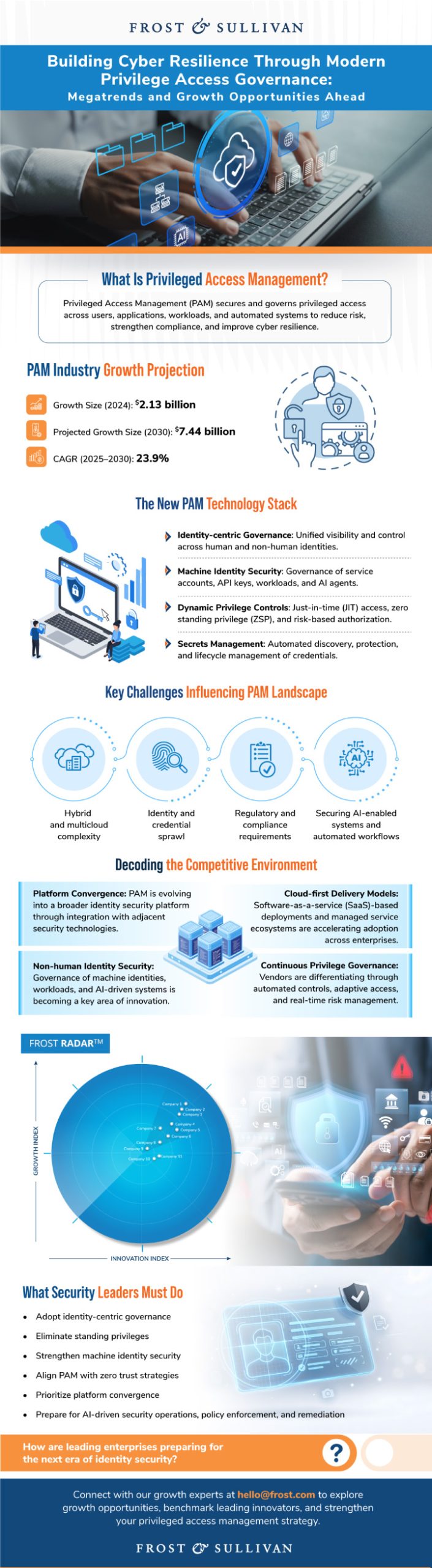
The global Privileged Access Management (PAM) industry is projected to grow from $2.13 billion in 2024 to $7.44 billion by 2030, driven by demand for identity-centric governance, machine identity security, and dynamic privilege controls.
Explore:
- Emerging growth opportunities
- Benchmarking of leading PAM providers
- Key strategic Priorities
Modern PAM platforms are evolving beyond credential vaulting and session monitoring to deliver continuous visibility, risk-based access controls, and governance across both human and non-human identities. As a result, PAM is becoming a foundational component of modern identity security and cyber resilience strategies.
Is your PAM strategy prepared for the future of identity security?
Listen to our podcast episode on growth opportunities transforming the Privileged Access Management Solutions.
Why Organizations Are Adopting Identity-centric Privilege Governance
Historically, PAM solutions focused on protecting privileged accounts through credential vaulting, password rotation, and session monitoring. While these capabilities remain important, today’s enterprise environments are seeking broader governance capabilities.
Organizations are increasingly prioritizing:
- Continuous visibility across privileged identities
- Just-in-time (JIT) access and zero standing privilege (ZSP)
- Governance of machine and non-human identities
- Cloud-native PAM
- Automated policy enforcement and life cycle management
- Risk-based access controls and monitoring
To address these requirements, PAM platforms are integrating identity governance, secrets management, machine identity security, and AI-enabled analytics into their platforms, positioning PAM as a foundational pillar of identity security.
Strategic Imperatives Reshaping Privileged Access Management
Transformative Megatrends
Cloud adoption, automation, AI-driven operations, and the rapid growth of machine identities are expanding the privileged access landscape and accelerating demand for identity-centric governance.
Competitive Intensity
Providers are differentiating through platform convergence, machine identity management, cloud-native architectures, and integrated identity security capabilities.
Disruptive Technologies
Machine identity governance, secrets management, AI-enabled analytics, JIT access, and ZSP are transforming how organizations manage privileged access.
Key Growth Drivers Accelerating PAM Adoption
- Expanding Identity Ecosystems: Organizations are managing growing numbers of human, machine, third-party, and AI-driven identities, increasing the need for centralized governance and visibility.
- Cloud and Hybrid Infrastructure Complexity: Distributed environments require consistent privilege controls across cloud, on-premises, SaaS, and operational technology environments.
- Increasing Focus on Identity Security: Organizations are aligning PAM initiatives with broader zero trust and identity security strategies to reduce attack surfaces and strengthen cyber resilience.
- Demand for Automation and Operational Efficiency: Security teams are adopting automated governance, dynamic access controls, and context-aware, policy-driven workflows to improve efficiency and reduce operational burden.
Growth Opportunities Transforming the PAM Landscape
Identity Security Convergence
Organizations are seeking unified platforms that integrate PAM with identity governance and administration, cloud infrastructure entitlement management, identity threat detection and response, and secrets management. This convergence is creating opportunities to improve governance, visibility, and operational efficiency across increasingly complex environments.
SaaS-driven Expansion
Cloud-native deployment models and managed service offerings are lowering adoption barriers and enabling organizations to accelerate implementation while reducing operational complexity.
Machine and AI Identity Governance
Machine identities, such as service accounts, application programming interface (API) keys, workloads, and AI agents are becoming the fastest-growing segment of the privileged access ecosystem. This shift is driving demand for automated discovery, advanced governance frameworks, secrets management capabilities, policy enforcement, and automated privilege controls.
Leading Innovators Advancing Privileged Access Management
- Palo Alto Networks (formerly CyberArk) continues to expand its identity security vision through machine identity security, secrets management, cloud privilege controls, and AI-focused governance capabilities.
- Delinea emphasizes simplified privilege management, cloud-native delivery models, and adaptive security controls designed to support modern enterprise environments.
- BeyondTrust advances integrated privilege management through endpoint privilege controls, remote access security, and expanded identity security capabilities.
- Saviynt: Saviynt strengthens its position through identity-centric governance, cloud entitlement management, and integrated identity security capabilities.
Download the sample analyses to explore comprehensive benchmarking and innovation leadership across the PAM landscape.
Best Practices for Security Leaders
- Prioritizing platforms that unify privileged access governance across human, machine, and workload identities under a single policy plane through capabilities such as continuous discovery, JIT access, ZSP, and lifecycle management.
- Integrating PAM with identity security, security operations, and compliance workflows to enable continuous monitoring, streamline audits, and improve risk-based decision-making.
- Aligning vendor selection based on cloud and hybrid deployment capabilities, ecosystem integrations, machine identity governance, AI-readiness, and their ability to scale without increasing operational complexity.
Organizations increasingly view PAM as a strategic enabler of identity security, cyber resilience, and digital transformation. As enterprise environments become more automated and interconnected, PAM platforms will play a pivotal role in governing access, reducing risk exposure, and securing human, machine, and AI identities.
Frequently Asked Questions (FAQs)
What is Privileged Access Management (PAM)?
What trends are shaping the future of PAM?
What is the market size of Privileged Access Management (PAM)?
Why are PAM solutions essential for compliance?
How do PAM solutions integrate with an organization's environment?
Ready to Lead the Transformation?
- Book a Growth Strategy Session: Align your growth roadmap with Frost & Sullivan’s visionary Growth Pipeline™ Dialog.
- Engage with Growth Experts: Co-design AI-enabled, data-driven operating models that scale industry-specific and commercial impact.
- Share Your Transformation Story: Position your organization as a transformation leader through Frost & Sullivan’s Transformational Growth Leadership platform.
- Join the Growth Council: Collaborate with industry leaders shaping the future of your ecosystem.
- Nominate for the Best Practices Recognition: Be recognized for excellence in growth strategy, execution, and customer impact.
- Demonstrate Industry Positioning on the Frost Radar™: Benchmark your growth performance and innovation strength against industry competitors.
- Activate Brand & Demand Growth: Accelerate awareness, engagement, and revenue growth through integrated brand and demand generation strategies.