This blog is based on Frost & Sullivan’s latest analysis, “Surface Treatment Chemicals Market, Global, 2025–2032,” authored by Vishwa Parthesh Desai from the Chemicals, Materials, & Nutrition Practice Area.
Executive Summary:
Surface treatment chemicals are transforming advanced manufacturing by enabling electrification, digitalization, and sustainable production. AI-driven process control, multifunctional chemistries, and integrated surface engineering solutions are creating new growth opportunities across EVs, semiconductors, aerospace, and renewable energy, helping manufacturers improve performance, efficiency, resilience, and long-term competitive advantage.
Manufacturing competitiveness depends on an organization’s ability to improve material performance, optimize production efficiency, and meet evolving sustainability requirements. Surface treatment chemicals are playing a significant role in this transformation, enabling manufacturers to address the demands of electrification, advanced materials, digital manufacturing, and increasingly complex production environments.
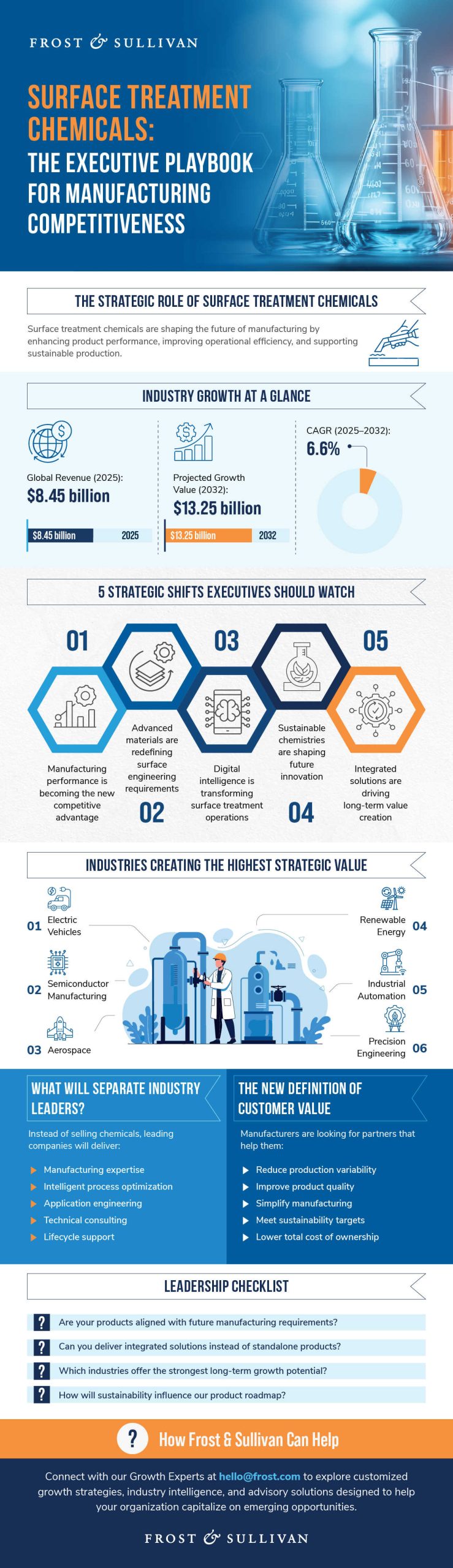
The global surface treatment chemicals industry is projected to grow from $8.45 billion in 2025 to $13.25 billion by 2032, driven by expanding applications across electric vehicles (EVs), semiconductors, renewable energy, aerospace, industrial machinery, and electronics.
Surface Treatment Chemicals: Enabling the Next Wave of Manufacturing Growth
Explore:
- Strategic imperatives
- Technology innovations
- Revenue analysis
- Growth opportunities
Beyond market growth, the industry is evolving toward digitally enabled manufacturing, sustainable chemistries, and integrated surface engineering solutions that are redefining how manufacturers improve quality, operational efficiency, and long-term competitiveness.
Is your organization prepared to capitalize on the growth opportunities reshaping surface engineering?
Key Takeaways
- Digital transformation is redefining surface treatment, with AI, IoT, and automation improving process efficiency, quality, and manufacturing performance.
- Sustainability and electrification are accelerating innovation, driving demand for chromium-free chemistries and advanced solutions for EVs, semiconductors, renewable energy, and aerospace.
- Future growth depends on integrated surface engineering, where manufacturers combine advanced chemistries, digital capabilities, and strategic partnerships to deliver greater value and competitive differentiation.
Tune into our podcast episode on Growth Opportunities in Surface Treatment Chemicals.
What Are Surface Treatment Chemicals?
Surface treatment chemicals are specialized formulations used to improve corrosion resistance, adhesion, conductivity, durability, surface preparation, and overall material performance across metals, plastics, composites, and other industrial substrates. They play a critical role in automotive, aerospace, electronics, semiconductors, renewable energy, and industrial manufacturing by enhancing both production efficiency and product reliability.
How the Surface Treatment Chemicals Value Chain Is Evolving
The surface treatment chemicals value chain is shifting from standalone chemical supply to integrated surface engineering solutions that combine advanced chemistries, automation, digital process control, and technical expertise. Manufacturers are placing greater emphasis on performance, process efficiency, sustainability, and application-specific outcomes, creating new opportunities for value creation across the industry.
Collaboration among chemical manufacturers, equipment suppliers, automation providers, and OEMs is accelerating the development of tailored solutions for EVs, semiconductors, renewable energy, aerospace, and advanced manufacturing.
This evolution is moving the industry beyond traditional product supply toward long-term solution partnerships that integrate chemistry, equipment, digital capabilities, and application expertise to deliver greater customer value.
This integrated approach strengthens innovation, improves operational performance, and supports faster commercialization of next-generation technologies.
Strategic Focus Areas for Industry Leaders
- Strengthen strategic partnerships to accelerate innovation and integrated solutions.
- Scale digital manufacturing through AI, automation, and intelligent process control.
- Expand into high-growth industries including EVs, semiconductors, renewable energy, and aerospace.
- Advance sustainable chemistries to improve compliance and competitive differentiation.
Strategic Imperatives Transforming the Surface Treatment Chemicals Industry
Disruptive Technologies
Digital manufacturing is reshaping surface treatment through AI-enabled process optimization, Internet of Things (IoT)-based monitoring, automation, and predictive analytics. These capabilities improve process control while accelerating formulation development and operational efficiency.
Transformative Megatrends
Sustainability regulations and circular economy initiatives are accelerating the transition toward chromium-free, low-volatile organic compounds (VOCs), water-based, and environmentally compliant chemistries without compromising industrial performance.
Industry Convergence
Chemical manufacturers are evolving into integrated solution providers by combining specialty formulations, process automation, digital monitoring, technical services, and equipment integration to deliver greater customer value.
How will your organization strengthen its competitive position as manufacturing requirements continue to evolve?
Key Challenges Shaping the Surface Treatment Chemicals Industry
Despite strong growth momentum, organizations continue to navigate several structural challenges:
- Environmental regulations driving reformulation and compliance costs
- Raw material price volatility affecting cost structures and profitability
- Lower dosage rates reducing volume growth despite higher-value formulations
- Waste management and metal recovery complexities
- Increasing adoption of alternative technologies such as plasma treatment and physical vapor deposition (PVD) in selected applications
Successfully addressing these challenges will require organizations to balance innovation, sustainability, operational efficiency, and long-term profitability.
Technology Innovations Advancing Surface Engineering
- Digital Process Control: AI, IoT, and automation improve manufacturing visibility, consistency, and productivity.
- Industrial Metal Coatings: Chromium-free and zirconium-based technologies support sustainable manufacturing while maintaining high performance.
- Multi-functional Surface Chemistries: Integrated formulations deliver corrosion protection, adhesion, conductivity, and durability within streamlined manufacturing processes.
- Precision Surface Engineering: Advanced treatment technologies support demanding applications across semiconductors, EV batteries, aerospace, and high-performance industrial systems.
Regional Growth Dynamics of Surface Treatment Chemicals
| Region | Growth Drivers | Key Focus |
| Asia-Pacific | Manufacturing scale, electronics, automotive production | Largest regional market |
| North America | EV production, aerospace, industrial modernization | High-value manufacturing |
| Europe | Sustainability regulations, advanced engineering | Green chemistry innovation |
| India & MEASA | Industrialization, infrastructure, manufacturing expansion | Fastest-growing regional opportunity |
Across regions, investment priorities differ, but the common focus remains improving manufacturing efficiency, sustainability, and competitive differentiation through advanced surface engineering technologies.
Top Growth Opportunities Shaping Surface Treatment Chemicals
Digital Manufacturing and Intelligent Process Control
AI, automation, IoT-enabled monitoring, and predictive analytics are transforming surface treatment processes by improving quality, reducing variability, and enabling data-driven manufacturing.
Multi-functional Surface Treatment Chemistries
Demand is increasing for advanced chemistries capable of protecting multiple substrates while combining corrosion resistance, adhesion, conductivity, and durability within simplified manufacturing processes.
Electrification and Advanced Manufacturing
Electric vehicles, semiconductor fabrication, renewable energy infrastructure, aerospace, and advanced electronics are expanding demand for specialized surface treatment solutions designed for next-generation manufacturing requirements.
The Future of Surface Treatment Chemicals
The future of surface treatment chemicals will be shaped by organizations that combine chemistries with digital capabilities, application expertise, and collaborative innovation.
As electrification, advanced manufacturing, sustainability, and digital transformation continue to converge, surface treatment chemicals will play an increasingly strategic role in improving manufacturing performance, enabling next-generation materials, and supporting industrial competitiveness.
For industry leaders, the opportunity lies in building differentiated solutions that support resilience, accelerate innovation, and capture new growth opportunities across manufacturing industries.
Frequently Asked Questions (FAQs):
1. What are surface treatment chemicals?
Surface treatment chemicals are specialized formulations used to improve corrosion resistance, adhesion, conductivity, durability, and surface preparation across metals, plastics, composites, and other industrial materials.
They play a critical role in improving manufacturing efficiency, extending product life, and enhancing the performance of components used across automotive, aerospace, electronics, renewable energy, and industrial manufacturing.
2. How large is the advanced surface treatment chemical market?
The global surface treatment chemicals market is valued at $8.45 billion in 2025 and is projected to reach $13.25 billion by 2032, growing at a CAGR of 6.6%.
3. What are the latest advancements in surface treatment technologies?
Latest surface treatment technologies combine digital manufacturing, intelligent process control, multifunctional chemistries, and sustainable formulations. These innovations are improving industrial metal coating processes by enhancing manufacturing efficiency, corrosion protection, and surface performance across industrial applications.
They also enable greater process consistency, predictive quality management, and improved resource utilization across increasingly automated manufacturing environments.
4. How can manufacturers improve the durability and reliability of metal components?
Manufacturers can improve durability and reliability by adopting surface treatment solutions that enhance corrosion resistance, adhesion, wear protection, and conductivity. Modern corrosion protection technologies help extend component life, reduce maintenance, and improve performance across industrial applications.
Advanced formulations also support lightweight materials, improved energy efficiency, and longer product lifecycles across high-performance manufacturing sectors.
5. How do surface treatment chemicals support EV manufacturing?
Surface treatment chemicals enhance corrosion protection, battery component performance, lightweight material compatibility, and durability, supporting the reliability and longevity of EV systems.
They also improve thermal management, electrical conductivity, and the long-term performance of battery systems and lightweight vehicle components.
6. Which industries create the greatest demand for surface treatment chemicals?
Surface treatment chemicals are widely used across automotive, aerospace, electronics, semiconductors, renewable energy, industrial equipment, construction, and general manufacturing. Demand continues to grow as these industries invest in electrification, advanced materials, automation, and sustainable manufacturing practices.
Ready to Lead the Transformation?
- Schedule a Growth Strategy Dialog: Align your growth roadmap with Frost & Sullivan’s Visionary Growth Pipeline™ Dialog.
- Engage with Growth Experts: Co-design AI-enabled, data-driven operating models that scale industry-specific and commercial impact.
- Showcase Your Transformational Leadership: Position your organization as a transformation leader through Frost & Sullivan’s Transformational Growth Leadership platform.
- Join the Growth Council: Collaborate with industry leaders shaping the future of your ecosystem.
- Explore Best Practices Recognition: Be recognized for excellence in growth strategy, execution, and customer impact.
- Benchmark Your Industry Positioning on the Frost Radar™: Benchmark your growth performance and innovation strength against industry competitors.
- Tell Your Story: Accelerate awareness, engagement, and revenue growth through integrated brand and demand generation strategies.