This blog is based on the analysis titled, Global Megatrends for the Next Decade, authored by Frost & Sullivan’s growth expert, Sukriti Mahna, and lead analyst Siddharth Dhamija from the Megatrends team.
What’s Happening in the Global Growth Environment?
The global growth environment is becoming more interconnected, but also more fragmented. Emerging economies are gaining influence, regional blocs are strengthening, and institutions are adapting to a world that is becoming more multi-polar. Governments are increasingly relying on artificial intelligence to support public services and policy delivery. Energy systems are being redesigned around resilience, local control, and lower emissions. At the same time, younger generations are bringing new expectations around flexibility, transparency, learning, and purpose into the mainstream.
Unlock Growth Pathways from Global Megatrends
- Explore the structural shifts reshaping growth over the next decade
- Track the megatrends influencing trade, governance, energy, and workforce change
- Understand the themes redefining long-term competitiveness across industries
Together, these shifts are creating a business environment in which growth pathways are becoming less linear and more regionally nuanced. Strategic planning is becoming more front-loaded, investment decisions are carrying longer implications, and operating models are being tested by overlapping technological, social, and geopolitical change.
How are these forces influencing your organization’s next phase of growth?
How the Megatrends Are Being Identified
Frost & Sullivan is identifying the global megatrends shaping the next decade through a structured research approach combining macroeconomic and demographic analysis, PESTLE (Political, Economic, Social, Technological, Legal, and Environmental) analysis, published research, client engagements, and interviews with business leaders and futurists. Past megatrend research, expert discussions, and partner roundtables are further refining the final trends, creating a forward-looking view of the structural shifts influencing growth, strategy, and transformation.
Megatrend 1: Rise of a Multi-polar World Order
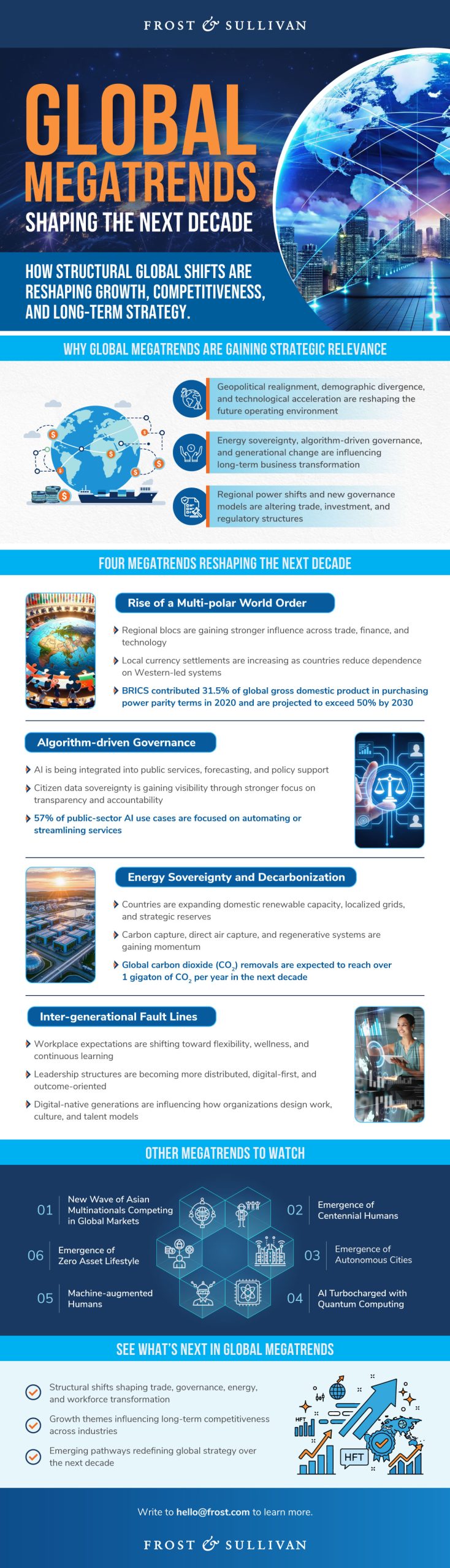
The global balance of power is shifting from a United States-led unipolar structure toward a more distributed world shaped by regional blocs and rising powers such as China, India, and countries across the Global South. This transition is influencing trade, investment, governance, and technology alignment across regions.
What’s Changing
- Regional alliances are gaining stronger influence across trade, finance, and technology.
- Local currency settlements are increasing as countries reduce dependence on Western-led financial systems.
- Alternative governance and security frameworks are emerging across a more fragmented global environment.
Impact in the next decade:
Growth Lens: |
Megatrend 2: Algorithm-driven Governance
Governments are increasingly integrating artificial intelligence systems to support decision-making, optimize public services, and shape more adaptive governance models. As digital democracies are evolving, institutions are relying more on algorithmic intelligence, while citizens are placing greater emphasis on transparency, accountability, and control over personal data.
What’s Changing
- AI is being embedded into public services, forecasting, and policy support functions.
- Citizen data sovereignty is gaining visibility through stronger focus on consent, transparency, and accountable digital systems.
- New governance frameworks are emerging around algorithm audits, risk classification, and institutional oversight.
Impact in the next decade
Growth Lens: |
Megatrend 3: Energy Sovereignty and Decarbonization
Energy sovereignty and decarbonization are converging as countries are prioritizing domestically controlled energy systems while accelerating carbon reduction and regenerative solutions. As geopolitical tensions and climate pressures are intensifying, nations are building more resilient, low-carbon energy ecosystems that reduce external dependence.
What’s Changing
- Countries are expanding domestic renewable capacity, localized grids, and strategic energy reserves.
- Carbon capture, utilization, and storage, direct air capture, and regenerative economic models are gaining momentum.
- Nuclear pathways, including small and micro reactors, are re-entering long-term energy discussions.
Impact in the next decade
Growth Lens: |
Megatrend 4: Inter-generational Fault Lines to Reshape Policy, Businesses, and More
A new generation of leadership is bringing digital-native thinking, ethical consciousness, and purpose-driven decision-making into mainstream organizational structures. Generational shifts are influencing how companies are innovating, attracting talent, designing workplaces, and responding to broader social and cultural change.
What’s Changing
- Technology democratization is enabling smaller teams to build, prototype, and scale ideas more quickly.
- Workplace expectations are shifting toward flexibility, wellness, transparency, and impact-driven roles.
- Learning models are moving from degree-led progression toward continuous, personalized upskilling.
Impact in the next decade:
Growth Lens: |
What Is This Signaling for Strategy Leaders?
- Strategic planning is becoming more front-loaded as convergence is increasing the cost and complexity of delayed response.
- Technology integration is accelerating as digital systems, intelligent platforms, and automation are becoming more central to growth models.
- Product and service design is evolving alongside demographic change, generational shifts, and rising expectations around flexibility and relevance.
- Sustainability integration is becoming more embedded in operations as resilience, energy transition, and circularity gain stronger strategic relevance.
- Strategic alliances are becoming more important as regional supply networks, technology ecosystems, and collaborative partnerships are strengthening long-term resilience.
The decade ahead is redefining how growth is being shaped, how competitiveness is being built, and how future readiness is being evaluated.
Is your organization aligning with the structural shifts redefining growth across the global economy?
FAQs: Global Megatrends Shaping the Next Decade
- What are global megatrends and why are they important for business strategy?
Global megatrends are large-scale structural shifts shaping business, society, technology, and policy over the long term. They are important for business strategy because they are influencing growth pathways, competitive positioning, investment priorities, and future operating environments across industries. - How are global megatrends reshaping growth in the next decade?
Global megatrends are reshaping growth by altering trade dynamics, accelerating artificial intelligence adoption, transforming energy systems, and changing workforce and consumer expectations. These shifts are influencing how organizations are planning, innovating, and positioning for long-term relevance. - Which megatrends are expected to have the biggest impact on industries in the next decade?
Some of the most influential megatrends shaping the next decade include the rise of a multi-polar world order, algorithm-driven governance, energy sovereignty and decarbonization, and inter-generational shifts in leadership and workforce behavior. These trends are affecting trade, regulation, talent models, infrastructure, and long-term competitiveness. - How can organizations track megatrends shaping future growth?
Organizations are tracking megatrends through structured research, macroeconomic and demographic analysis, technology monitoring, and ongoing evaluation of geopolitical, regulatory, and social change. This approach is helping leaders identify early signals of transformation and understand how structural shifts are influencing future growth.
Ready to Lead the Technology Transformation?
- Book a Growth Strategy Session: Align your growth roadmap with Frost & Sullivan’s visionary Growth Pipeline™ Dialog.
- Engage with Growth Experts: Co-design AI-enabled, data-driven operating models that scale industry-specific and commercial impact.
- Share Your Transformation Story: Position your organization as a transformation leader through Frost & Sullivan’s Transformational Growth Leadership platform.
- Join the Growth Council: Collaborate with industry leaders shaping the future of your ecosystem.
- Nominate for the Best Practices Recognition: Be recognized for excellence in growth strategy, execution, and customer impact.
- Demonstrate Industry Positioning on the Frost Radar™: Benchmark your growth performance and innovation strength against industry competitors.
- Activate Brand & Demand Growth: Accelerate awareness, engagement, and revenue growth through integrated brand and demand generation strategies.