This blog is based on the analysis titled, “Next-generation Sensing Trends & Technologies for Security Applications,” authored by Frost & Sullivan’s growth expert, Varun Babu, and lead analyst, Ashish Anil Kaul, from the TechVision—Sensors & Instrumentation team.
Executive Summary
The convergence of advanced sensing, AI-driven analytics, and connected infrastructure is accelerating the transition toward intelligent security ecosystems. Hyperspectral imaging, thermal and LWIR sensors, quantum imaging, and event-based cameras are improving threat detection, surveillance accuracy, and operational responsiveness. These advancements are creating business opportunities in AI-powered threat intelligence, green cybersecurity infrastructure, and digital twin security simulation, enabling organizations to reduce security risks, improve operational efficiency, and develop scalable security services.
Key Takeaways
- Advanced Sensing Technologies: Hyperspectral imaging, thermal and long-wave infrared (LWIR) sensors, quantum imaging, and event-based cameras are strengthening threat detection across physical security environments.
- Hyperconnected Security Ecosystems: The convergence of intelligent sensors, artificial intelligence (AI) analytics, and secure communications is enabling predictive threat management and coordinated security responses.
- Emerging Business Models: AI-powered threat intelligence platforms and subscription-based security services are creating new revenue opportunities.
- Sustainable Security Infrastructure: Energy-efficient computing, lightweight encryption, and edge AI are supporting lower operational costs and greener security architectures.
- Predictive Security Planning: Digital twin platforms are improving security simulation, infrastructure resilience, and preparedness for potential disruptions.
What Are Next-generation Sensing Technologies for Security Applications?
Next-generation sensing technologies are advanced imaging and detection systems that capture, process, and interpret environmental information to identify potential security threats. These technologies include hyperspectral imaging, thermal and LWIR sensors, quantum imaging, and event-based cameras.
When integrated with AI, Internet of Things (IoT) networks, and secure communication architectures, these technologies are enabling hyperconnected secure ecosystems capable of real-time monitoring, predictive risk assessment, and automated security responses across critical infrastructure, defense, industrial facilities, and smart cities.
Why Is Intelligent Security Becoming a Strategic Priority?
Security requirements are evolving as rapid urbanization, expanding digital infrastructure, and rising cyber threats are increasing the complexity of protecting physical and digital assets. According to the United Nations, 68% of the global population is projected to live in urban areas by 2050, while Cybersecurity Ventures estimated global cybercrime costs at $10.5 trillion in 2025. Traditional surveillance and security systems are facing growing limitations in detecting sophisticated threats, managing interconnected infrastructure, and responding to incidents in real time. Organizations are increasingly exploring advanced sensing technologies and AI-powered security platforms to improve situational awareness, reduce operational vulnerabilities, and strengthen resilience.
Where Are the Next Growth Opportunities in Intelligent Security?
As advanced sensing technologies are reshaping security ecosystems, new opportunities are emerging across AI-powered threat intelligence, intelligent surveillance, and predictive security platforms.
Explore Frost & Sullivan’s growth opportunity analysis to identify emerging technologies, commercialization pathways, and strategic imperatives.
This shift is accelerating the development of hyperconnected secure ecosystems, where next-generation imaging, intelligent analytics, and secure communication networks are working together to enable predictive threat detection and coordinated security responses. For technology providers, infrastructure operators, and security solution developers, these developments are opening new opportunities across intelligent surveillance, integrated security platforms, and emerging Security-as-a-Service models.
How Are Emerging Sensing Technologies Reshaping the Future of Intelligent Security?
Listen to our Growth Podcast exploring emerging sensing technologies and security innovations.
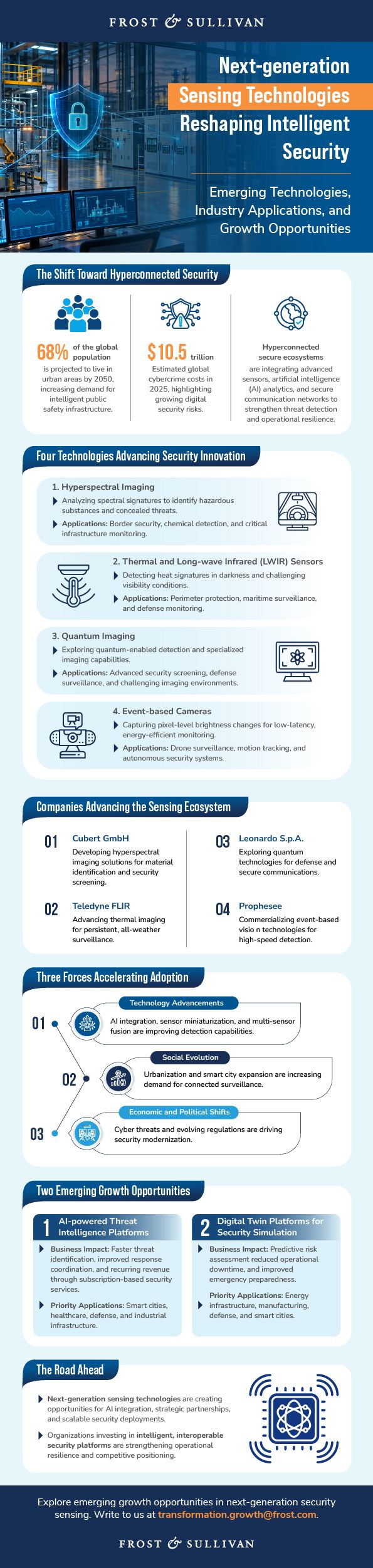
Megatrends Accelerating the Shift Toward Intelligent Security
The global security landscape is evolving as technological advancements, urbanization, and increasing cyber-physical threats are reshaping how organizations protect people, assets, and critical infrastructure. These developments are accelerating the transition toward hyperconnected secure ecosystems, where advanced sensing, AI-powered analytics, and secure communication networks are enabling more proactive security operations.
Three megatrends are influencing technology adoption, investment priorities, and emerging growth opportunities.
- Technology Advancements: Enabling Predictive and Autonomous Security: Advances in hyperspectral imaging, thermal sensing, quantum imaging, and event-based vision are expanding the capabilities of conventional surveillance systems. When integrated with AI and IoT platforms, these technologies are improving threat identification, enabling continuous monitoring, and supporting faster responses across complex security environments.
Business Impact: For technology providers, this convergence is creating opportunities to develop integrated sensing platforms, edge AI solutions, and intelligent surveillance systems that address increasingly sophisticated security requirements.
- Social Evolution: Expanding Demand for Connected Security Infrastructure: Rapid urbanization, smart city development, and growing reliance on digital identity systems are increasing demand for scalable security infrastructure. Public authorities and infrastructure operators are exploring connected surveillance networks, biometric authentication, and automated monitoring to strengthen public safety and operational efficiency.
Business Impact: This shift is creating growth opportunities across smart city security, identity management, and integrated public safety platforms, particularly as organizations are prioritizing interoperability and real-time situational awareness.
- Economic and Political Shifts: Strengthening Security Resilience and Compliance: Escalating cyber threats, geopolitical uncertainty, and evolving data protection requirements are influencing security investments across government, defense, and critical infrastructure sectors. Organizations are increasingly seeking solutions that combine physical threat detection with cybersecurity, regulatory compliance, and infrastructure resilience.
Business Impact: These developments are accelerating demand for cyber-physical security integration, secure sensing architectures, and subscription-based security services, creating new opportunities for technology providers and system integrators.
Frost & Sullivan Perspective
The convergence of these megatrends is shifting competitive advantage toward interoperable, AI-enabled, and scalable security platforms. Organizations aligning sensing innovation with evolving security requirements and strategic ecosystem partnerships are strengthening their ability to capture growth across the global security landscape.
Four Emerging Sensing Technologies Transforming Security Applications
Advances in imaging, sensor miniaturization, and AI-driven analytics are expanding the capabilities of intelligent security systems. From detecting concealed threats to enabling high-speed surveillance, next-generation sensing technologies are improving situational awareness and creating new opportunities across defense, critical infrastructure, and public safety.
- Hyperspectral Imaging: Strengthening Material Identification and Threat Detection: Hyperspectral imaging is enabling security systems to analyze detailed spectral signatures, identifying materials and substances that conventional imaging technologies may struggle to distinguish. Advances in compact sensors, AI-powered classification, and multi-sensor integration are expanding applications across border security, hazardous material detection, and critical infrastructure monitoring.
Growth Potential: Demand for precise threat identification is creating opportunities for compact hyperspectral cameras, automated screening systems, and integrated surveillance platforms.
- Thermal and LWIR Sensors: Advancing Continuous Security Monitoring: Thermal and LWIR sensors are strengthening surveillance capabilities by detecting heat signatures in darkness and challenging visibility conditions. Developments in compact thermal imaging modules, edge AI, and intelligent sensor integration are improving perimeter protection, border monitoring, and autonomous surveillance.
Growth Potential: Increasing demand for persistent monitoring is accelerating opportunities in energy-efficient thermal sensors, intelligent perimeter security, and integrated defense surveillance systems.
- Quantum Imaging: Expanding Specialized Security Detection: Quantum imaging technologies are exploring new approaches to capturing and processing visual information using quantum properties of light. Research advancements are opening possibilities for specialized security screening, imaging in challenging environments, and defense applications requiring enhanced detection capabilities.
Growth Potential: Continued innovation in quantum sensing and computational imaging is creating longer-term opportunities for specialized imaging platforms, research partnerships, and advanced defense technologies.
- Event-based Cameras: Enabling High-Speed, Low-power Surveillance: Event-based cameras are transforming conventional imaging by capturing changes in pixel brightness rather than recording complete image frames. This approach is enabling low-latency visual processing while reducing redundant data generation, making it valuable for rapidly changing security environments.
Growth Potential: Integration with edge AI, autonomous drones, and intelligent surveillance platforms is creating opportunities for real-time threat detection, motion tracking, and energy-efficient security systems.
Which emerging sensing technologies are creating the greatest opportunities for growth across intelligent security applications?
Companies to Action: Innovators Advancing Next-Generation Security Sensing
The competitive landscape for intelligent security sensing is evolving as established technology providers and emerging innovators are advancing specialized imaging, AI-powered analytics, and intelligent sensor integration. Their innovations are creating opportunities across defense, border security, critical infrastructure, and autonomous surveillance.
|
Company |
Technology Innovation & Application |
Business Impact |
|
|
Snapshot hyperspectral cameras and AI-assisted spectral analysis for hazardous material detection, border monitoring, and defense surveillance. |
Improving threat identification accuracy and enabling faster security assessments. |
|
|
Compact thermal imaging modules, intelligent surveillance payloads, and edge AI integration for perimeter and all-weather monitoring. |
Strengthening continuous surveillance, reducing manual monitoring requirements, and improving operational responsiveness. |
|
|
Quantum-enabled sensing research and secure communication technologies for defense and critical infrastructure applications. |
Supporting advanced detection capabilities, secure information exchange, and long-term infrastructure resilience. |
|
|
Neuromorphic vision sensors and Metavision software for high-speed motion detection, autonomous systems, and intelligent surveillance. |
Enabling low-latency threat recognition, reducing data processing requirements, and improving energy efficiency. |
|
Frost & Sullivan Perspective: Competitive differentiation is increasingly depending on AI integration, real-time processing, and scalable sensing platforms, creating opportunities for strategic partnerships and commercialization. |
||
Which technology innovators and strategic partnerships are best positioned to accelerate the commercialization of next-generation security sensing solutions?
Top 2 Growth Opportunities in Next-generation Security Sensing
The convergence of advanced sensing, AI-driven analytics, and connected infrastructure is creating opportunities for scalable security platforms and predictive threat management.
- AI-powered Threat Intelligence Platforms: Growing security complexity and fragmented monitoring systems are accelerating demand for unified platforms that integrate sensor data, AI analytics, and real-time threat intelligence.
- Business Impact: Improving threat detection, reducing response times, and strengthening operational resilience.
- Growth Potential: Subscription-based Threat Intelligence-as-a-Service models are creating recurring revenue opportunities across smart cities, defense, healthcare, and industrial infrastructure.
- Digital Twin Platforms for Security Simulation: Increasing interdependencies across critical infrastructure are driving demand for digital environments that simulate security threats, operational disruptions, and potential system failures.
- Business Impact: Improving risk preparedness, reducing operational downtime, and supporting proactive security planning.
- Growth Potential: AI-powered simulation platforms are opening opportunities across smart cities, industrial facilities, energy infrastructure, and defense.
The Road Ahead: Building Intelligent and Resilient Security Ecosystems
Next-generation sensing technologies are accelerating the transition toward predictive, interconnected, and AI-enabled security ecosystems. As organizations are prioritizing threat detection and infrastructure resilience, three strategic priorities are shaping future growth:
- Scalable Security Platforms: Integrating advanced sensing and AI analytics to strengthen security across smart cities and critical infrastructure.
- Regulatory Readiness: Adapting security solutions to evolving data protection requirements and regional compliance frameworks.
- Innovative Business Models: Expanding subscription-based security services and automated compliance solutions to create recurring revenue opportunities.
Organizations aligning technology innovation, regulatory adaptability, and strategic partnerships are strengthening their competitive positioning while unlocking new pathways for sustainable growth.
Ready to Lead the Transformation?
- Schedule a Growth Strategy Dialog: Align your growth roadmap with Frost & Sullivan’s Visionary Growth Pipeline™ Dialog.
- Engage with Growth Experts: Co-design AI-enabled, data-driven operating models that scale industry-specific and commercial impact.
- Showcase Your Transformational Leadership: Position your organization as a transformation leader through Frost & Sullivan’s Transformational Growth Leadership platform.
- Join the Growth Council: Collaborate with industry leaders shaping the future of your ecosystem.
- Explore Best Practices Recognition: Be recognized for excellence in growth strategy, execution, and customer impact.
- Benchmark Your Industry Positioning on the Frost Radar™: Benchmark your growth performance and innovation strength against industry competitors.
- Tell Your Story: Accelerate awareness, engagement, and revenue growth through integrated brand and demand generation strategies.
Frequently Asked Questions (FAQs)
1. What are next-generation sensing technologies for security applications?
Next-generation sensing technologies are advanced imaging and detection systems that are improving threat identification, surveillance, and situational awareness. Key technologies include hyperspectral imaging, thermal and LWIR sensors, quantum imaging, and event-based cameras. Their integration with AI and connected infrastructure is enabling more intelligent and responsive security operations.
2. How are next-generation sensing technologies transforming security systems?
Advanced sensing technologies are enabling real-time threat detection, predictive monitoring, and automated security responses. By combining sensor data with AI-driven analytics and secure communication networks, organizations are improving surveillance accuracy, reducing response times, and strengthening security across interconnected environments.
3. What are the key applications of hyperspectral imaging in security?
Hyperspectral imaging is supporting hazardous material identification, chemical threat detection, border surveillance, and critical infrastructure protection. Its ability to analyze detailed spectral signatures is enabling security systems to distinguish materials that conventional imaging technologies may struggle to identify.
4. How are thermal and LWIR sensors improving security surveillance?
Thermal and long-wave infrared (LWIR) sensors are enabling continuous monitoring by detecting heat signatures in darkness and challenging visibility conditions. These capabilities are strengthening perimeter protection, border security, maritime surveillance, and autonomous monitoring, particularly when integrated with AI-powered analytics.
5. What role are quantum imaging and event-based cameras playing in intelligent security?
Quantum imaging is opening possibilities for specialized detection and advanced security screening, while event-based cameras are enabling high-speed, low-latency monitoring with reduced data processing requirements. Both technologies are creating opportunities for next-generation surveillance, defense applications, and intelligent security platforms, although their commercialization pathways differ.
6. What are hyperconnected secure ecosystems?
Hyperconnected secure ecosystems are integrated security environments combining advanced sensors, AI analytics, IoT networks, and secure communication infrastructure. These interconnected systems are enabling coordinated threat detection, predictive risk assessment, and faster security responses across smart cities, industrial facilities, and critical infrastructure.
7. What are the leading growth opportunities in next-generation security sensing?
Two emerging growth opportunities are AI-powered threat intelligence platforms and digital twin platforms for security simulation. AI-driven platforms are improving threat analysis and enabling subscription-based security services, while digital twins are supporting predictive risk assessment, emergency preparedness, and infrastructure resilience.
8. How can organizations capitalize on growth opportunities in intelligent security?
Organizations are strengthening their competitive positioning by prioritizing AI-enabled sensing integration, interoperable security platforms, regulatory readiness, and strategic technology partnerships. Scalable security services and emerging subscription-based business models are also creating opportunities for recurring revenue and long-term growth.