This blog is based on the analysis titled, Bio-identical Actives in Cosmetics via Biotechnological Processes, authored by Frost & Sullivan’s Chemicals & Advanced Materials growth expert, Abhishek Paul Choudhury, from the TechVision team.
Bio-identical cosmetic actives are redefining how the beauty industry develops high-performance, sustainable, and science-led ingredients. Enabled by synthetic biology, precision fermentation, cell-free biomanufacturing, and AI-powered molecule discovery, these technologies are producing targeted ingredients such as recombinant collagen, designer peptides, microbial postbiotics, and fermentation-derived lipids. As brands seek cleaner formulations, traceable sourcing, and next-generation efficacy, bio-identical actives are gaining traction across skincare, dermocosmetics, and hybrid beauty-wellness applications.
This innovation wave is advancing cosmetics even further by reducing dependence on animal-derived and petrochemical inputs while improving consistency, scalability, and functional performance. New breakthroughs ranging from AI-designed peptides to extremophile-derived ultraviolet (UV) filters are expanding formulation possibilities and accelerating product differentiation. With patent activity, scientific research, and cross-disciplinary collaboration rising globally, the competitive race to lead biotech-driven beauty is intensifying.
Unlock Growth Opportunities in Biotech Beauty
Gain clarity on the forces reshaping cosmetic ingredient innovation with Frost & Sullivan’s analysis on bio-identical cosmetic actives. This outlook offers:
- Key biotechnology trends transforming beauty ingredients
• Opportunities across peptides, lipids, postbiotics, and sustainable actives
• Competitive momentum and commercialization pathways
• Strategic priorities for brands and suppliers
Download the analysis to see how biotech ingredients are shaping future beauty growth
Do you have the strategic frameworks to identify where bio-identical cosmetic actives will create the strongest competitive advantage across your innovation pipeline?
Listen to the Growth Podcast on how bio-identical actives are reshaping beauty innovation.
The Impact of the Top 3 Strategic Imperatives on Bio-identical Cosmetic Actives
- Transformative Megatrends: Sustainable and Transparent Beauty Demand
Consumer preferences are shifting toward wellness, safety, and environmentally responsible beauty products. Brands are responding by reformulating portfolios with ingredients that offer traceability, ethical sourcing, and proven efficacy.
- Rising demand for clean-label and science-backed beauty products
- Greater focus on ingredient transparency and product safety
- Reduced dependence on traditional animal- and petro-derived inputs
- Stronger adoption across skincare, dermocosmetics, and hybrid wellness categories
- Disruptive Technologies: AI and Biotech-led Ingredient Innovation
Artificial intelligence (AI), precision fermentation, and cell-free biomanufacturing are accelerating how cosmetic actives are discovered and produced. These technologies enable faster development cycles and highly targeted ingredient performance.
- AI-driven molecule discovery identifying next-generation actives
- Precision fermentation enabling scalable ingredient production
- Recombinant collagen, designer peptides, and microbial postbiotics gaining traction
- Lower development barriers and faster commercialization pathways
- Industry Convergence: Where Beauty Meets Biotechnology
Bio-identical actives are emerging through the convergence of biotechnology, cosmetics, dermatology, and engineering. This intersection is unlocking ingredients previously limited by cost, sourcing, or formulation complexity.
- Cross-disciplinary innovation accelerating product development
- New UV filters, peptides, and microbiome-support ingredients entering pipelines
- Scientific breakthroughs converting into consumer-ready applications
- New business models forming across ingredient suppliers and beauty brands
Is your beauty innovation strategy aligned with the technologies shaping the next generation of cosmetic actives?
Growth Drivers Accelerating Bio-identical Cosmetic Actives Adoption
- Clean, Sustainable, Vegan Demand: Reshaping Ingredient Preferences
Bio-identical actives align with rising demand for clean beauty, sustainability, and ethical sourcing. As consumers and brands move away from animal-derived and petrochemical ingredients, biotech-enabled alternatives are gaining stronger commercial traction across premium beauty categories. - Corporate Net-zero and ESG Goals: Driving Strategic Ingredient Shifts
Beauty companies are under increasing pressure to reduce carbon emissions, water intensity, and environmental footprint. Biotechnological production pathways can support lower-impact sourcing models and strengthen ESG (Environmental, Social, and Governance) performance targets. - Regulatory Focus on Traceability and Safer Inputs: Accelerating Transition
Governments and regulators are placing greater emphasis on traceability, ingredient transparency, and sustainable compliance. Bio-identical actives offer controlled production routes that can better meet evolving global standards than conventional extraction models.
Is your ingredient strategy aligned with the sustainability expectations shaping future beauty demand?
|
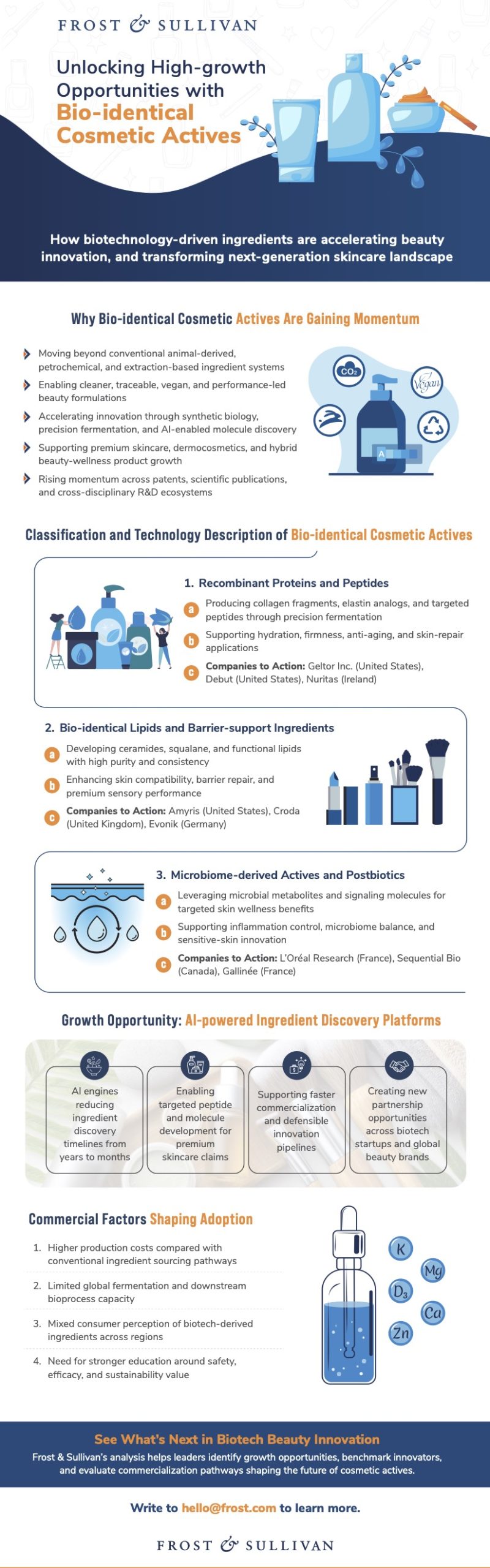
Emerging Bio-identical Cosmetic Active Categories
Which ingredient category could create the strongest differentiation in your next beauty launch? |
|
Growth Challenges Affecting Commercial Scale-up
- High Production Costs: Slowing Wider Adoption
Biotechnological manufacturing can remain more expensive than traditional solvent extraction for several ingredients. Investment requirements for bioreactors, cleanroom systems, utilities, and purification processes continue to create cost barriers for rapid scale-up. - Limited Fermentation and Bioprocess Capacity: Constraining Supply
Global industrial biotechnology capacity for cosmetic ingredients is still developing. Limited large-scale fermentation and downstream processing infrastructure can restrict availability of certain next-generation actives. - Consumer Perception of Lab-grown Ingredients: Creating Adoption Gaps
Some consumers may associate biotech-derived ingredients with synthetic or unnatural products. Clear education, transparent branding, and science-backed communication will be essential to improving trust and accelerating mainstream acceptance.
How quickly can your business overcome scale, cost, and perception barriers to lead the next wave of beauty innovation?
|
Companies to Action Leading Commercialization Momentum
Which innovators should be on your radar as biotech beauty ingredients move into mainstream commercialization? |
Key Growth Opportunities Transforming Bio-identical Cosmetic Actives
- AI-powered Discovery Platforms for Novel Peptides and Actives: AI and machine learning are accelerating ingredient discovery by analyzing complex molecular datasets and identifying targeted peptides, proteins, and bio-identical actives faster than traditional research methods. This is shortening development timelines and enabling precision-led beauty innovation.
- Cell-free Biomanufacturing for On-demand Active Production: Cell-free production systems are creating new pathways for rapid, flexible, and highly controlled manufacturing of cosmetic ingredients. These platforms can reduce waste, improve purity, and support faster commercialization of complex molecules that are difficult to source conventionally.
- Microbiome-derived Signaling Molecules for Next-generation Skincare: Advances in microbiome science are unlocking metabolites, peptides, and signaling molecules that support barrier repair, inflammation control, pigmentation balance, and skin harmony. This category is emerging as a high-potential frontier for science-backed skincare differentiation.
Frequently Asked Questions
- What are bio-identical cosmetic actives?
Bio-identical cosmetic actives are ingredients developed to closely replicate naturally occurring molecules found in the skin, plants, or biological systems. They are often produced through biotechnology methods such as precision fermentation, synthetic biology, and cell-free biomanufacturing to deliver targeted performance, consistency, and sustainability benefits.
- Why are bio-identical actives gaining popularity in cosmetics?
They are gaining traction because beauty brands and consumers increasingly value clean formulations, traceable sourcing, vegan alternatives, and science-backed efficacy. These ingredients can also reduce reliance on animal-derived and petrochemical inputs while supporting premium product innovation.
- How is biotechnology used in cosmetic ingredient development?
Biotechnology enables the creation of advanced ingredients through methods such as fermentation, enzyme engineering, microbial cultivation, and artificial intelligence-led molecule discovery. These approaches help brands develop collagen alternatives, peptides, lipids, antioxidants, and other next-generation actives more efficiently.
- What are the biggest growth opportunities in bio-identical cosmetic actives?
High-potential opportunities include AI-powered ingredient discovery, cell-free manufacturing platforms, microbiome-derived actives, sustainable lipids, recombinant proteins, and advanced anti-aging ingredients. These areas are expected to shape the next phase of innovation across skincare, dermocosmetics, and wellness beauty categories.
Ready to Lead the Transformation?
- Book a Growth Strategy Session: Align your growth roadmap with Frost & Sullivan’s visionary Growth Pipeline™ Dialog.
- Engage with Growth Experts: Co-design AI-enabled, data-driven operating models that scale industry-specific and commercial impact.
- Share Your Transformation Story: Position your organization as a transformation leader through Frost & Sullivan’s Transformational Growth Leadership platform.
- Join the Growth Council: Collaborate with industry leaders shaping the future of your ecosystem.
- Nominate for the Best Practices Recognition: Be recognized for excellence in growth strategy, execution, and customer impact.
- Demonstrate Industry Positioning on the Frost Radar™: Benchmark your growth performance and innovation strength against industry competitors.
- Activate Brand & Demand Growth: Accelerate awareness, engagement, and revenue growth through integrated brand and demand generation strategies.