This blog is based on Frost & Sullivan’s “Top Growth Opportunities in Next-generation Robotics,” built from three Technology Opportunity Engine analyses. Developed by Frost & Sullivan’s growth expert, Varun Babu, from the TechVision Advanced Manufacturing and Automation team.
Tune in to the Growth Podcast for expert perspectives on next-generation robotics.
Next-generation robotics is moving from fixed automation to adaptive, intelligent systems across dynamic environments.
What’s In It for You?
- Key megatrends in cognitive robotics, AI inspection, and precision automation
- Growth opportunities across flexible and scalable robotics platforms
- Strategic considerations for deploying next-generation automation
Access the sample whitepaper on Next-Generation Robotics and Autonomous Manufacturing
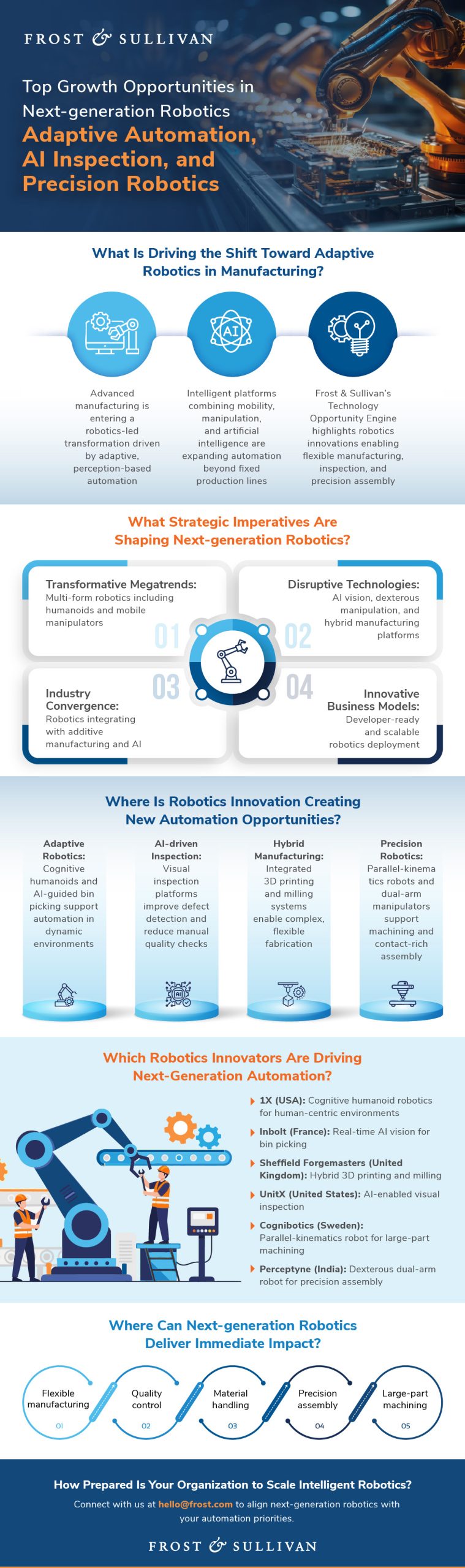
Technology Shifts Driving Next-generation Robotics Adoption
- Cognitive Robotics and Adaptive Manipulation: Cognitive humanoids and AI-guided bin picking systems are enabling automation in dynamic environments. These platforms combine real-time perception, safe interaction, and flexible manipulation to support home assistance and industrial handling workflows.
- Hybrid Manufacturing and Intelligent Inspection: Hybrid three-dimensional (3D) printing and milling systems, along with AI-enabled visual inspection, are improving manufacturing flexibility and quality control. These solutions reduce manual intervention while supporting complex production environments.
- Precision Robotics and Dexterous Automation: Parallel-kinematics robots and dual-arm manipulators are enabling high-precision machining and contact-rich assembly. These systems combine rigid architectures, dynamic motion control, and perception-driven manipulation for complex automation tasks.
How is your organization aligning robotics investments with adaptive automation and precision manufacturing?
From Fixed Automation to Adaptive Robotics Platforms
Automation is shifting toward robotics platforms that combine perception, manipulation, and mobility. Cognitive humanoids enable human-centric assistance, AI vision improves bin picking and inspection, and hybrid manufacturing with dexterous manipulators supports precision production.
These developments are expanding automation into dynamic environments and high-variability workflows. Three robotics opportunity areas are emerging as central to this transition: adaptive robotics, intelligent manufacturing and inspection, and precision automation platforms.
- Adaptive Robotics for Dynamic Environments
Cognitive robotics and AI-guided perception are enabling automation in environments where variability, object randomness, and human interaction have limited traditional robotics deployment. These platforms combine real-time perception, adaptive manipulation, and safe interaction to support home assistance and industrial handling workflows.
- 1X (USA): Cognitive Robotics for Human-centric Environments
- Full-body humanoid designed for multi-task assistance in dynamic indoor settings
- Multi-modal perception integrating vision, audio, and contextual memory
- Human-in-the-loop teleoperation enables rapid task learning and adaptation
- Soft-compliance actuation improves safe interaction with people and objects
- Inbolt (France): Real-time AI-Guided Manipulation for Bin Picking
- Robot-mounted 3D perception for unstructured picking environments
- Closed-loop grasp intelligence adapts to random part orientation
- Eliminates fixed vision infrastructure and complex calibration
- Enables flexible deployment across assembly and material handling workflows
How prepared is your organization to deploy adaptive robotics in unstructured environments?
- Intelligent Manufacturing and AI-driven Quality Control
Hybrid additive manufacturing and AI-enabled inspection platforms are improving production flexibility and quality assurance across industrial environments. These solutions combine robotic fabrication, precision machining, and perception-driven inspection to support scalable manufacturing and reduce manual intervention.
- Sheffield Forgemasters (United Kingdom): Hybrid 3D Printing and Milling for Complex Casting
- Integrated additive and machining platform within a single manufacturing cell
- Processes up to 60 kg per hour for large casting pattern production
- Supports high-complexity geometry and large-format manufacturing workflows
- Enables flexible fabrication for industrial casting applications
- UnitX (United States): AI-enabled Visual Inspection Platform
- AI-based defect detection for high-variance surfaces
- Pixel-level inspection using synthetic defect data generation
- Multi-angle illumination improves detection across reflective components
- Supports deployment across semiconductor, electronics, and battery production
How are you leveraging AI-driven inspection and hybrid manufacturing to improve production flexibility?
- Precision Robotics for Complex Industrial Automation
Parallel-kinematics robots and dexterous dual-arm manipulators are enabling high-precision machining and contact-rich assembly across industrial environments. These systems combine rigid architectures, dynamic motion control, and perception-enabled manipulation to support complex automation workflows.
- Cognibotics (Sweden): Parallel-kinematics Robot for Large-part Machining
- Eight-link parallel architecture designed for high rigidity and precision
- Supports machining, drilling, welding, and additive processing tasks
- Computer numerical control-style positioning for large workspace operations
- Enables flexible automation for large-component manufacturing
- Perceptyne (India): Dexterous Dual-arm Robot for Precision Assembly
- Dual seven-degree-of-freedom arms for bimanual manipulation
- Integrated vision, tactile, and force sensing for contact-rich assembly
- Teleoperation-based training enables repeatable automation
- Designed for electronics and automotive assembly environments
How are you prioritizing precision robotics for complex machining and assembly?
Strategic Outlook
Next-generation robotics is accelerating the transition toward flexible, perception-driven automation across manufacturing and industrial environments. Cognitive humanoids, AI-enabled inspection, hybrid fabrication platforms, and dexterous manipulators are enabling organizations to automate complex, variable workflows. As robotics continues to converge with artificial intelligence and advanced manufacturing technologies, companies prioritizing adaptive automation will be better positioned to improve efficiency, scale operations, and address labor and precision challenges.
Frequently Asked Questions: Next-generation Robotics
- What are next-generation robotics in advanced manufacturing?
Next-generation robotics refers to intelligent automation platforms that combine perception, mobility, and dexterous manipulation. These include cognitive humanoids, AI-guided inspection systems, hybrid manufacturing robots, and dual-arm manipulators designed for dynamic industrial environments.
- How are cognitive humanoids being used in industrial automation?
Cognitive humanoids are being deployed for multi-task assistance, flexible handling, and human-centric operations. Their ability to perceive environments, adapt to variability, and safely interact with humans makes them suitable for dynamic workflows and unstructured environments.
- What role does artificial intelligence (AI) play in robotic inspection?
AI enables real-time defect detection, adaptive inspection, and automated quality control. AI-enabled vision systems can inspect high-variance components, reduce manual intervention, and improve production consistency.
- Why are dexterous manipulators important for automation?
Dexterous manipulators enable robots to perform contact-rich assembly, precision handling, and complex machining tasks. These systems combine multiple degrees of freedom, sensing, and teleoperation training to automate high-mix manufacturing workflows.
Ready to Lead the Transformation?
- Book a Growth Strategy Session: Align your growth roadmap with Frost & Sullivan’s visionary Growth Pipeline™ Dialog.
- Engage with Growth Experts: Co-design AI-enabled, data-driven operating models that scale industry-specific and commercial impact.
- Share Your Transformation Story: Position your organization as a transformation leader through Frost & Sullivan’s Transformational Growth Leadership platform.
- Join the Growth Council: Collaborate with industry leaders shaping the future of your ecosystem.
- Nominate for the Best Practices Recognition: Be recognized for excellence in growth strategy, execution, and customer impact.
- Demonstrate Industry Positioning on the Frost Radar™: Benchmark your growth performance and innovation strength against industry competitors.
- Activate Brand & Demand Growth: Accelerate awareness, engagement, and revenue growth through integrated brand and demand generation strategies.
Which growth opportunities are emerging as batteryless sensing scales across IoT deployments?
Key Growth Drivers for Self-powered Sensors in IoT Devices
- Self-powered sensors are gaining momentum as healthcare demand, autonomous IoT deployments, and energy harvesting innovations accelerate batteryless sensing adoption. These drivers are shaping next-generation biomedical and distributed monitoring ecosystems.
- Continuous health monitoring demand: Rising chronic disease prevalence and preference for home-based monitoring are increasing adoption of self-powered vital sensors, sweat analyzers, implantable diagnostics, and motion-driven wearables
- Battery-free IoT deployments: Autonomous nodes across healthcare, smart homes, and industrial sensing are reducing battery replacement needs and lowering maintenance costs
- Energy harvesting advancements: Material innovation and hybrid harvesting architectures are improving power density, efficiency, and device miniaturization for biomedical and wearable applications
Are these drivers accelerating your batteryless IoT sensing strategy?
Challenges Influencing Self-powered Sensor Adoption
Despite strong momentum, power limitations, development complexity, and regulatory pathways are influencing deployment timelines across biomedical IoT applications.
- Limited power density: Triboelectric nanogenerators and piezoelectric nanogenerators face variability due to environmental fluctuations, restricting high-power applications
- Development complexity: Multidisciplinary requirements across materials science, electronics, and biocompatibility are increasing costs and slowing market entry
Clinical and regulatory timelines: Lengthy approval pathways for implants and wearable biomedical sensors are delaying commercialization
Which barriers are shaping your self-powered IoT sensor deployment roadmap?
|
Self-powered Sensors: Enabling Batteryless IoT
|
|
Companies to Action: Self-powered Sensor Innovation
- Sony Group Corporation, Japan — Energy-harvesting smart textiles using conductive–dielectric fiber laminates functioning as triboelectric nanogenerators for self-powered sensing and smart clothing applications
- Cobionix Corporation, Canada — Robotic exoskeleton with textile-integrated sensors and triboelectric nanogenerators enabling self-powered sensing and human–robot interaction
- Baracoda Daily Healthtech, France — Self-powered physiological biosensing module using triboelectric nanogenerator-based energy harvesting for motion and biometric monitoring
- City University of Hong Kong, Hong Kong — Sweat-based diagnostic wearable using triboelectric nanogenerator-driven sweat extraction and wireless biochemical monitoring
Which partnerships could accelerate your batteryless sensing roadmap?
Growth Opportunities in Self-powered Sensors for IoT Devices
- Adaptive Intelligence for Autonomous IoT Sensor Ecosystems
Self-powered sensors using triboelectric nanogenerators and piezoelectric nanogenerators are evolving into intelligent nodes capable of autonomous sensing and local processing. These architectures are enabling scalable, maintenance-free IoT deployments across industrial and healthcare environments.
- Key Actions for Vendors:
Developing interoperability frameworks for self-powered sensors
Prioritizing ultralow-power machine learning models
Building modular energy harvesting and sensing platforms
- Biological Intelligence for Sustainable Medical Solutions
Self-powered implantable and wearable devices are integrating nanoscale energy harvesting with embedded intelligence. These systems are supporting continuous physiological monitoring and predictive energy management for sustainable healthcare deployments.
- Key Actions for Vendors:
Developing soft-matter and biofluidic sensing architectures
Establishing pipelines for ultralow-power edge models
Partnering with clinicians for predictive monitoring solutions
- Longevity through Self-healing and Self-sustaining Physiological Systems
Self-powered sensors combined with self-healing materials and low-power intelligence are enabling long-lifetime physiological monitoring. These architectures are supporting autonomous repair, energy regulation, and sustained sensing performance.
- Key Actions for Vendors:
Accelerating hybrid energy harvester development
Scaling self-healing nanocomposites and stretchable electronics
Establishing certification frameworks for long-lifetime systems
Frequently Asked Questions (FAQs)
- What are self-powered sensors in IoT devices?
Self-powered sensors are batteryless IoT devices that generate electricity from ambient sources such as motion, heat, light, radio frequency, or pressure. These sensors operate autonomously without battery replacement and support continuous monitoring across healthcare, wearables, and distributed sensing environments.
- How do self-powered sensors enable batteryless IoT deployments?
Self-powered sensors use energy-harvesting technologies including triboelectric nanogenerators and piezoelectric nanogenerators to convert ambient energy into usable power. This enables always-on sensing, reduces maintenance requirements, and supports deployment in remote or hard-to-access environments.
- What are the key advantages of self-powered IoT sensors?
Self-powered sensors reduce maintenance costs, eliminate battery replacement, and support compact device designs. These capabilities enable scalable IoT deployments, continuous monitoring, and sustainable sensing across wearable, implantable, and infrastructure applications.
- What are the main applications of self-powered sensors?
Applications include wearable health monitoring, implantable medical devices, diagnostics, motion-driven wearables, and distributed healthcare ecosystems. These sensors are also expanding into smart environments and autonomous IoT sensing deployments.
Ready to Lead the Transformation?
- Book a Growth Strategy Session: Align your growth roadmap with Frost & Sullivan’s visionary Growth Pipeline™ Dialog.
- Engage with Growth Experts: Co-design AI-enabled, data-driven operating models that scale industry-specific and commercial impact.
- Share Your Transformation Story: Position your organization as a transformation leader through Frost & Sullivan’s Transformational Growth Leadership platform.
- Join the Growth Council: Collaborate with industry leaders shaping the future of your ecosystem.
- Nominate for the Best Practices Recognition: Be recognized for excellence in growth strategy, execution, and customer impact.
- Demonstrate Industry Positioning on the Frost Radar™: Benchmark your growth performance and innovation strength against industry competitors.
Activate Brand & Demand Growth: Accelerate awareness, engagement, and revenue growth through integrated brand and demand generation strategies.