This blog is based on the analysis titled, “Advanced Steel Alloys for High-performance Industrial and Mobility Applications,” authored by Frost & Sullivan’s growth expert, Abhishek Paul Choudhury, and lead analyst Diksha Nautiyal from the TechVision—Chemicals & Advanced Materials team.
What Is Driving the Transformation Toward Advanced Steel Alloys?
Advanced steel alloys are reshaping industrial and mobility applications as manufacturers seek materials that can deliver higher performance, improved durability, and greater sustainability. Electrification, industrial automation, infrastructure modernization, and decarbonization initiatives are increasing demand for materials that can withstand demanding operating environments while supporting lightweighting, corrosion resistance, and lifecycle efficiency.
Several factors are accelerating adoption:
- Electrification of transportation systems
- Expansion of industrial automation and advanced manufacturing
- Infrastructure modernization initiatives
- Increasing focus on sustainability and emissions reduction
- Demand for lightweight, durable, and high-strength materials
Advanced Steel Alloys: Reshaping Industrial and Mobility Performance
Access:
- Emerging alloy innovations enabling lightweight, high-performance, and sustainable industrial and mobility applications
- Key technology trends shaping the future of advanced steel alloys, from AI-driven alloy design to hydrogen-based steelmaking
- Strategic growth opportunities accelerating adoption across mobility, industrial machinery, and low-carbon steel production through 2030
What will drive the next phase of advanced steel alloy innovation?
Strategic Imperatives Reshaping Alloy Innovation
- Transformative Megatrends: Electrification, energy transition initiatives, infrastructure modernization, and sustainability mandates are accelerating demand for lightweight, high-strength, corrosion-resistant, and low-carbon steel alloys. Material selection is increasingly influencing operational performance, lifecycle value, and emissions reduction strategies.
- Disruptive Technologies: Advances in thermomechanical processing, AI-driven materials design, additive manufacturing, and powder metallurgy are enabling faster alloy development and enhanced material performance. These technologies are creating new opportunities for application-specific materials tailored to evolving industrial requirements.
- Geopolitical Chaos: The supply of critical alloying elements, including nickel, cobalt, molybdenum, and vanadium, remains concentrated in a limited number of regions. As supply-chain uncertainty and raw material price volatility increase, manufacturers are exploring diversified sourcing strategies, recycling initiatives, and alternative alloy formulations.
How will evolving material requirements influence the future of alloy innovation?
What’s Accelerating and Constraining Adoption?
Demand for advanced steel alloys is increasing as manufacturers seek materials that can improve performance, durability, and operational efficiency across industrial and mobility applications. At the same time, cost pressures, manufacturing complexity, and competing material technologies continue to influence adoption decisions.
Key factors accelerating adoption include:
- Increasing demand for lightweight and high-strength materials that improve fuel efficiency, performance, and load capacity
- Rising industrial automation and advanced manufacturing activities requiring steels with superior wear resistance, hardness, and dimensional stability
- Growing need for corrosion-resistant materials capable of operating in challenging industrial environments
However, several challenges continue to shape industry adoption:
- High production costs associated with alloying elements such as nickel, cobalt, molybdenum, and chromium
- Competition from alternative lightweight materials, including carbon fiber composites, aluminum alloys, titanium alloys, and advanced polymers
- Complex manufacturing and processing requirements involving specialized equipment, thermomechanical processing, and heat treatment technologies
As organizations balance performance, sustainability, and cost considerations, material selection is becoming an increasingly strategic decision across industrial and mobility value chains.
Companies to Action: Innovation Leaders Advancing Advanced Steel Alloys
Recent product developments highlight how leading materials companies are strengthening their competitive positions through alloy innovation, sustainability initiatives, and advanced manufacturing capabilities.
- Tungaloy Corporation expanded its duplex stainless steel portfolio with a new CVD grade designed to improve wear resistance, fracture resistance, and tool life in stainless steel machining applications.
- Aperam SA introduced a precipitation-hardened steel grade that reduces dependence on costly alloying elements while maintaining corrosion resistance and increasing recycled material content.
- Sandvik AB launched a tool steel powder optimized for additive manufacturing, combining high hardness, toughness, wear resistance, and a lower carbon footprint.
Key themes emerging from industry leaders include:
- Developing cost-optimized alloy formulations
- Expanding materials for additive manufacturing applications
- Advancing sustainability through low-carbon and recycled-content solutions
- Enhancing performance through application-specific alloy development
|
Top Trends Shaping the Future of Advanced Steel Alloys
|
Growth Opportunities Creating Competitive Advantage
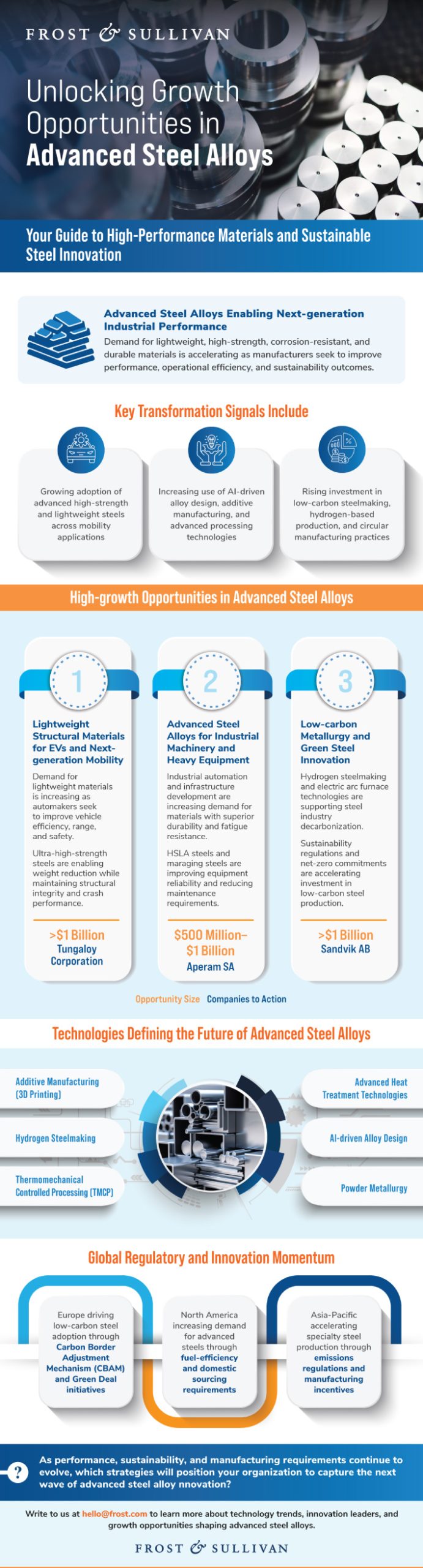
As manufacturers seek to balance performance, efficiency, and sustainability objectives, advanced steel alloys are creating new avenues for growth across mobility, industrial equipment, and low-carbon manufacturing. The following opportunities are expected to shape the next phase of industry development.
- Lightweight Structural Materials for Electric Vehicles (EVs) and Next-generation Mobility: The transition toward electric and hybrid vehicles is increasing demand for lightweight materials that can offset battery weight while improving efficiency, range, and safety. Advanced steel alloys, particularly ultra-high-strength steels, offer an attractive combination of strength, weight reduction, manufacturability, and cost effectiveness, making them critical to next-generation vehicle architectures.
- Advanced Steel Alloys for Industrial Machinery and Heavy Equipment: Industrial automation, infrastructure development, and demand for high-performance equipment are driving adoption of advanced steel alloys across machinery, construction equipment, and energy systems. Materials such as HSLA steels and maraging steels help improve durability, fatigue resistance, and operational reliability while reducing lifecycle costs.
- Low-carbon Metallurgy and Green Steel Innovation: Sustainability commitments and emissions-reduction targets are accelerating investment in low-carbon steel production pathways. Technologies such as hydrogen-based direct reduction and electric arc furnaces are creating opportunities to reduce the environmental footprint of steelmaking while supporting demand for high-performance materials.
Which opportunity will create the greatest competitive advantage for your organization?
Ready to Lead the Transformation?
- Book a Growth Strategy Session: Align your growth roadmap with Frost & Sullivan’s visionary Growth Pipeline™ Dialog.
- Engage with Growth Experts: Co-design AI-enabled, data-driven operating models that scale industry-specific and commercial impact.
- Share Your Transformation Story: Position your organization as a transformation leader through Frost & Sullivan’s Transformational Growth Leadership platform.
- Join the Growth Council: Collaborate with industry leaders shaping the future of your ecosystem.
- Nominate for the Best Practices Recognition: Be recognized for excellence in growth strategy, execution, and customer impact.
- Demonstrate Industry Positioning on the Frost Radar™: Benchmark your growth performance and innovation strength against industry competitors.
- Activate Brand & Demand Growth: Accelerate awareness, engagement, and revenue growth through integrated brand and demand generation strategies.
Frequently Asked Questions (FAQs)
What are advanced steel alloys?
Advanced steel alloys are engineered steel materials designed to deliver enhanced mechanical properties, such as higher strength, improved corrosion resistance, greater durability, and superior wear performance. Examples include high-strength low-alloy (HSLA) steels, ultra-high-strength steels, maraging steels, duplex stainless steels, tool steels, and precipitation-hardened steels.
Why are advanced steel alloys gaining importance in industrial and mobility applications?
Industries are increasingly seeking materials that support lightweighting, operational efficiency, durability, and sustainability objectives. Advanced steel alloys help manufacturers meet evolving performance requirements while improving safety, reliability, and lifecycle value.
Which industries are driving demand for advanced steel alloys?
Demand is growing across mobility, manufacturing, construction, energy and environment, and metal and mining industries. Applications range from electric vehicles and industrial machinery to infrastructure, tooling, and energy systems.
What technologies are shaping the future of advanced steel alloys?
Key technologies include thermomechanical controlled processing (TMCP), advanced heat treatment, additive manufacturing, powder metallurgy, artificial intelligence (AI)-driven alloy design, and hydrogen-based steelmaking.
What challenges are affecting the adoption of advanced steel alloys?
Major challenges include high production costs, raw material price volatility, competition from alternative lightweight materials, and the complexity of advanced manufacturing and processing requirements.