This blog is based on Frost & Sullivan’s Advanced MedTech series “Innovations and Growth Opportunities in Advanced Medical Devices, Surgical Robotic Platforms and Medical Imaging Systems,” built from three Technology Opportunity Engine analyses. Developed by Frost & Sullivan’s growth expert, Neeraj Jadhav, from the TechVision Medical Device & Imaging team.
Healthcare technology is entering a decisive phase where advanced medical devices, intelligent imaging systems, and connected digital health platforms are redefining precision care delivery. From minimally invasive surgical robotics and helium-free imaging to needle-free glucose biosensing and non-invasive neuromodulation, emerging technologies are improving diagnostic accuracy, enabling personalized therapy, and expanding access to decentralized care. These innovations are shifting MedTech from standalone devices toward integrated, data-driven care ecosystems.
Frost & Sullivan’s latest analysis highlights three growth-rich domains transforming next-generation healthcare technology, spanning precision surgical robotics, connected diabetes management, and advanced detection with non-invasive therapeutics.
What’s In It for You?
- Growth opportunities across surgical robotics, digital health, and imaging platforms
- Innovation trends shaping next-generation advanced medical devices
- Strategic considerations for precision, connected, and decentralized care
[Access the sample whitepaper on Advanced Medical Devices and Surgical Robotics]
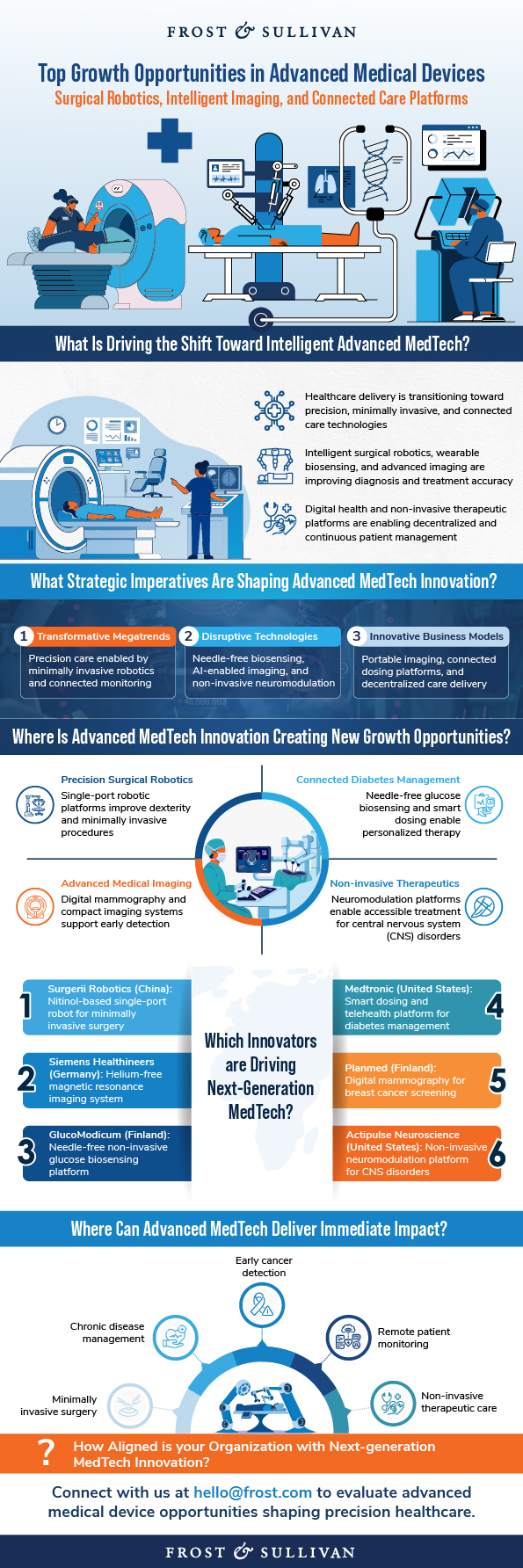
Technology Shifts Driving Advanced MedTech Innovation
- Precision Robotics and Minimally Invasive Surgery: Single-port robotic platforms and flexible surgical systems are improving procedural accuracy while reducing invasiveness. These technologies enable high dexterity in confined anatomical spaces and support improved surgical outcomes.
- Connected Monitoring and Intelligent Therapy Platforms: Needle-free biosensing, smart dosing systems, and telehealth-enabled platforms are transforming chronic disease management. These solutions support continuous monitoring, automated decision support, and personalized therapy.
- Advanced Imaging and Non-invasive Therapeutics: Digital mammography, compact imaging platforms, and neuromodulation technologies are improving early detection and enabling accessible treatment. These innovations support preventive care and decentralized healthcare delivery.
How is your organization aligning MedTech investments with precision, connected, and non-invasive care technologies?
From Device Innovation to Integrated Care Platforms
Advanced MedTech innovation is shifting toward platforms that combine diagnostics, intervention, and monitoring. Surgical robotics improves procedural precision, intelligent biosensing enables continuous insights, and advanced imaging supports early detection. Three growth opportunity areas are emerging as pivotal to this transition.
Growth Opportunity 1: Precision Minimally Invasive Surgery and Advanced Imaging Platforms
Single-port surgical robotics and next-generation imaging systems are improving procedural precision, reducing invasiveness, and expanding access to advanced diagnostics. These technologies are enabling minimally invasive interventions, enhanced visualization, and more efficient clinical workflows.
- Surgerii Robotics (China): Nitinol-based Single-port Robot for Minimally Invasive Surgeries
-
- Flexible snake-like robotic architecture designed for single-incision procedures
- Dual-continuum nitinol mechanism enables high dexterity in narrow anatomical spaces
- Three-dimensional (3D) visualization supports precise surgical navigation
- Reduced incision size minimizes patient trauma and recovery time
- Siemens Healthineers (Germany): Helium-free Magnetic Resonance Imaging System
-
- Helium-free design reduces infrastructure complexity and operational constraints
- Compact system architecture enables flexible installation across care settings
- Optimized imaging workflow supports faster diagnostics and improved efficiency
- Lower maintenance requirements support broader deployment of advanced imaging
Is your organization prioritizing minimally invasive robotics and compact imaging platforms to expand precision care capabilities?
Growth Opportunity 2: Intelligent Diabetes Monitoring and Automated Dosing Platforms
Non-invasive biosensing and connected dosing technologies are advancing diabetes management by enabling painless glucose monitoring, automated insulin guidance, and remote care integration. These solutions are improving adherence, enabling personalized therapy, and supporting continuous disease management.
- GlucoModicum (Finland): Needle-free, Non-invasive Glucose Biosensing
-
- Magnetohydrodynamic technology enables non-invasive interstitial fluid extraction
- Needle-free patch replaces finger-prick and needle-based monitoring
- High-sensitivity biosensing supports episodic metabolic insights
- Modular architecture with rechargeable transmitter and replaceable sensor
- Medtronic (United States): Smart Dosing and Telehealth Platform for Diabetes Management
-
- Smart insulin pen integrates with continuous glucose monitoring data
- Automated dose calculations using real-time glucose readings
- Missed dose alerts and personalized dosing recommendations
- Cloud-connected platform enables remote care and therapy optimization
How prepared is your team to adopt needle-free monitoring and connected dosing for personalized diabetes management?
[Access the sample whitepaper on Advanced Medical Devices and Surgical Robotics]
Growth Opportunity 3: Early Cancer Detection and Non-invasive Neuromodulation Therapies
Advanced imaging and non-invasive neuromodulation platforms are expanding early diagnosis and at-home therapeutic care. These technologies are improving detection accuracy, reducing diagnostic uncertainty, and enabling accessible treatment for neurological and psychiatric conditions.
- Planmed (Finland): Digital Mammography for Breast Cancer Screening
-
- High-definition digital mammography with 3D breast tomosynthesis
- Continuous Tomosynthesis acquisition reduces motion artifacts and tissue overlap
- Layered high-resolution imaging improves detection of small tumors
- Enhanced image reconstruction supports precise lesion localization
- Actipulse Neuroscience, Inc. (United States): Non-invasive Neuromodulation Platform for Central Nervous System (CNS) Disorders
-
- Patterned magnetic pulses modulate brain circuits for mood and cognitive support
- Compact, transcranial magnetic stimulation-based hardware for portable, easy-to-use neuromodulation in clinical and home settings
- Preloaded stimulation protocols simplify setup and treatment delivery
- Low-intensity neuromodulation supports at-home therapy under supervision
Are you investing in early detection imaging and non-invasive neuromodulation to enable decentralized care delivery?
Strategic Outlook
Advanced medical devices, surgical robotics, connected monitoring platforms, and non-invasive therapeutics are accelerating the shift toward precision, personalized, and decentralized healthcare. As MedTech innovation converges with artificial intelligence, digital health ecosystems, and remote monitoring technologies, organizations prioritizing integrated care platforms will be better positioned to improve outcomes and capture long-term growth opportunities.
Frequently Asked Questions: Advanced Medical Devices and Next generation MedTech
What are next-generation advanced medical devices?
Next-generation advanced medical devices integrate surgical robotics, intelligent imaging, wearable biosensing, and non-invasive therapeutic platforms into connected care ecosystems. These technologies support minimally invasive procedures, continuous monitoring, automated decision support, and personalized treatment, improving clinical precision and patient outcomes.
How are surgical robotics improving minimally invasive procedures?
Single-port robotic systems and flexible instrument architectures enable surgeons to operate through smaller incisions with improved dexterity and visualization. These platforms reduce tissue trauma, enhance maneuverability in confined anatomical spaces, and support faster recovery and improved procedural accuracy.
What is needle-free glucose monitoring and why is it important?
Needle-free glucose monitoring uses non-invasive biosensing technologies to extract interstitial fluid without finger-pricks or implanted sensors. These solutions improve patient comfort, increase adherence, and enable more frequent glucose insights, supporting personalized diabetes management and long-term disease control.
How do smart dosing platforms improve diabetes management?
Smart dosing platforms integrate continuous glucose monitoring data with intelligent insulin guidance. These systems automate dose calculations, provide missed-dose alerts, and enable remote care through connected applications, improving glycemic control and reducing manual decision-making.
What role does digital mammography play in early cancer detection?
Digital mammography with 3D breast tomosynthesis captures layered, high-resolution images that reduce tissue overlap and improve detection of small tumors. These systems enhance diagnostic accuracy, reduce false negatives, and support earlier intervention.
Ready to Lead the Transformation?
- Book a Growth Strategy Session: Align your growth roadmap with Frost & Sullivan’s visionary Growth Pipeline™ Dialog.
- Engage with Growth Experts: Co-design AI-enabled, data-driven operating models that scale industry-specific and commercial impact.
- Share Your Transformation Story: Position your organization as a transformation leader through Frost & Sullivan’s Transformational Growth Leadership platform.
- Join the Growth Council: Collaborate with industry leaders shaping the future of your ecosystem.
- Nominate for the Best Practices Recognition: Be recognized for excellence in growth strategy, execution, and customer impact.
- Demonstrate Industry Positioning on the Frost Radar™: Benchmark your growth performance and innovation strength against industry competitors.
- Activate Brand & Demand Growth: Accelerate awareness, engagement, and revenue growth through integrated brand and demand generation strategies.