This blog is based on Frost & Sullivan’s “Top Growth Opportunities in Precision Therapeutics,” built from four Technology Opportunity Engine analyses by Frost & Sullivan’s Health & Wellness growth expert, Vandana Iyer, from the TechVision team.
Healthcare innovation is entering a transformative phase where precision medicine, advanced biologics, cloud-native healthcare ecosystems, and artificial intelligence (AI)-enabled therapeutic development are reshaping care delivery and treatment strategies. Organizations are increasingly prioritizing technologies that improve clinical efficiency, strengthen targeted intervention, accelerate therapeutic development, and support scalable healthcare delivery models.
What’s In It for You?
- Key growth opportunities across precision therapeutics and AI-enabled healthcare platforms
- Emerging innovation themes shaping next-generation healthcare transformation
- Strategic opportunities across biologics, RNA therapeutics, and precision antimicrobial platforms
[Access the Sample Whitepaper on Precision Therapeutics and Next-generation Healthcare Platforms]
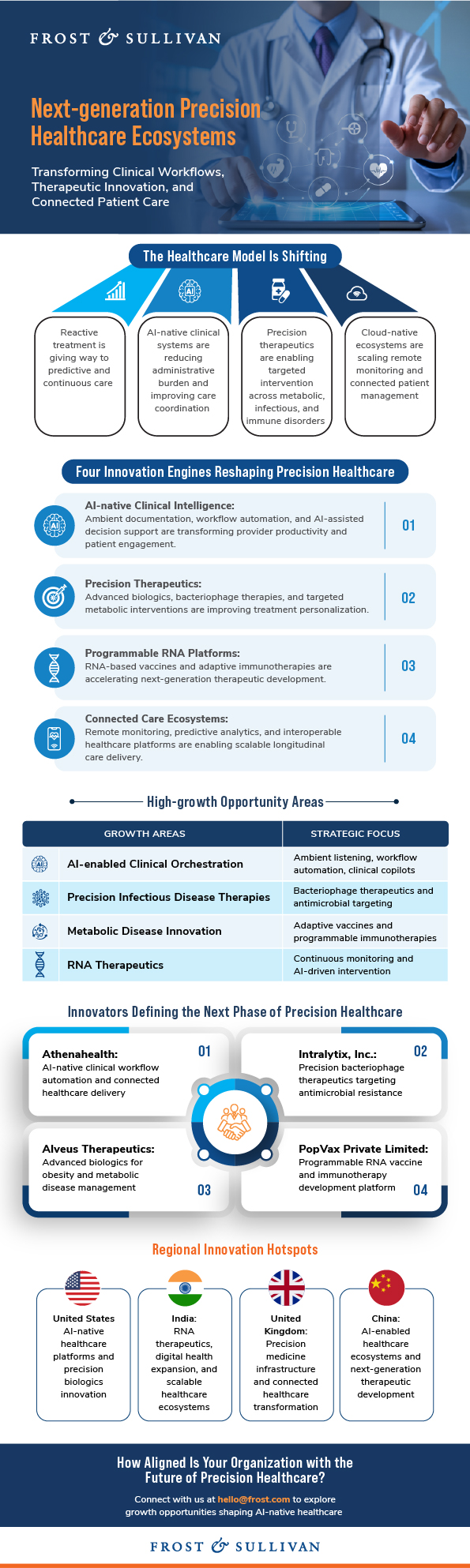
Technology Shifts Driving Precision Healthcare Transformation
Several innovation themes are accelerating the transition toward more connected, data-driven, and personalized healthcare ecosystems. AI-enabled healthcare management, precision antimicrobial therapies, next-generation biologics, and programmable RNA platforms are expanding how healthcare organizations approach clinical efficiency, therapeutic development, and targeted intervention.
These technologies are improving healthcare workflow automation, enabling precision treatment pathways, accelerating vaccine and biologic development, and strengthening scalable care delivery models across global healthcare environments.
The following opportunity areas highlight selected innovations accelerating the future of precision healthcare transformation.
- AI-native Clinical Workflow and Healthcare Management Platforms
Healthcare organizations are accelerating investments in cloud-native and AI-enabled platforms to improve operational efficiency, reduce clinician administrative burden, strengthen care coordination, and support scalable healthcare delivery models. Integrated clinical and financial workflow ecosystems are emerging as an important enabler of connected, data-driven healthcare transformation. The following innovator highlights this shift toward connected, AI-native healthcare delivery ecosystems.
Athenahealth (United States): AI-enabled Clinical and Patient Management Platform
- Cloud-native platform supporting clinical, financial, and patient management workflows
- Ambient Notes platform uses generative AI and ambient listening for automated clinical documentation
- Multi-model Natural Language Processing (NLP) framework supports specialty-specific documentation workflows
- Integrated Electronic Health Records (EHRs), revenue cycle management, and clinical decision support capabilities
- Future roadmap includes predictive coding, embedded risk intelligence, multilingual workflows, telehealth integration, and remote patient monitoring connectivity
How are cloud-native healthcare ecosystems influencing enterprise healthcare transformation strategies?
- Personalized Bacteriophage Therapeutics for Antimicrobial-resistant Infections
Antimicrobial resistance is accelerating demand for precision antimicrobial therapies capable of targeting resistant bacterial pathogens beyond traditional antibiotic approaches. Advances in bacteriophage engineering, AI-enabled phage selection, and scalable phage therapeutic platforms are strengthening opportunities for targeted infectious disease intervention across healthcare applications. The following innovator highlights this shift toward precision bacteriophage-enabled therapeutic development.
Intralytix, Inc. (United States): Personalized Bacteriophage Therapeutics Platform
- Bacteriophage-based therapeutic platform targeting antibiotic-resistant bacterial infections
- Uses naturally occurring lytic phages for precision antimicrobial intervention
- PhageSelector™ platform combines AI, machine learning, and high-throughput robotics for phage optimization and scaling
- Well-characterized phage library supports targeted therapeutic discovery and therapeutic formulation development
- Future priorities include advancing clinical-stage therapeutic candidates and expanding regulatory clearances across healthcare applications
How are next-generation antimicrobial platforms reshaping infectious disease strategies?
[Access the Sample Whitepaper on Precision Therapeutics and Next-generation Healthcare Platforms]
- Next-generation Biologics for Metabolic Disease and Obesity Management
Rising obesity prevalence and long-term metabolic health challenges are accelerating demand for next-generation biologics designed to improve treatment durability, efficacy, tolerability, and patient outcomes. Advances in precision metabolic therapeutics, receptor engineering, and biologic pathway modulation are strengthening opportunities for differentiated obesity and metabolic disease interventions. The following innovator highlights this shift toward targeted biologic therapies for metabolic disease management.
Alveus Therapeutics (United States): Precision Biologics for Obesity and Metabolic Disorders
- Developing next-generation biologics targeting obesity and metabolic diseases
- Research and development strategy combines human genetic data, biological expertise, and precision drug development
- Focuses on highly validated metabolic targets and first-in-class therapeutic compounds
- ALV-100 uses dual metabolic pathway modulation to improve long-term weight management outcomes
- Selective amylin receptor engineering designed to improve efficacy while reducing treatment burden and side effects
- Future priorities include advancing Phase 2 clinical development and accelerating next-generation metabolic therapeutic pipeline expansion
How are precision biologics reshaping metabolic disease and obesity treatment strategies?
- mRNA-enabled Vaccine Platforms for Rapid and Scalable Immunotherapy Development
Growing demand for rapid vaccine development, scalable manufacturing, and adaptable immunotherapy platforms is accelerating innovation across mRNA-enabled therapeutics and next-generation vaccine technologies. Advances in RNA engineering, programmable antigen design, and virus-like particle platforms are strengthening opportunities for faster response to emerging infectious diseases and precision immunotherapy development. The following innovator highlights this shift toward programmable and scalable RNA-based vaccine platforms.
PopVax Private Limited (India): mRNA-encoded Virus-like Particle Vaccine Platform
- Developing mRNA-based vaccines and cancer immunotherapies using computational and experimental platforms
- Integrated RNA Foundry infrastructure supports research and development, process development, and Good Manufacturing Practice (GMP)-scale manufacturing
- mRNA-encoded virus-like particle (VLP) platform combines RNA delivery with structural immunogen display
- Multivalent antigen presentation designed to improve antibody response and broaden immune coverage
- Programmable platform architecture enables rapid redesign and deployment against emerging variants
- Future priorities include advancing Investigational New Drug (IND)-enabling studies, scaling manufacturing capabilities, and accelerating clinical pipeline expansion
How are programmable RNA platforms influencing the future of vaccine and immunotherapy development?
[Access the Sample Whitepaper on Precision Therapeutics and Next-generation Healthcare Platforms]
Strategic Outlook
Precision therapeutics and next-generation healthcare platforms are accelerating the convergence of AI, advanced biologics, regenerative medicine, RNA therapeutics, and connected healthcare ecosystems. Organizations prioritizing scalable therapeutic innovation, targeted intervention, and AI-enabled healthcare transformation are expected to strengthen operational efficiency, improve clinical outcomes, and accelerate precision healthcare adoption.
Ready to Lead the Technology Transformation?
- Book a Growth Strategy Session: Align your growth roadmap with Frost & Sullivan’s visionary Growth Pipeline™ Dialog.
- Engage with Growth Experts: Co-design AI-enabled, data-driven operating models that scale industry-specific and commercial impact.
- Share Your Transformation Story: Position your organization as a transformation leader through Frost & Sullivan’s Transformational Growth Leadership platform.
- Join the Growth Council: Collaborate with industry leaders shaping the future of your ecosystem.
- Nominate for the Best Practices Recognition: Be recognized for excellence in growth strategy, execution, and customer impact.
- Demonstrate Industry Positioning on the Frost Radar™: Benchmark your growth performance and innovation strength against industry competitors.
- Activate Brand & Demand Growth: Accelerate awareness, engagement, and revenue growth through integrated brand and demand generation strategies.
FAQs: Key Questions in Precision Therapeutics and Healthcare Innovation
1. How are AI-native healthcare platforms improving clinical workflows?
AI-native healthcare platforms automate clinical documentation, improve care coordination, strengthen decision support, and reduce administrative burden through integrated cloud-native healthcare ecosystems.
2. Why are bacteriophage therapeutics gaining attention in infectious disease treatment?
Bacteriophage therapeutics provide targeted antimicrobial intervention against antibiotic-resistant pathogens and support precision infectious disease treatment strategies beyond traditional antibiotics.
3. What is driving growth in next-generation biologics for obesity and metabolic diseases?
Rising obesity prevalence, demand for durable weight management solutions, and advances in precision metabolic therapeutics are accelerating innovation across next-generation biologics.
4. How are mRNA platforms transforming vaccine and immunotherapy development?
mRNA-enabled platforms support rapid vaccine design, scalable manufacturing, programmable antigen development, and faster response to emerging infectious diseases and cancer immunotherapies.