This blog is based on the analyses, Frost Radar™: Digital Signage Platforms, 2026, authored by Frost & Sullivan’s growth expert Alaa Saayed, from the Digital Content Services team.
The Future of Digital Signage: Beyond Screen Management
Until recently, digital signage was only thought of as a communication tool. Whether it was a retail promotion, an employee notification, or a menu board, success was simply about communicating the correct information to the appropriate digital signage display at the right time.
Today, that expectation has changed. With deployments expanding across retail, healthcare, manufacturing, education, hospitality, workplaces, and Digital Out-of-Home (DOOH) settings, enterprises are considering options beyond just content publishing. They want digital signage software that integrates physical spaces with organizational data, customer journeys, operational systems and real-time decision-making.
Digital Signage Software: The New Growth Playbook
Frost & Sullivan’s latest podcast explores how leading digital signage platforms are responding to rising AI-powered content operations, DOOH advertising, and more.
🎧 Listen to the Growth Podcast
Discover the competitive strategies, best practices, and connectivity innovations from top companies today!
This is transforming the role of digital signage solutions. These platforms are no longer standalone content management tools. Now, they are becoming intelligent, business infrastructure, making it easier to simplify operations, enable automation, integrate with enterprise applications; thereby, delivering demonstrable business outcomes.
At the same time, customer expectations are constantly evolving. Digital signage solutions are expected to be easier to manage, deploy, and flexible enough to support employee communications, self-service kiosks, interactive customer engagement, and DOOH advertising.
For digital signage companies, this is more than just a technological shift. It marks a broader redefinition of value creation, where competitive advantage is based on intelligent platforms, and not just screen management.
Megatrends Accelerating the Next Phase of Digital Signage Growth
- Artificial intelligence (AI)-powered Content Operations
AI is eliminating the laborious work from managing digital signage software. Content creation, translation, localization, scheduling, monitoring, and optimization are becoming increasingly automated, allowing enterprises to create more personalized experiences while operating larger screen networks effectively.
- Connected Enterprise Ecosystems
Organizations expect digital signage platforms to seamlessly integrate with enterprise applications, collaboration tools, Application Programming Interfaces (APIs), Point of Sale (POS) systems, Internet of Things (IoT) infrastructure, and real-time business data. This enables every digital signage display to reflect real-time business conditions and become part of broader enterprise operations.
- Retail Media & DOOH
The commercial value of digital signage is rising, due to the rapid growth of DOOH advertising and networks. Beyond corporate communications, firms are using screen networks to improve audience targeting, offer more engaging customer experiences, and create new revenue streams through advertising and commerce.
- Flexible Cloud-native Deployments
Support for cloud-native architectures, browser-based distribution, System-on-Chip (SoC) displays, smart TVs, kiosks, and mixed operating systems make deployments faster and more flexible. This allows digital signage companies to accommodate a wider spectrum of customer environments, while minimizing deployment complexity and operational expenses.
Click here to access the latest growth opportunity analysis on Digital Signage Platforms.
Digital Signage Platforms at a Glance
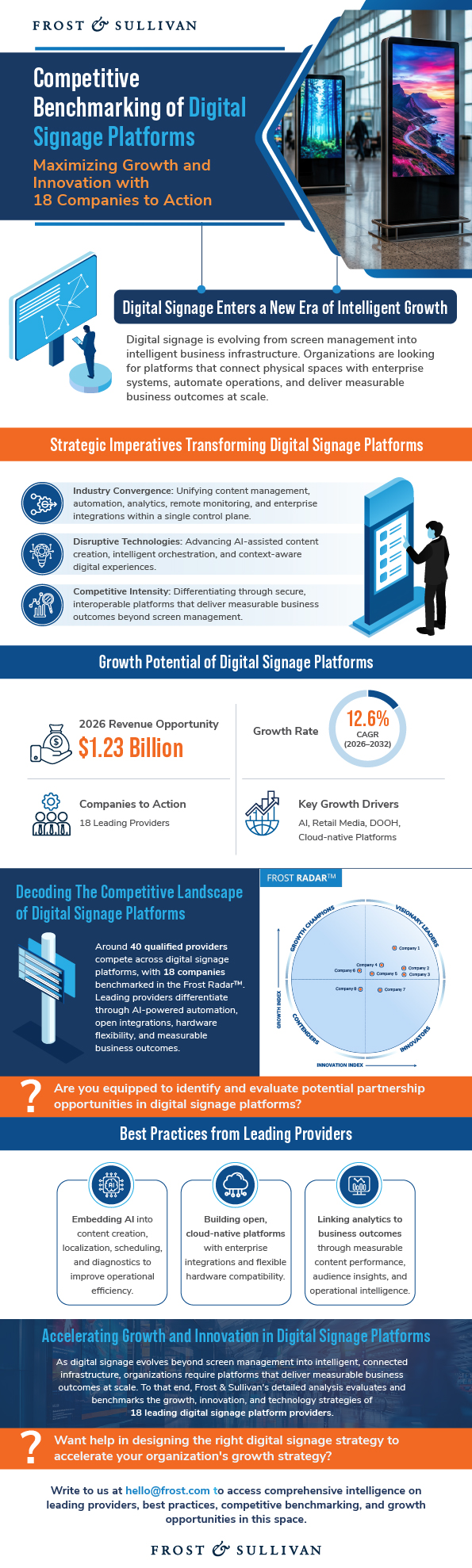
Digital Signage Growth Opportunities Creating Long-term Competitive Advantage
- Industry-specific Digital Signage Solutions
There is an increasing demand for digital signage platforms that are purpose-built for retail, healthcare, manufacturing, hospitality, education and corporate workspaces. Customized workflows and industry-specific capabilities are helping firms accelerate their time-to-market, while delivering greater business value.
- Expanding Retail Media Opportunities
Retail media and DOOH advertising are establishing digital signage platforms as a revenue-generating asset. As DOOH ecosystems evolve, enterprises now have new opportunities to monetize screen networks, while offering relevant and measurable customer engagement.
- Intelligent, Flexible Deployment
Cloud-native digital signage solutions, hardware-agnostic architectures and browser-based deployment methodologies are easing the path to scalability across thousands of endpoints. For enterprises, this means more flexibility, faster deployment and less operational complexity, without sacrificing performance.
Best Practices Leveraged by Leading Digital Signage Platform Providers
- Embedding AI across digital signage software to simplify content generation, workflow automation, localization, scheduling and diagnostics.
- Developing open and interoperable digital signage solutions that connect with enterprise applications, analytics, collaboration tools, and various hardware environments.
- Measure business outcomes with engagement analytics, operational insights, and performance metrics that go far beyond standard proof-of-play reporting.
Is your organization equipped with the growth strategies and best practices to thrive through this transformation?
Click here to access the latest growth opportunity analysis on Digital Signage Platforms.
Ready to Lead the Transformation?
- Schedule a Growth Strategy Dialog: Align your growth roadmap with Frost & Sullivan’s Visionary Growth Pipeline™ Dialog.
- Engage with Growth Experts: Co-design AI-enabled, data-driven operating models that scale industry-specific and commercial impact.
- Showcase Your Transformational Leadership: Position your organization as a transformation leader through Frost & Sullivan’s Transformational Growth Leadership platform.
- Join the Growth Council: Collaborate with industry leaders shaping the future of your ecosystem.
- Explore Best Practices Recognition: Be recognized for excellence in growth strategy, execution, and customer impact.
- Benchmark Your Industry Positioning on the Frost Radar™: Benchmark your growth performance and innovation strength against industry competitors.
- Tell Your Story: Accelerate awareness, engagement, and revenue growth through integrated brand and demand generation strategies.
Frequently Asked Questions (FAQs): Digital Signage Platforms
1. How should executives measure the business impact of digital signage beyond content delivery?
As digital signage becomes more closely integrated with enterprise operations, organizations are expanding success metrics beyond screen uptime and proof of play. Increasingly, performance is being evaluated through customer engagement, operational efficiency, workforce productivity, revenue contribution, and the ability of digital signage platforms to support broader business objectives.
2. How will digital signage platforms support enterprise AI strategies over the next five years?
AI is expected to play a much larger role in how digital signage software delivers value across the enterprise. Beyond automating content workflows, future platforms will increasingly leverage contextual data, predictive analytics, and intelligent orchestration to create more responsive experiences that align with evolving business priorities and customer expectations.
3. What distinguishes a strategic digital signage partner from a technology vendor?
As organizations expand deployments, digital signage companies are increasingly evaluated on more than product functionality. Long-term differentiation is being shaped by platform innovation, enterprise integration capabilities, managed services, ecosystem partnerships, and the ability to deliver measurable business outcomes through scalable digital signage solutions.
4. How can digital signage support broader customer engagement and revenue strategies?
The role of digital signage continues to expand beyond enterprise communications. The growth of Digital Out of Home ecosystems is enabling organizations to create more personalized customer experiences, strengthen audience engagement, and unlock new monetization opportunities while leveraging existing digital signage displays and infrastructure.