This blog is based on Frost & Sullivan’s “Top Growth Opportunities in Sensor Technology,” built from six Technology Opportunity Engine analyses by Frost & Sullivan’s Sensors & Instrumentation growth expert, Varun Babu, from the TechVision team.
Executive Summary
Intelligent sensing technologies are becoming foundational to the next generation of autonomous systems as artificial intelligence (AI), edge computing, robotics, and connected infrastructure accelerate demand for real-time perception and decision intelligence. Advances in sensor fusion, LiDAR, radar, quantum sensing, hyperspectral imaging, thermal imaging, and AI-native edge sensors are enabling machines to interpret complex environments with greater accuracy, autonomy, and efficiency. For technology developers, equipment manufacturers, system integrators, and enterprise decision-makers, intelligent sensing represents a strategic opportunity to build adaptive, context-aware systems that enhance operational performance and unlock long-term competitive advantage
Enabling Next-generation Perception and Decision Intelligence
Sensing technologies are entering a transformative phase where artificial intelligence (AI), multimodal perception, edge computing, and advanced materials are redefining how machines understand and interact with the physical world. Organizations are increasingly prioritizing sensor technologies that improve environmental awareness, enable real-time decision-making, support autonomous operations, and deliver higher precision across industrial, mobility, healthcare, and infrastructure applications.
Why This Analysis Matters
- Key growth opportunities emerging across intelligent perception, autonomous sensing, and distributed sensor ecosystems.
- Innovation trends shaping the future of LiDAR, radar, sensor fusion, quantum sensing, thermal imaging, and edge AI-enabled sensing technologies.
- Strategic opportunities across industrial automation, robotics, connected healthcare, automotive systems, and intelligent infrastructure applications.
Access the Sample Analysis on Intelligent Sensing and Autonomous Systems
From AI-native 3D vision and sensor fusion platforms to quantum sensors, hyperspectral imaging, energy-harvesting architectures, and next-generation LiDAR and radar technologies, advanced sensing innovations are enabling more intelligent, adaptive, and autonomous systems.
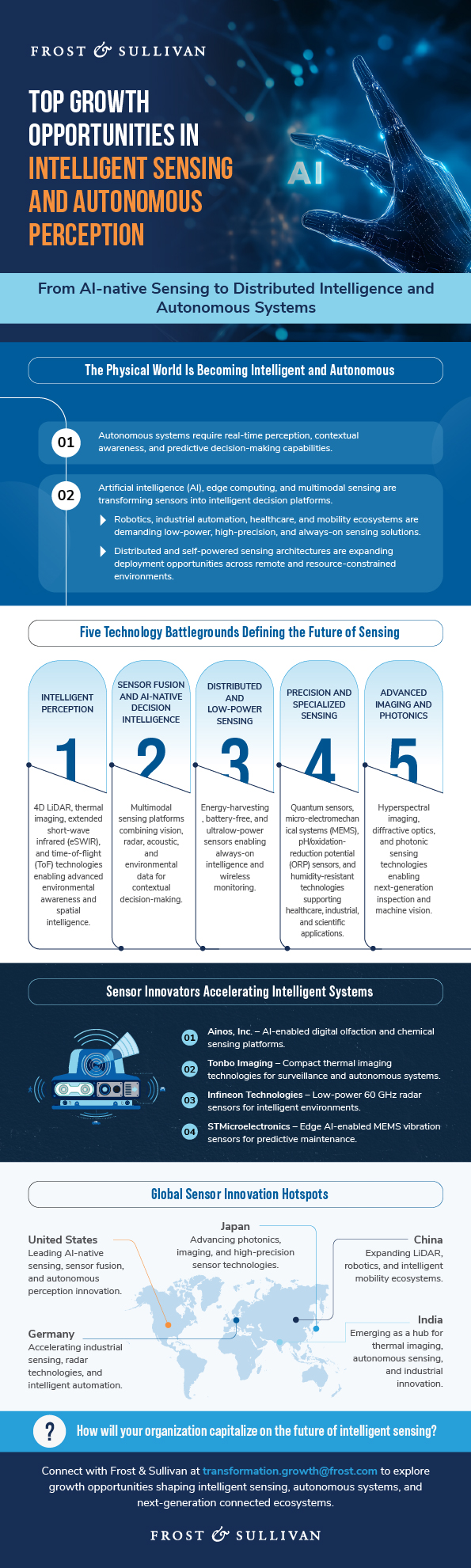
Core Technology Themes Accelerating Intelligent Sensing and Autonomous Systems
Across the analyses, Frost & Sullivan identifies five dominant themes shaping the next phase of sensor innovation and intelligent system development:
- Intelligent Perception and Spatial Awareness: AI-native 3D vision, time-of-flight (ToF) sensing, thermal imaging, extended short-wave infrared (eSWIR), hyperspectral imaging, 4D LiDAR, and 4D radar technologies are significantly improving machine perception, environmental understanding, and real-time situational awareness across autonomous vehicles, robotics, industrial automation, and smart infrastructure.
- Multimodal and Sensor Fusion Intelligence: Sensor fusion platforms, AI-enabled perception engines, and distributed sensing architectures are enabling systems to integrate multiple data streams and make more contextual, accurate, and autonomous decisions. These technologies are accelerating adoption across physical AI, perimeter security, industrial automation, and connected mobility applications.
- Low-power and Distributed Sensing Architectures: Energy-harvesting sensors, ultralow-power image sensors, battery-free sensing platforms, and wireless sensor networks are enabling always-on intelligence and expanding sensing capabilities across remote, hard-to-access, and resource-constrained environments.
- Precision and Specialized Sensing Technologies: Quantum gravity sensors, micro-electromechanical systems (MEMS) accelerometers, pH/oxidation-reduction potential (ORP) sensors, humidity-resistant sensors, digital olfaction platforms, and subcutaneous optical glucose sensors are delivering higher sensitivity, improved reliability, and application-specific intelligence across healthcare, industrial monitoring, environmental sensing, and scientific instrumentation.
- Advanced Photonics and Next-generation Imaging: Diffractive optical processors, silicon (Si) PIN photodiodes, volumetric acoustic imaging, hyperspectral imaging, and chip-scale frequency-modulated continuous wave (FMCW) LiDAR technologies are expanding the boundaries of sensing performance and enabling new capabilities in machine vision, structural health monitoring, defense, and advanced scientific applications.
How is your organization preparing for the future of intelligent sensing?
Technology Shifts Driving Intelligent Sensing and Autonomous Systems
Several innovation themes are accelerating the transition toward more intelligent, context-aware, and autonomous sensing ecosystems. AI-native perception platforms, multimodal sensing architectures, edge intelligence, and specialized sensing technologies are expanding how organizations monitor, interpret, and respond to increasingly complex physical environments.
These technologies are improving machine perception, enabling predictive operations, strengthening real-time decision-making, and creating new opportunities across industrial automation, healthcare, environmental monitoring, robotics, and connected infrastructure.
The following opportunity area highlights a selected innovation accelerating the future of intelligent sensing.
- AI-powered Digital Olfaction Platforms for Advanced Chemical Sensing: Organizations are increasingly seeking sensing technologies that can identify complex chemical signatures in real time while reducing reliance on invasive sampling, laboratory analysis, and highly controlled environments. Digital olfaction platforms are emerging as a new sensing paradigm that combines advanced sensor hardware with AI-driven interpretation to enable scalable and non-invasive chemical detection.
The following innovator highlights this shift toward AI-enabled chemical sensing and digital perception.
Ainos, Inc. (United States): MEMS-based Digital Olfaction Platform
- AI-native digital olfaction platform that converts chemical signatures into digital “Smell IDs” for real-time analysis and classification.
- MEMS-based metal-oxide semiconductor sensor architecture designed for compact, embedded, and handheld sensing applications.
- Multi-gas volatile organic compound (VOC) detection capability supporting applications across healthcare, industrial monitoring, and environmental sensing.
- AI-driven odor signature classification that improves interpretation of complex chemical patterns beyond traditional rule-based electronic nose systems.
- Future focus areas include semiconductor monitoring, hospital diagnostics, elder-care automation, and industrial environmental monitoring applications.
How will AI-enabled digital olfaction platforms redefine the future of chemical sensing and environmental intelligence?
- Thermal Imaging Sensors Enabling Intelligent Perception: The growing need for all-weather perception and persistent situational awareness is driving demand for compact, energy-efficient thermal imaging technologies. Advances in miniaturization and onboard processing are expanding thermal imaging applications beyond traditional defense markets into autonomous systems, industrial monitoring, and smart infrastructure. The following innovator highlights this shift toward intelligent and embedded thermal sensing.
Tonbo Imaging (India): Thermal Imaging Platform for Surveillance and Target Acquisition
- Compact long-wave infrared (LWIR) thermal imaging platform for embedded and portable applications.
- Uncooled microbolometer technology with onboard image processing and digital enhancement capabilities
- High imaging sensitivity enables precise detection of temperature variations in challenging environments.
- Lightweight, low-power architecture simplifies integration across autonomous platforms and surveillance systems.
- Future roadmap includes AI-enabled image processing, sensor fusion, and applications in autonomous defense and intelligent surveillance.
How will compact thermal imaging technologies reshape autonomous perception and situational awareness?
- Autonomous 60 GHz Radar Sensors Enabling Context-aware Smart Devices: The growing demand for touchless interaction, occupancy awareness, and intelligent automation is accelerating the adoption of compact radar sensing technologies. Advances in low-power 60 GHz radar are enabling smart devices to detect presence, motion, and direction while improving privacy and reducing false triggers compared with traditional sensing approaches. The following innovator highlights this shift toward autonomous and context-aware sensing.
Infineon Technologies (Germany): 60 GHz Autonomous Motion Sensor
- Fully integrated 60 GHz Doppler radar sensor for motion, presence, and direction detection.
- Low-power, autonomous operation with built-in signal processing, enabling easy integration into consumer and industrial devices.
- Antenna-in-package (AiP) architecture simplifies system design and reduces component complexity.
- Supports human motion detection at ranges of up to 7 meters, with extended capabilities through external processing.
- Applications include smart homes, building automation, occupancy sensing, human-machine interfaces, and industrial automation.
- Future roadmap focuses on deeper integration of low-power radar into smart environments and context-aware sensing applications.
How will autonomous radar sensing redefine human-machine interaction and intelligent environments?
- Edge AI Vibration Sensors Enabling Predictive Industrial Intelligence: As industrial environments become increasingly automated and connected, organizations are moving from reactive maintenance toward predictive and condition-based operations. Advances in MEMS sensing and embedded AI are enabling vibration sensors to analyze machine health directly at the edge, reducing system complexity and accelerating fault detection. The following innovator highlights this shift toward intelligent, decentralized predictive maintenance.
STMicroelectronics (Switzerland): MEMS Vibration Sensor for Predictive Maintenance
- Three-axis MEMS vibration sensor with integrated AI processing for real-time condition monitoring.
- On-sensor analytics and feature extraction reduce reliance on cloud computing and external processing.
- Wide bandwidth and high-frequency vibration detection enable earlier identification of equipment anomalies and failures.
- Industrial-grade design supports operation in harsh environments and temperatures of up to 125°C.
- Applications include industrial automation, smart factories, rotating machinery, and Industrial Internet of Things (IIoT) environments.
- Future roadmap focuses on advanced onboard analytics, anomaly detection, and sensor fusion for autonomous maintenance systems.
How will edge AI sensing transform predictive maintenance and industrial operations?
The Future of Sensing Is Becoming Intelligent, Autonomous, and Context-aware
Advanced sensing technologies are becoming foundational to the next generation of autonomous and intelligent systems. As AI, edge computing, and multimodal perception continue to converge, sensors are evolving beyond data collection to deliver real-time intelligence, predictive insights, and context-aware decision-making across industries. Organizations that understand these technology shifts will be better positioned to identify new growth opportunities and build future-ready sensing ecosystems.
How is your organization preparing for the future of intelligent sensing?
Ready to Lead the Transformation?
- Schedule a Growth Strategy Dialog: Align your growth roadmap with Frost & Sullivan’s Visionary Growth Pipeline™ Dialog.
- Engage with Growth Experts: Co-design AI-enabled, data-driven operating models that scale industry-specific and commercial impact.
- Showcase Your Transformational Leadership: Position your organization as a transformation leader through Frost & Sullivan’s Transformational Growth Leadership platform.
- Join the Growth Council: Collaborate with industry leaders shaping the future of your ecosystem.
- Explore Best Practices Recognition: Be recognized for excellence in growth strategy, execution, and customer impact.
- Benchmark Your Industry Positioning on the Frost Radar™: Benchmark your growth performance and innovation strength against industry competitors.
- Tell Your Story: Accelerate awareness, engagement, and revenue growth through integrated brand and demand generation strategies.
Frequently Asked Questions
1. What are intelligent sensors, and why are they important?
Intelligent sensors combine sensing capabilities with onboard processing, connectivity, and AI-driven analytics to interpret data and support real-time decision-making. They are becoming essential for autonomous systems, industrial automation, smart infrastructure, and connected healthcare applications.
2. Which sensor technologies are driving the next wave of innovation?
Several technologies are shaping the future of sensing, including:
- LiDAR and 4D radar for autonomous perception
- Sensor fusion and AI-native vision systems for contextual intelligence
- Quantum sensors for ultra-sensitive measurements
- Thermal and hyperspectral imaging for advanced detection and inspection
- Energy-harvesting and ultralow-power sensors for distributed and always-on sensing
3. How is AI transforming sensor technologies?
AI is enabling sensors to move beyond data collection toward intelligent perception and autonomous decision-making. AI-powered sensing platforms can analyze information locally, improve accuracy, reduce false alarms, and enable predictive applications across robotics, manufacturing, healthcare, and mobility ecosystems.
4. What industries are creating the greatest opportunities for advanced sensors?
High-growth opportunities are emerging across:
- Industrial automation and predictive maintenance
- Robotics and autonomous systems
- Automotive and intelligent mobility
- Healthcare and wearable technologies
- Smart infrastructure and environmental monitoring
- Defense and security applications
5. What trends are shaping the future of intelligent sensing?
The next phase of sensor innovation will be defined by:
- Multimodal and sensor fusion architectures
- Edge AI and distributed intelligence
- Miniaturized and low-power sensing platforms
- Quantum and precision sensing technologies
- Autonomous perception systems for physical AI and robotics