This blog is based on Frost & Sullivan’s recent analysis, US Military Intelligence Analytics Industry Growth Opportunities, 2025–2028, authored by growth expert Wayne Shaw and lead expert Avi Kalo from the Aerospace & Defense Practice Area.
Executive Summary
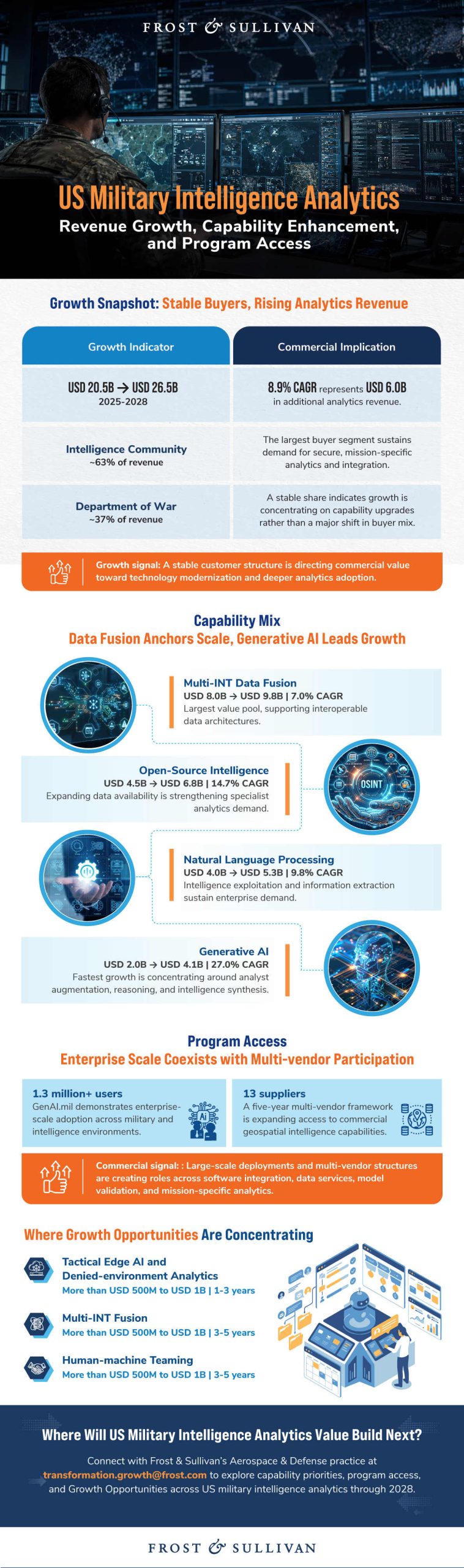
US military intelligence analytics is expanding as defense and intelligence agencies integrate artificial intelligence (AI) into intelligence processing and decision support. Industry revenue is projected to rise from $20.5 billion in 2025 to $26.5 billion by 2028, at an 8.9% compound annual growth rate (CAGR). Growing demand for integrated intelligence capabilities is widening commercial opportunities for analytics specialists and defense integrators. Secure mission integration and interoperability are carrying greater weight in supplier differentiation.
Key Takeaways:
- Open-source intelligence is expanding specialist opportunities: Growing reliance on publicly available data is strengthening demand for dedicated intelligence platforms.
- Tactical edge AI is creating new entry points: Denied-environment operations are driving demand for intelligence processing closer to deployed forces.
- Human-machine teaming is extending solution value: Analyst augmentation is generating opportunities in workflow integration and adoption services.
- Explainable AI is influencing technology adoption: Demand for traceable analytical outputs is making validation capabilities increasingly important in mission-critical applications.
What Is Military Intelligence Analytics?
Military intelligence analytics uses advanced analytical software to process information from different intelligence sources and support threat assessment and operational decision-making. Multi-intelligence (multi-INT) data fusion brings these sources together, enabling analysts to identify patterns and interpret complex activity within a unified analytical environment.
Generating $8 billion in US revenue in 2025, multi-INT data fusion represents the industry’s largest application segment. Its scale is reinforcing the commercial importance of software that connects intelligence collection with analytical workflows.
How Are US Military Intelligence Programs Shaping Supplier Opportunities?
US intelligence modernization is progressing through distinct purchasing and deployment environments. The Intelligence Community accounts for approximately 63% of projected industry revenue, while military departments are advancing analytics within operational mission systems. Growing data volumes and pressure to shorten intelligence cycles are accelerating the transition from isolated pilots to broader deployments.
Are You Positioned for US Military Intelligence Analytics Growth?
Explore how agency priorities, contracting structures, and mission requirements are shaping supplier opportunities through 2028.
[Download the Strategic Analysis]
Supplier participation is reflecting these different requirements. Foundational technology providers are supplying core AI capabilities, analytics specialists are developing mission-focused applications, and defense integrators are supporting deployment within established programs. Initiatives such as Project Maven and Luno are illustrating distinct commercial roles for AI platform providers and geospatial intelligence specialists. Agency priorities and contracting structures are defining supplier access across the industry.
Top 3 Strategic Imperatives Shaping US Military Intelligence Analytics Growth
- Industry Convergence: Joint All-Domain Command and Control (JADC2) frameworks and multi-domain operations are connecting intelligence functions across military services. Shared data architectures are expanding opportunities for cross-domain coordination and specialized capabilities within interconnected mission systems.
- Competitive Intensity: AI-native firms are challenging established defense contractors as government buyers prioritize faster acquisition and continuous capability upgrades. Open architectures are increasing the relevance of modular software solutions that can be integrated into larger programs.
- Disruptive Technologies: Advances in AI models, space-based sensing, and resilient computing are supporting distributed intelligence operations. Reusable analytical components that operate across deployment environments are gaining commercial relevance as intelligence systems become more software-centric.
Frost & Sullivan Perspective
According to Frost & Sullivan, supplier differentiation in US military intelligence analytics is being shaped by the ability to translate software innovation into operational capability. Established defense integrators retain advantages in program access and mission integration, while specialist providers are gaining relevance through modular analytical solutions. The ability to deliver reliable capabilities and accommodate frequent upgrades is influencing longer-term positioning across defense intelligence programs.
Have you evaluated your organization’s technology and digital capabilities to support future growth initiatives?
📖 Explore how software-led C5ISR modernization is expanding interoperability and supplier participation across defense programs.
Growth Drivers Expanding Military Intelligence Analytics Demand, Restraints Shaping Deployment
US military intelligence analytics demand is being pulled forward by decision-speed requirements and the shift toward foundation models. Deployment remains constrained by legacy data silos and adversarial model risks, separating providers by software depth, integration capability, and assurance expertise.
| Growth Factor | Industry Evidence | Business Implication |
| Decision-cycle acceleration | Multi-domain operations are generating data faster than human-led analysis can process, increasing demand for real-time threat identification and prioritization. | Predictive analytics and automated processing are extending supplier roles into mission-level intelligence workflows. |
| Foundation models and generative AI (GenAI) | Intelligence applications are shifting from task-specific algorithms toward adaptable foundation models. GenAI revenue is projected to rise from $2.0 billion in 2025 to $4.1 billion in 2028, at a 27.0% CAGR. | Model adaptation, analytical orchestration, and secure deployment are creating higher-value positions for specialist software providers. |
| Legacy interoperability | Isolated intelligence repositories and proprietary protocols are restricting access to unified, cross-domain datasets. | Data integration and modernization capabilities are gaining commercial relevance, although deployment complexity can extend implementation cycles. |
| Adversarial model threats | Data poisoning and evasion attacks are increasing risks across the AI model life cycle. | Model testing, robustness validation, and AI assurance are expanding specialist roles around operational deployment. |
Business Implication: Software-led growth is widening application opportunities, while interoperability and AI assurance requirements are extending commercial value into integration, validation, and mission support.
Have you assessed the deployment risks that could affect your military intelligence analytics growth strategy?
Top Three Growth Opportunities Expanding Military Intelligence Analytics Value
Three areas are creating distinct commercialization pathways across US military intelligence analytics. Each represents a five-year opportunity above $500 million and up to $1 billion, with tactical edge analytics carrying the shorter commercialization horizon and multi-INT fusion and human-machine teaming developing over a longer period.
- Operationalizing Tactical Edge AI and Denied-environment Analytics
A 1-to-3-year horizon is concentrating near-term opportunity around analytics that can operate locally when connectivity is limited or disrupted. US Army, US Air Force, Special Operations Command, and Defense Advanced Research Projects Agency programs are supporting demand for processing that converts sensor feeds into compact, decision-relevant outputs at the point of operation.
Business implication: Deployable processing, metadata-centric intelligence, and mission-specific edge applications are gaining near-term relevance as agencies reduce dependence on centralized infrastructure.
- Multi-INT Fusion
Over a 3-to-5-year horizon, intelligence architectures are integrating previously separated data sources through common platforms and distributed processing. Data-mesh approaches, cloud infrastructure, and tactical processing are supporting larger-scale correlation across intelligence domains.
Business implication: Data architecture and interoperability capabilities are creating broader supplier roles as agencies connect intelligence sources across enterprise and tactical environments.
- Human-machine Teaming (Augmented Analysts)
A 3-to-5-year horizon is expanding the role of AI assistants within analyst environments. Automation is taking on repetitive activities such as triage, tagging, and initial pattern detection, while human analysts remain central to contextual reasoning, validation, and higher-value assessment.
Business implication: Analyst-centric interfaces, workflow integration, training, and implementation services are extending supplier participation beyond core analytical software.
How well is your organization positioned to capitalize on emerging military intelligence analytics growth opportunities?
Future Outlook: Capability Modernization Is Defining the Next Phase of Military Intelligence Analytics
Through 2028, the buyer mix across the Intelligence Community and military departments is remaining broadly stable, while investment is shifting within the technology stack. GenAI, advanced data fusion, open-source intelligence, and edge analytics are gaining a larger role as agencies expand machine-assisted intelligence across enterprise and operational environments.
According to Frost & Sullivan, the next phase of competitive differentiation is being shaped by how effectively analytical capabilities can operate across classified, enterprise, and tactical environments. Modular software, interoperable architectures, and secure deployment are strengthening the value of solutions that can be upgraded and reused across programs, preserving distinct roles for established integrators and specialist analytics providers.
How effectively is your organization moving military intelligence analytics opportunities from identification to implementation?
Ready to Lead the Transformation?
- Schedule a Growth Strategy Dialog: Align your growth roadmap with Frost & Sullivan’s Visionary Growth Pipeline™ Dialog.
- Engage with Growth Experts: Co-design AI-enabled, data-driven operating models that scale industry-specific and commercial impact.
- Showcase Your Transformational Leadership: Position your organization as a transformation leader through Frost & Sullivan’s Transformational Growth Leadership platform.
- Join the Growth Council: Collaborate with industry leaders shaping the future of your ecosystem.
- Explore Best Practices Recognition: Be recognized for excellence in growth strategy, execution, and customer impact.
- Benchmark Your Industry Positioning on the Frost Radar™: Benchmark your growth performance and innovation strength against industry competitors.
- Tell Your Story: Accelerate awareness, engagement, and revenue growth through integrated brand and demand generation strategies.
Connect with our growth experts at [email protected].
FAQs
1. What are the key US Military Intelligence Analytics Industry Growth Opportunities?
Key US Military Intelligence Analytics Industry Growth Opportunities include tactical edge AI and denied-environment analytics, Multi-INT Fusion, and human-machine teaming. These areas are creating supplier roles across deployable processing, interoperable data architectures, workflow integration, and analyst-support capabilities.
2. How is edge AI supporting military intelligence operations?
Edge AI enables intelligence processing closer to deployed forces when connectivity to centralized infrastructure is limited. Local processing can reduce data-transfer requirements and support faster analysis in contested or bandwidth-constrained environments.
3. What is US Military Intelligence Analytics?
US Military Intelligence Analytics uses advanced analytical software and artificial intelligence to process information from multiple intelligence sources. It supports threat assessment, intelligence synthesis, and operational decision-making across enterprise and tactical environments.
4. How is open source intelligence contributing to military intelligence growth?
Open source intelligence is gaining importance as agencies draw on expanding volumes of publicly available information alongside classified sources. The segment is forecast to grow from $4.5 billion in 2025 to $6.8 billion in 2028, reflecting stronger operational reliance on OSINT analytics.
5. What role does geospatial intelligence play in military intelligence analytics?
Geospatial intelligence supports the analysis of satellite imagery, location-based data, and other spatial information used for detection, tracking, and situational awareness. US intelligence programs are increasingly combining geospatial data with AI-enabled processing and multi-source fusion.
6. How is human-machine teaming changing intelligence analysis?
Human-machine teaming is combining AI-assisted analysis with human judgment across intelligence workflows. Automation is handling activities such as triage and initial pattern detection, allowing analysts to focus more on contextual reasoning, validation, and strategic assessment.
7. How is Military Intelligence AI changing intelligence workflows?
Military Intelligence AI is supporting faster processing, pattern identification, data triage, and analyst augmentation. Human analysts remain central to contextual reasoning and validation, while AI is taking on more repetitive analytical tasks and supporting decision-making across intelligence workflows.
8. Why is Multi-INT Fusion important in military intelligence analytics?
Multi-INT Fusion brings signals, geospatial, open-source, and other intelligence streams into a common analytical environment. It supports broader correlation across intelligence domains and is increasing demand for interoperable data architectures, distributed processing, and analytical platforms.