Rising energy costs, stricter sustainability mandates, and the growing demand for healthier environments are pushing building owners to rethink their operational strategies. Conventional building systems can no longer keep pace with the need for real‑time efficiency, predictive maintenance, and climate‑smart performance.
In response, companies are embracing AI, the Internet of Things (IoT), and cloud‑enabled smart sensors to optimize energy consumption, monitor indoor air quality (IAQ), and improve occupant well‑being. With smart building solutions expected to reach $50.99 billion by 2028, growing at 26% (CAGR), the transition to smart and connected buildings is accelerating rapidly.
With rising costs and sustainability pressures, is your business equipped with the right tools to capitalize on greener, high-performance spaces?
Megatrends Catalyzing Smart Building Strategies
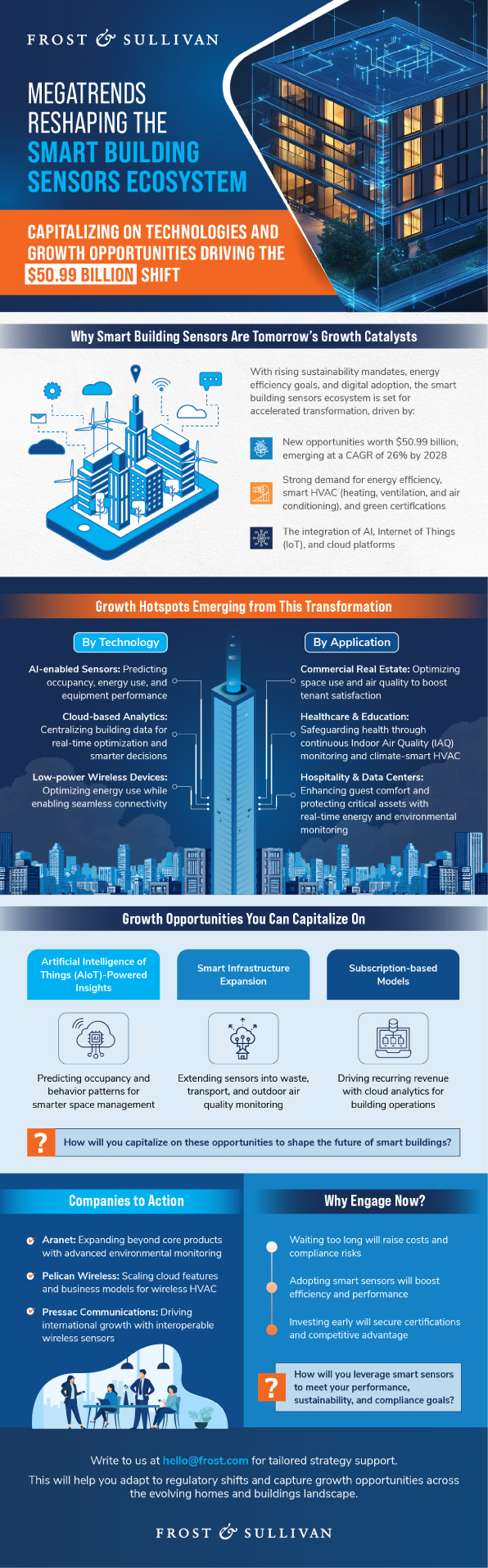
The question is, how will these forces redefine your path towards sustainable buildings?
Access the full analysis to identify growth areas and innovation hotspots.
Strategic Imperative Driving the Future of Smart Building Sensors
These imperatives are pushing businesses to rethink how they approach building strategies:
- Disruptive Technologies: Leveraging IoT, AI, and multifunctional sensors will deliver real‑time insights into building operations, enabling energy optimization, digital twin applications, and enhanced occupant comfort.
- Innovative Business Models: Combining next‑generation sensors with Software‑as‑a‑Service (SaaS) platforms will create recurring revenue streams, as companies monetize insights on occupancy, energy use, and environmental conditions for developers, energy providers, and facility managers.
- Industry Convergence: Embedding sensors into interconnected ecosystems will drive collaboration with architects, engineers, and construction firms to enable HVAC (heating, ventilation, and air conditioning) synchronization, predictive maintenance, and adaptive safety protocols.
Which partnerships and collaborations will help you align growth strategies with these imperatives?
What’s Fueling the Growth of Smart Building Sensors
The adoption of smart building sensors is accelerating as several forces reshape the built environment:
- Integrating IoT, AI, sensor fusion, and cloud analytics is transforming building management. This shift moves operations from reactive fixes to proactive strategies, enabling real‑time decisions, predictive maintenance, and lower costs.
- Driving decarbonization and certifications such as Leadership in Energy and Environmental Design (LEED), International WELL Building Institute certification (WELL), Fitwel, and Regenerative Ecological, Social & Economic Targets (RESET) is fueling demand for wireless sensors, IAQ monitoring, and HVAC solutions.
- Securing $37.5 billion in funding between 2020 and 2024, smart building startups are fueling innovations in IoT platforms, AI‑driven HVAC optimization, digital twins, and energy management.
Are you equipped to turn these growth drivers into long‑term competitive advantages?
Companies to Action
These innovators fall into three categories—general providers, IAQ specialists, and people flow leaders. Together, they show how innovation is transforming efficiency, driving sustainability, and enhancing occupant experience in buildings:
- Milesight: Delivering IAQ, people counting, workplace management, and video surveillance through continuous Research and Development (R&D) and global expansion.
- VergeSense: Enabling advanced workplace analytics with its low‑power Infinity sensor, offering occupancy insights for hybrid offices and commercial real estate.
- Airthings: Advancing health‑focused monitoring with devices like Wave Enhance and Corentium Home 2, supporting compliance and occupant well‑
Is your business prepared to benchmark performance against the companies driving the future of smart, sustainable buildings?
Where the Most Lucrative Opportunities Lie
These growth opportunities will enable companies to strengthen their position and unlock new value:
- Embedding AI into IoT sensors enables predictive analytics on occupancy and behavior patterns. These insights improve efficiency in retail and workplace management while creating new revenue streams.
- Expanding sensor use into waste management, smart transportation, and outdoor air quality monitoring opens new avenues to address urbanization challenges and sustainability goals.
- Moving to software‑driven, subscription‑based services strengthens customer retention and creates recurring revenues through cloud analytics for space utilization and environmental monitoring.
Are you implementing the right best practices to capitalize these emerging growth opportunities?
Get the full guide for actionable strategies and investment priorities.
Next Steps: Building Smarter, Greener, and More Connected Futures
The future of smart buildings hinges on how effectively companies leverage AI, IoT, and cloud‑enabled sensors to reduce costs, meet sustainability targets, and create healthier environments. Sensors have moved from being optional add‑ons to becoming central to building management and optimization.
As adoption accelerates, the businesses that embrace new technologies, adopt scalable business models, and collaborate with leading players will be the ones paving the way for long‑term success.
What steps will your business take to lead the future of smart building sensors?
Looking to prioritize the right investments, explore regional opportunities, or benchmark performance in smart building sensors?
Get in touch with our homes and buildings Growth Experts to know more.