This blog is based on the analysis titled, Cellular Versus Satellite Networks: Coverage, Reach, and Real-World Presence, authored by Frost & Sullivan’s growth expert, Heena Juneja, and lead analyst Avinab Das from the Information and Communication Technology, TechVision team.
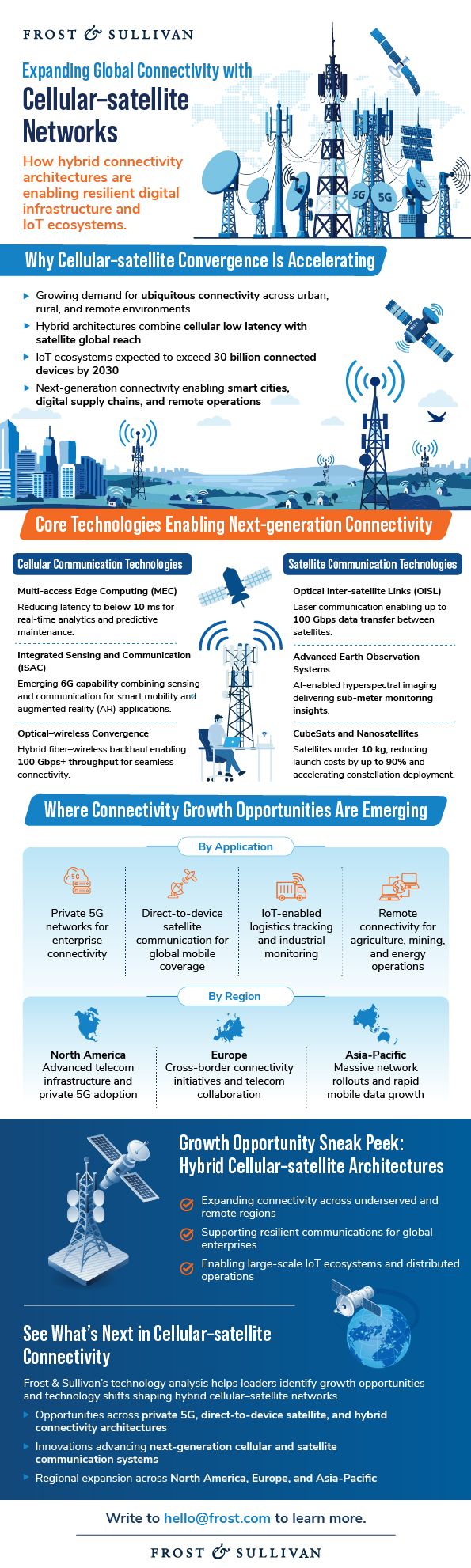
Global connectivity strategies are entering a new phase as cellular and satellite communication technologies begin to converge. Cellular networks have long delivered high-capacity coverage across dense urban environments, while satellite systems have extended communication into remote and geographically challenging regions. Advances in satellite constellations, spectrum utilization, and network integration are now bringing these technologies closer together, enabling hybrid connectivity models capable of delivering reliable communications across previously underserved areas.
This convergence is expanding the role of connectivity beyond traditional telecommunications infrastructure. Hybrid cellular–satellite architectures are increasingly supporting Internet of Things (IoT) ecosystems, enabling agricultural monitoring, global logistics tracking, and industrial operations in locations where terrestrial networks alone cannot deliver consistent coverage.
Cellular–satellite Networks: Unlock the Next Wave of Global Connectivity
Access:
- Emerging technologies transforming hybrid cellular–satellite connectivity
- Regional deployment trends shaping global telecom infrastructure
- Strategic growth opportunities across private 5G, D2D satellite, and IoT ecosystems
As connectivity demand grows across industries, integrating terrestrial and satellite networks will play a central role in building resilient digital ecosystems capable of supporting the next generation of connected services.
Do you have the strategic frameworks to identify where hybrid cellular–satellite networks will create the greatest competitive advantage?
The Impact of the Top 3 Strategic Imperatives on Cellular and Satellite Networks
- Innovative Business Models: Expanding Telecom Revenue Streams
Telecom operators are moving beyond traditional voice and data services to develop new revenue models built around digital platforms, AI, and industry-specific connectivity solutions. These models enable operators to deliver tailored services across sectors such as logistics, agriculture, and smart infrastructure while strengthening customer engagement in competitive markets. - Disruptive Technologies: Direct-to-cell Connectivity
Emerging technologies such as direct-to-cell (D2C) satellite communication and low-earth orbit (LEO) satellite constellations are expanding network reach and enabling seamless integration with cellular infrastructure. These innovations support low-latency connectivity, intelligent network management, and new digital applications across remote and underserved regions. - Industry Convergence: Hybrid Cellular–satellite Networks
The convergence of cellular and satellite technologies is enabling hybrid network architectures that combine terrestrial infrastructure with global satellite coverage. These integrated networks improve resilience, expand connectivity reach, and support growing IoT applications across industries.
Why Cellular–satellite Integration Matters
- Hybrid cellular–satellite networks are closing connectivity gaps across remote and underserved regions.
- Businesses can combine cellular speed with satellite reach to ensure continuous operations.
- Expanding IoT ecosystems are increasing demand for ubiquitous, always-on connectivity.
- Hybrid networks enable real-time data access, resilient infrastructure, and global operational reach.
- Connectivity presence is becoming a strategic differentiator for digital-first enterprises.
Growth Drivers Accelerating Hybrid Cellular–Satellite Connectivity
- IoT and M2M Expansion: Driving Global Device Connectivity
The rapid growth of IoT and machine-to-machine (M2M) ecosystems is increasing demand for networks that can support both dense urban deployments and global coverage. Cellular networks enable high device density in cities, while satellite systems extend connectivity to remote environments. - 5G–satellite Integration: Expanding Hybrid Network Coverage
The integration of 5G infrastructure with satellite systems is enabling hybrid networks that combine high-speed terrestrial connectivity with satellite reach. This approach is expanding reliable coverage across underserved regions and supporting new digital services.
Growth Challenges Affecting Hybrid Connectivity Expansion
- Regulatory and Spectrum Complexity: Slowing Global Deployments
Spectrum allocation and satellite orbital approvals require coordination across multiple jurisdictions, often delaying network deployment timelines. - High Capital Investment Requirements: Limiting Infrastructure Expansion
Cellular tower deployments and satellite launches demand significant capital investment, slowing expansion in cost-sensitive markets.
Is your connectivity strategy prepared to capture the opportunities emerging from hybrid cellular–satellite networks?
Future Megatrends in Cellular and Satellite Communication
Advancements in network intelligence, next-generation infrastructure, and satellite deployments are reshaping how connectivity is delivered across urban and remote environments.
Together, these megatrends are expanding coverage, improving network performance, and enabling new connectivity-driven applications across industries.
- Cellular Communication
- AI-driven Intelligent Networks
AI is enabling predictive maintenance, autonomous network management, and improved operational efficiency across next-generation cellular infrastructure. - Next-generation Air Interface Development
New air interface technologies and spectrum integration are preparing networks for ultra-high-speed communications and future 6G capabilities.
- AI-driven Intelligent Networks
- Satellite Communication
- Rapid LEO Constellation Expansion
The deployment of large LEO satellite constellations is expanding global broadband capacity and improving connectivity across remote and underserved regions. - Reusable Launch Technology
Reusable rocket systems are reducing satellite deployment costs and accelerating commercial satellite service expansion.
- Rapid LEO Constellation Expansion
Which connectivity innovations will define telecom infrastructure through 2030?
Download the sample to explore the full connectivity opportunity landscape
Growth Opportunities Shaping the Cellular–satellite Ecosystem
As connectivity demand expands across industries and geographies, three high-impact growth opportunities are emerging across cellular and satellite technologies.
- Expansion of 5G and Private Networks
Enterprises are adopting private 5G networks to enable secure, low-latency connectivity for industrial automation, smart manufacturing, and real-time analytics. Demand is rising across sectors such as electronics, semiconductors, and advanced manufacturing.
Opportunity signal: Over USD 1 billion market potential within five years. - Direct-to-device (D2D) Satellite Connectivity
Satellite-enabled smartphones are enabling direct device connectivity in remote regions and emergency scenarios, extending mobile coverage beyond terrestrial infrastructure.
Opportunity signal: Growing adoption across mobility, public safety, and global logistics applications. - Hybrid Cellular–satellite Integration
Integrated terrestrial–satellite architectures are emerging as the foundation for global connectivity, supporting IoT deployments and resilient communications across distributed operations.
Opportunity signal: High adoption potential across agriculture, logistics, and remote industrial environments.
Frequently Asked Questions
1.What is the difference between cellular and satellite networks?
Cellular networks rely on terrestrial infrastructure such as towers and base stations to deliver high-speed connectivity in densely populated regions. Satellite networks use orbiting satellites to provide communication coverage across large geographic areas, including remote locations where terrestrial infrastructure is limited.
2.Why are cellular and satellite networks converging?
Cellular and satellite technologies are converging to create hybrid connectivity models that combine cellular speed and low latency with satellite’s global coverage. This integration helps address connectivity gaps in rural regions, supports IoT applications, and enables resilient communication networks for industries operating across diverse environments.
3.What industries benefit most from hybrid cellular–satellite connectivity?
Industries with distributed or remote operations benefit significantly from hybrid connectivity. These include agriculture, logistics, mining, maritime operations, energy infrastructure, and disaster response services that require reliable connectivity across both urban and remote environments.
4.What are the key growth opportunities in cellular and satellite communications?
Key growth opportunities include the expansion of private 5G networks for enterprise applications, direct-to-device satellite connectivity enabling mobile communication without terrestrial coverage, and hybrid cellular–satellite architectures supporting global IoT deployments and resilient communication networks.
Ready to Lead the Transformation?
- Book a Growth Strategy Session: Align your growth roadmap with Frost & Sullivan’s visionary Growth Pipeline™ Dialog.
- Engage with Growth Experts: Co-design AI-enabled, data-driven operating models that scale industry-specific and commercial impact.
- Share Your Transformation Story: Position your organization as a transformation leader through Frost & Sullivan’s Transformational Growth Leadership platform.
- Join the Growth Council: Collaborate with industry leaders shaping the future of your ecosystem.
- Nominate for the Best Practices Recognition: Be recognized for excellence in growth strategy, execution, and customer impact.
- Demonstrate Industry Positioning on the Frost Radar™: Benchmark your growth performance and innovation strength against industry competitors.
- Activate Brand & Demand Growth: Accelerate awareness, engagement, and revenue growth through integrated brand and demand generation strategies.