With advancements in digital infrastructure, business models, and disruptive technologies, the global data centers and colocation services industry is undergoing rapid transformation. Now, as AI adoption accelerates, providers are evolving beyond traditional space-and-power offerings toward interconnected digital ecosystems that combine high-density infrastructure, intelligent orchestration, private AI connectivity, and validated deployment environments.
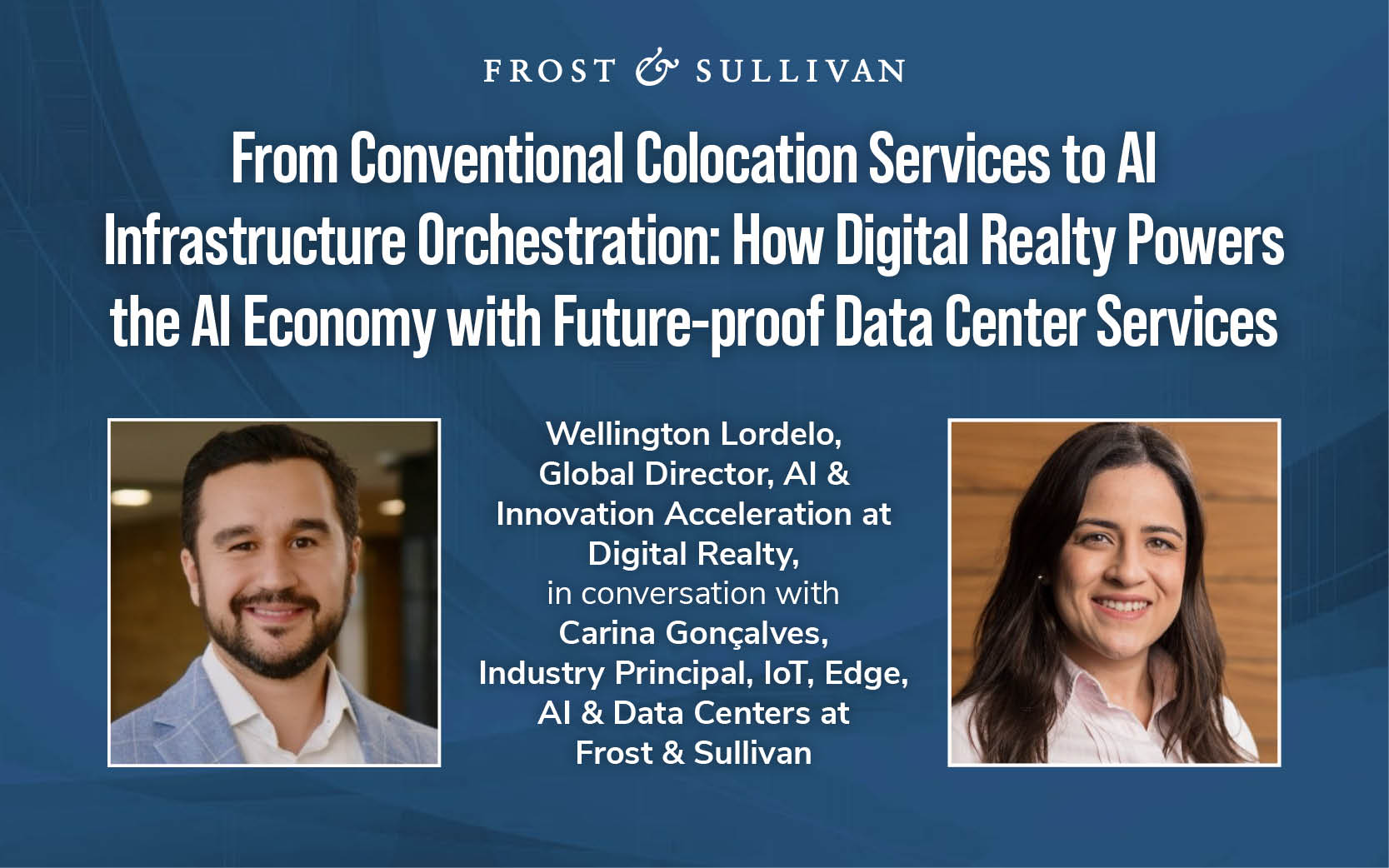
In this Movers & Shakers conversation, Wellington Lordelo, Global Director, AI & Innovation Acceleration at Digital Realty, speaks with Carina Gonçalves, Industry Principal, IoT, Edge, AI & Data Centers at Frost & Sullivan, about the company’s transition from traditional colocation services to AI-enabled digital infrastructure platforms, the emergence of interconnected AI ecosystems, high-performance connectivity, and the future of data centers as intelligent AI factories.
“The shift to AI has pushed us toward “zone-based” design. Instead of treating the entire data hall as a homogeneous environment, we’re designing zones optimized for different density profiles within the same campus. That lets us serve a customer who needs 10kW traditional IT racks alongside a customer running 100kW GPU clusters, with appropriate cooling, power distribution, and airflow management for each”
–Wellington Lordelo, Global Director, AI & Innovation Acceleration at Digital Realty
From Colocation to Orchestration: Moving Up the AI Value Chain
Carina Gonçalves: As AI transforms digital infrastructure, how is Digital Realty repositioning itself beyond traditional services to capture value higher up the stack (interconnection, orchestration, and AI platform enablement)?
Wellington Lordelo: Digital Realty has over 20 years of experience helping customers of all sizes with their hybrid IT and digital transformation efforts. PlatformDIGITAL® is designed as a data meeting place, not just a space-and-power provider. AI has added complexity to typical enterprise workloads, and our heritage and expertise is with these highly complex, high-density environments. Right now, enterprises need more than a rack and a cross-connect. They need an environment where their data, their cloud providers, their OEM infrastructure, and their network partners all converge in a controlled, private setting.
We launched the Digital Realty Innovation Lab, or DRIL, in Northern Virginia in 2025, and we’ve already expanded it to Singapore, Japan, and London. DRIL is a production-grade validation environment where enterprises can test AI workloads at densities up to 150kW per cabinet, connected to real cloud and network providers through ServiceFabric®, our service orchestration platform. We’ve also introduced the Private AI Exchange, AIPx, which uses ServiceFabric to enable private, high-performance connectivity between AI ecosystem participants.
So, when you ask about moving up the stack, the answer is: interconnection, orchestration, and ecosystem enablement are not future plans. They’re in production today.
Growth Strategies: Building AI-ready Data Centers
Carina Gonçalves: What core technical and operational characteristics define “AI-ready” data center infrastructure in your growth strategy over the next 3–5 years?
Wellington Lordelo: I’d frame it across four dimensions:
- First, power density and flexibility: the ability to support 50kW to 150kW-plus per cabinet with both air and liquid cooling options, and to do that within existing campuses, not just purpose-built greenfield sites.
- Second, interconnection depth: AI workloads are not standalone. They depend on access to data sources, model repositories, cloud endpoints, and GPU clusters that may live across multiple providers. ServiceFabric gives us that fabric-level connectivity.
- Third, validation infrastructure: the DRILs give customers the ability to test before they deploy, which reduces risk and accelerates time to production.
- Fourth, operational maturity: AI infrastructure functions differently than traditional IT. Thermal management, power distribution, and workload orchestration all require a level of operational sophistication that comes from running 300-plus data centers across 30+ countries.
Over the next three to five years, the definition of “AI-ready” will continue to evolve, but the foundation is power, connectivity, validation, and operational depth. Importantly, AI-ready liquid-cooled data center infrastructure can be delivered in 12 to 16 weeks.
The Ecosystem Play: Delivering Value Beyond Infrastructure
Carina Gonçalves: Across the AI infrastructure stack, where do you see the most significant avenues for value creation—power access, land and real estate, interconnection ecosystems, or digital/platform services?
Wellington Lordelo: The most durable value creation is within the interconnection ecosystem and the platform services that enable enterprises to consume AI infrastructure without building it themselves.
Think about what happens when an enterprise wants to deploy a private AI workload. They need GPU compute, they need low-latency access to their data, they need connectivity to their cloud providers, and they need all of that in a secure, compliant environment. The provider that can assemble that stack, not just the real estate but the ecosystem around it, captures disproportionate value. That’s why we’ve been so intentional about ServiceFabric, DRILs, and building pre-validated solutions with OEM partners.
At production scale, token economics become an executive-level cost imperative—optimizing token value through proprietary data and token cost through owned infrastructure. Nobody counted tokens in pilots. At production scale, the CFO does, and that math leads to one place: owned infrastructure that transitions an enterprise from a token buyer to a token factory.
AI Workload Dynamics: Training vs. Inference
Carina Gonçalves: How do the differing requirements of AI training versus inference workloads influencing your data center design choices and geographic deployment strategy?
Wellington Lordelo: Training and inference are fundamentally different workloads, and they impose different requirements on infrastructure:
- Training is GPU-dense, power-hungry, and latency-tolerant within the cluster but extremely sensitive to interconnect bandwidth between nodes. It tends to concentrate in large-scale campuses where you can deliver hundreds of megawatts and high-density liquid cooling. Northern Virginia, Dallas, Chicago, and increasingly international regions like Singapore are natural training hubs because of power availability and network density.
- Inference is the opposite in some ways. It’s latency-sensitive to the end user, lower density per node, but high volume and geographically distributed. As AI moves from training to production inference, the deployment model starts to look more like content delivery: you need points of presence close to where the data lives and where the users are. Our global footprint of 300-plus facilities across 55 metros is advantageous for inference distribution.
We’re also seeing hybrid patterns where customers want to train centrally and infer at the edge or at regional hubs, which is exactly the architecture PlatformDIGITAL® was designed to support.
Additionally, we are moving from simple chatbots to agentic AI. Agents act as a demand multiplier, requiring orders of magnitude more tokens per task, converting inference into a massive, persistent baseload that must live in the metro.
Innovation in Action: Liquid Cooling and Zone-based Design
Carina Gonçalves: As GPU and accelerator densities increase, what innovations are you implementing in rack design, cooling, and facility layout to support extreme density environments?
Wellington Lordelo: We’ve deployed direct liquid cooling capability across 170 data centers globally, which proves our operational scale. We support rack densities above 100kW per cabinet in facilities like our Woking campus in London, where we recently completed a liquid-cooled, high-performance compute (HPC) cluster deployment. Our DRIL facilities are designed for up to 150kW per cabinet with direct liquid cooling as a standard option. Recently, in Q1 2026, we landed a Life Sciences AI deployment in Phoenix and Amsterdam, supporting 140 to 150 kW per rack using NVIDIA GB300 systems across two continents.
On facility layout, the shift to AI has pushed us toward what I’d call “zone-based” design. Instead of treating the entire data hall as a homogeneous environment, we’re designing zones optimized for different density profiles within the same campus. That lets us serve a customer who needs 10kW traditional IT racks alongside a customer running 100kW GPU clusters, with appropriate cooling, power distribution, and airflow management for each. The key innovation isn’t any single cooling technology. It’s the ability to offer a continuum of density and cooling options within a unified operational framework, so customers aren’t locked into a single deployment model as their workloads evolve.
We’ve been doing liquid cooling for over 15 years. That operational expertise sets us apart from operators who may have a gigawatt of power without knowing how to actually bring it to market.
Navigating Growth Challenges Through Strategic Partnerships
Carina Gonçalves: Power has become a primary constraint for AI infrastructure. How are you securing long-term power availability, and what role do grid partnerships, colocation with generation, or energy diversification play?
Wellington Lordelo: Power is the single most critical input in our business, and we treat it that way. We currently have $16.5 billion of CapEx under construction, which translates to 1.2 gigawatts of active development and a massive 5+ gigawatt global land bank. A significant portion of this goes to securing pre-entitled power in Tier 1 metros where vacancy is below 2% and power is structurally constrained.
We work directly with utilities and grid operators years in advance to secure long-term power commitments. A great example of our collaborative approach to power design is our work with NVIDIA at our Brickyard facility in Virginia, which serves as NVIDIA’s AI Factory Research Center and a 96MW AI Factory. We are actively collaborating with NVIDIA to ensure our modular designs and power distribution can handle their upcoming megawatt-scale racks.
Our partnership with NVIDIA, Emerald AI, EPRI, and PJM to develop the world’s first power-flexible AI campus is another example. The idea is that AI workloads can modulate their power consumption in coordination with grid conditions, turning data centers from passive load into active grid participants.
Energy diversification is also critical. We do a tremendous amount of work backing our power with green access through bonds, solar, and wind. Furthermore, we are actively evaluating nuclear—specifically engaging with major Small Modular Reactor (SMR) manufacturers around the world. The consistent, predictable baseload profile of an AI data center is almost uniquely suited to nuclear generation. We’re pragmatic about this: renewables for what they do well, nuclear for long-term baseload, and tight grid partnerships for reliability.
Preparing for Transformative Megatrends: Sustainability and Decarbonization
Carina Gonçalves: How are you evolving your sustainability strategy to reconcile AI-driven energy consumption with carbon reduction commitments? What role do emerging solutions like nuclear, microgrids, on-site generation play?
Wellington Lordelo: This is the tension every infrastructure provider is navigating, and I think intellectual honesty matters here. AI workloads are energy-intensive. Pretending otherwise doesn’t help anyone. What we can do is ensure that every megawatt we add is as clean and efficient as possible, and that we’re investing in technologies that will bend the curve over time.
In 2024, we matched 75% of our global electricity needs with renewable energy, a nine-point increase year over year. We matched 185 data centers with 100% renewable energy. Our collaboration with Vattenfall in Sweden pioneered 24/7 hourly renewable energy matching, not just annual certificate-based matching but real-time, granular tracking of carbon-free consumption. On emerging solutions, we see nuclear, particularly SMRs, as a credible path to carbon-free baseload generation that matches data center load profiles. We’re also investing in grid-flexible power management through our collaboration with NVIDIA and Emerald AI, which allows AI workloads to respond dynamically to grid conditions and renewable availability. The sustainability strategy isn’t about choosing between growth and decarbonization. It’s about making growth cleaner at every step and being transparent about where we are on that journey.
The Interconnection Advantage and Data Gravity
Carina Gonçalves: How does PlatformDIGITAL® enable AI ecosystems in terms of data gravity, interconnection, and hybrid/multi-cloud orchestration?
Wellington Lordelo:
PlatformDIGITAL® was built on the principle of data gravity: the recognition that as data accumulates in a location, it becomes increasingly difficult and expensive to move, so the applications, analytics, and services need to come to the data. While training datasets are massive, it is agentic inference that requires real-time reasoning against live enterprise data. You cannot shuttle that data back and forth to a remote cloud without destroying your “time-to-context” and degrading model performance.
ServiceFabric is the interconnection layer that makes this work. It enables private, high-performance connectivity between participants in an AI ecosystem: the enterprise with the data, the cloud provider with the compute, the OEM with the hardware, the network provider with the transport.
The Private AI Exchange, AIPx, extends this into a structured environment where these participants can connect and transact privately, without traversing the public internet.
Are we seeing demand for AI-specific ecosystems? Absolutely. Customers are asking for environments where they can access GPU compute, connect to model providers, and process sensitive data, all within a controlled, auditable perimeter. That’s not a future roadmap item. That’s what DRIL and AIPx are delivering today.
Capitalizing on Disruptive Technologies: AI and Automation in Data Center Operations
Carina Gonçalves: With rising complexity in AI infrastructure, what role will automation, telemetry, and AI-driven operations play in improving efficiency, performance, and uptime across your portfolio?
Wellington Lordelo: Operating 300-plus data centers across 30+ countries generates an enormous amount of operational data, and we’re increasingly using AI and machine learning to extract value from that data. Predictive maintenance, thermal optimization, capacity planning, and anomaly detection are all areas where AI-driven operations improve both efficiency and reliability.
The NVIDIA collaboration at our Manassas campus includes exploration of innovative approaches to power management and energy efficiency, which is fundamentally an AI-operations challenge. When you’re running facilities at 100kW-plus per rack with liquid cooling, the margin for error in thermal management shrinks considerably. AI-driven telemetry helps us detect drift before it becomes a problem, optimize cooling delivery in real time, and make capacity planning decisions based on actual workload patterns rather than static assumptions. I’d also note that automation plays a critical role in interconnection. ServiceFabric enables programmatic provisioning of connectivity, which means customers can spin up new connections, adjust bandwidth, and configure routing without manual intervention. As AI workloads become more dynamic, that kind of operational agility becomes essential.
Closing Reflections: Growth Opportunities in The Data Center Vision for 2030
Carina Gonçalves: Looking towards 2030, how will data centers differ from today in terms of scale, architecture, and role in the AI economy? What is the one major strategic bet you are making for the next decade?
Wellington Lordelo: By 2030, data centers will look fundamentally different in three ways.
- First, power density will be an order of magnitude higher than today’s conventional facilities. Facilities designed for 5 to 10 kW per rack will be legacy. The standard will be 50kW and above, with liquid cooling as the default, not the exception.
- Second, the architecture will be heterogeneous: CPU, GPU, custom accelerators, quantum processing units, and emerging compute paradigms coexisting within the same facility, connected by high-bandwidth, low-latency fabrics. Quantum computing is moving from lab curiosity to operational reality, and data centers will need to accommodate quantum systems alongside classical infrastructure, with the cooling, power, and connectivity profiles those systems require. The hybrid classical-quantum workflow, where quantum processors handle specific optimization or simulation tasks and hand off results to classical compute, will demand a new level of architectural flexibility.
- Third, the role in the AI economy will shift from passive hosting to active orchestration. Data centers will be AI factories, not storage units.
Our strategic bet is on ecosystem density. The provider that assembles the richest ecosystem of compute, connectivity, data, and services, including next-generation paradigms like quantum, within a unified platform will define the next era of digital infrastructure. That’s why we’re investing in PlatformDIGITAL®, ServiceFabric, the DRIL network, and pre-validated AI solutions with OEM partners. The DRIL model is particularly relevant here: as quantum systems mature, enterprises will need the same kind of validation environment for quantum workloads that they need for AI today, a place to test, benchmark, and integrate before committing to production. We believe the future belongs to platforms that make advanced infrastructure consumable, not just available.
The data center of 2030 won’t be defined by how many megawatts it can deliver. It will be defined by how effectively it connects the participants in the AI and quantum economy and reduces the friction between having a capability and putting it into production.

About Wellington Lordelo
Wellington Lordelo is the Global Director of AI and Innovation at Digital Realty, where he drives cutting-edge solutions that help enterprises and service providers harness the power of AI and data-driven strategies for digital transformation. With over 20 years of experience in IT and telecom, Wellington has a proven track record of collaborating globally with Fortune 500 companies on multi-cloud solutions, data center optimization, and enterprise strategy. He holds the main certifications in Generative AI, Network and has spoken at numerous industry events across the Americas.
Carina Gonçalves is an ICT specialist with deep expertise in data center infrastructure and AI markets, currently serving as an Industry Principal at Frost & Sullivan. As a strategic analyst and trusted advisor, she delivers actionable market intelligence and consulting insights that enable clients to navigate the evolving data center landscape, identify growth opportunities, and make informed, data-driven investment and operational decisions.

About Carina Gonçalves
Ready to Lead the Transformation?
Frost & Sullivan’s Transformational Growth Leadership program provides the intelligence, best practices, growth opportunities, and expertise organizations need to thrive through the evolution of data centers, colocation services, and digital infrastructure solutions. The question then is, what can you do to thrive through this transformation?
- Book a Growth Dialog:Align your organization’s infrastructure and IT strategy with Frost & Sullivan’s Growth Pipeline™ Dialog.
- Engage with Growth Experts:Co-design AI-enabled, data-driven tools, platforms, and services that help scale industry-specific and commercial impact.
- Share Your Transformation Story: Position your organization as a transformation leader in data centers and colocation services through Frost & Sullivan’s Transformational Growth Leadership program.
- Join the Growth Council:Collaborate with cross-industry leaders shaping the future of ICT ecosystems.
- Nominate for Best Practices Recognition:Be recognized for excellence in data center services, interconnection, hybrid/multi-cloud orchestration, and customer impact.
- See Your Competitive Positioning on the Frost Radar™:Benchmark your growth performance and innovation strengths against your top competitors.
- Activate Brand & Demand Growth:Accelerate awareness, engagement, and revenue growth through integrated brand and demand generation strategies.
Appendix
To know more about growth opportunities, megatrends, companies to action, and best practices in data centers and colocation services landscape view our latest portfolio of growth analyses on the subject: