This blog is based on our analyses Human-machine Integration/Manned-unmanned Teaming, Global, 2025–2027 and Military Unmanned Ground Vehicles, Global, 2024–2030 authored by growth expert Wayne Shaw and lead analyst Shreya Khakurel from the Aerospace and Defense Practice Area.
Human-machine Teaming Is Becoming a Defense Program Priority
Defense modernization is shifting from standalone unmanned assets to coordinated force structures where crewed platforms, autonomous systems, sensors, and control layers operate within a unified mission architecture.
MUM-T is emerging at the center of this transition across air, land, and naval operations. Military unmanned ground vehicles (UGVs) bring the shift closer to ground force planning, where autonomy is increasingly tied to survivability, operational reach, persistence, and mission flexibility.
Turning MUM-T and UGV Momentum into Growth Action
Frost & Sullivan’s sample analysis helps defense firms assess:
- Strategic Imperatives shaping MUM-T and UGV adoption
- Growth Opportunities across procurement, R&D, and edge autonomy
- Capability priorities across secure coordination, modular systems, and ground robotics
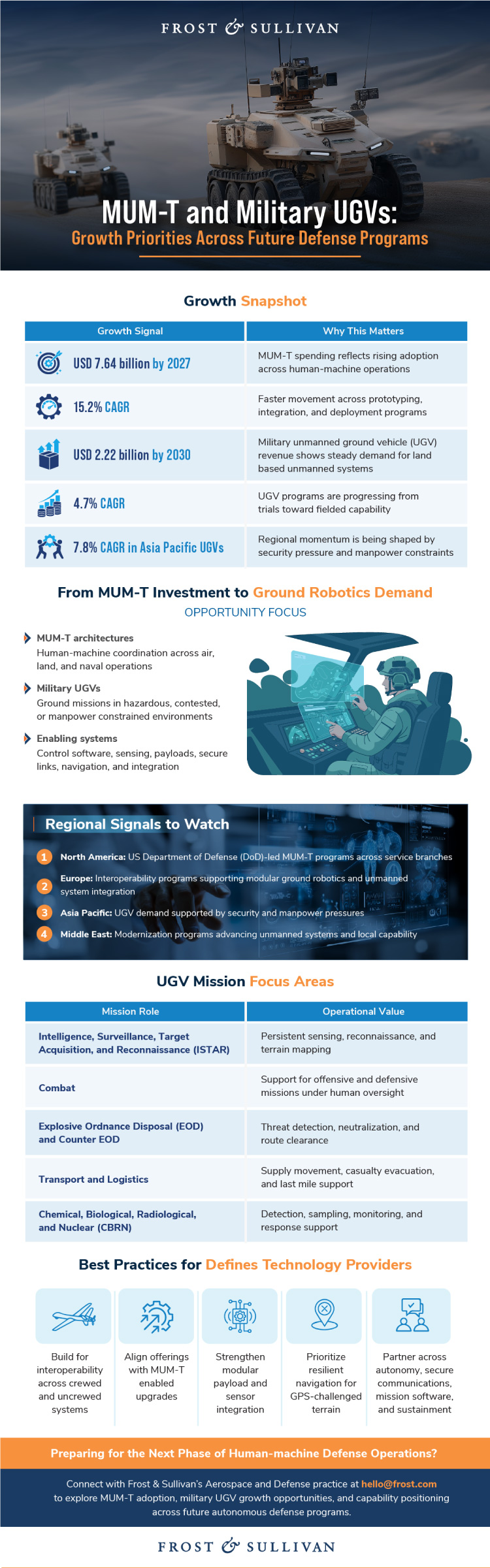
MUM-T spending is forecast to reach USD 7.64 billion by 2027, while military UGV revenue is projected to rise to USD 2.22 billion by 2030. For autonomy, robotics, mission systems, and integration providers, the opportunity is moving beyond platform supply toward the technologies that make human-machine operations reliable, interoperable, and program aligned.
Listen to Our Growth Podcast Episode on MUM-T, Military UGVs, and Autonomous Defense Operations
Strategic Imperatives Shaping MUM-T and UGV Adoption
As MUM-T and military UGV programs enter broader capability planning, three Strategic Imperatives are influencing where defense investment, partnerships, and program priorities are forming.
- Transformative Megatrends: Unmanned systems are gaining strategic relevance as defense forces prioritize greater survivability, wider mission reach, and safer execution across hazardous environments.
- Disruptive Technologies: Autonomy, sensing, edge processing, secure connectivity, and swarming technologies are reshaping how crewed and uncrewed systems coordinate across complex missions.
- Competitive Intensity: Defense primes, robotics specialists, autonomy firms, and nontraditional technology providers are competing for roles as modular and platform agnostic systems gain procurement relevance.
Taken together, these forces are pushing program value toward coordination, integration, and mission control rather than platform capability alone.
Key Growth Drivers Accelerating MUM-T and Military UGV Adoption
MUM-T and military UGV adoption is gaining pace as defense forces prioritize safer mission execution, faster coordination, and adaptable system design.
- Emerging military concepts of operation: MUM-T is becoming relevant as forces coordinate crewed and uncrewed platforms across air, land, and naval missions.
- Open system architecture: Modular designs are helping defense teams integrate sensors, payloads, communication systems, and autonomy modules with lower redesign complexity.
- Networked battlefield awareness: UGVs are gaining value as connected assets that support distributed sensing, reconnaissance, and mission coordination.
- Longer mission endurance: Battery improvements, hybrid power systems, and thermal management advances are expanding the operational use case for ground robotics.
For defense firms, the demand signal is moving toward adaptable systems, cleaner integration, resilient connectivity, and mission ready autonomy.
Key Challenges Shaping MUM-T and Military UGV Deployment
As MUM-T and military UGV programs move closer to field use, deployment will depend on how effectively defense firms address operational risk, integration complexity, and human control requirements.
- Cyber and electronic warfare exposure: MUM-T depends on secure wireless communication, making protected data exchange and network resilience essential to mission continuity.
- Operator workload: Managing several unmanned assets can increase cognitive pressure unless interfaces, controls, and training models are built around human decision making.
- Interoperability gaps: Differing standards, radios, data links, and platform architectures can slow coordination across air, land, and naval operations.
- Ground autonomy limitations: UGV deployment remains constrained by cluttered terrain, debris, vegetation, urban environments, and global positioning system (GPS) challenged conditions, limiting broader confidence in fully unmanned ground operations.
Program confidence will depend on secure coordination, simpler control, cleaner integration, and field ready autonomy.
Growth Opportunities Accelerating Across MUM-T and Military UGV Programs
The strongest growth opportunities are emerging where converging defense technologies, onboard intelligence, and distributed sustainment capabilities are accelerating the transition of MUM-T and military UGV programs from development to field readiness.
- Defense Tech’s Impact on the MUM-T Industry: Emerging technology firms, startups, academic institutions, and defense innovation ecosystems are bringing AI, autonomy, sensor integration, secure communications, and additive manufacturing into MUM-T development, reducing timelines and supporting scalable modular systems.
- Edge AI and Onboard Learning: UGVs operating in degraded or contested connectivity environments are creating demand for local data processing, onboard machine learning (ML) models, low latency response, and adaptive mission behavior with reduced dependence on centralized command nodes.
- Additive Manufacturing: Digital engineering and 3D printing are improving UGV sustainment by enabling localized fabrication, repair, and modification of components such as mounts, brackets, housings, and sensor enclosures in austere or contested environments.
For defense firms, program value is shifting toward technologies that improve modularity, mission continuity, local autonomy, and sustainment responsiveness across human-machine defense operations.
Companies to Action Across Human-machine Defense Operations
MUM-T and military UGV programs are creating stronger relevance for companies that can translate autonomy, sensing, secure coordination, and deployable robotics into field-ready defense capability.
- L3Harris Technologies: Its MUMT-X (Manned-Unmanned Teaming eXpanded) work on AH 64 Apache upgrades signals growing demand for systems that connect crewed aircraft with unmanned assets in coordinated missions.
- QinetiQ: Its Squad Packable Utility Robot (SPUR) and mini-SPUR procurement for the US Coast Guard reflects demand for modular robotic systems supporting ISR (Intelligence, Surveillance, and Reconnaissance) and explosive ordnance disposal (EOD) applications.
- Hanwha Aerospace: Its specialized EOD tactical robot procurement in South Korea shows how military UGVs are supporting bomb disposal, route clearance, and surveillance in high-risk environments.
- Milrem Robotics: Its THeMIS (Tracked Hybrid Modular Infantry System) procurement for Japan reflects the role of modular unmanned ground platforms in surveillance, intelligence, and EOD or counter EOD missions.
These innovators point to a growth pathway where company relevance is tied less to standalone platforms and more to mission integration, modular robotics, and autonomous coordination across defense operations.
Charting the Next Path for Human-machine Defense Operations
As MUM-T and military UGV programs mature, differentiation will depend on how well firms support integration, command confidence, and reliable performance in contested environments.
Unmanned platforms will remain important, but program relevance will increasingly come from the systems that connect control, sensing, communications, payloads, and mission integration.
Ready to Lead the Transformation?
- Book a Growth Strategy Session: Align your growth roadmap with Frost & Sullivan’s visionary Growth Pipeline™ Dialog.
- Engage with Growth Experts: Co-design AI-enabled, data-driven operating models that scale industry-specific and commercial impact.
- Share Your Transformation Story: Position your organization as a transformation leader through Frost & Sullivan’s Transformational Growth Leadership platform.
- Join the Growth Council: Collaborate with industry leaders shaping the future of your ecosystem.
- Nominate for the Best Practices Recognition: Be recognized for excellence in growth strategy, execution, and customer impact.
- Demonstrate Industry Positioning on the Frost Radar™: Benchmark your growth performance and innovation strength against industry competitors.
- Activate Brand & Demand Growth: Accelerate awareness, engagement, and revenue growth through integrated brand and demand generation strategies.