Loitering munitions (LMs) are gaining budget attention because they combine intelligence, surveillance, and reconnaissance (ISR), beyond-line-of-sight (BLOS) engagement, and precision effects within a single expendable system.
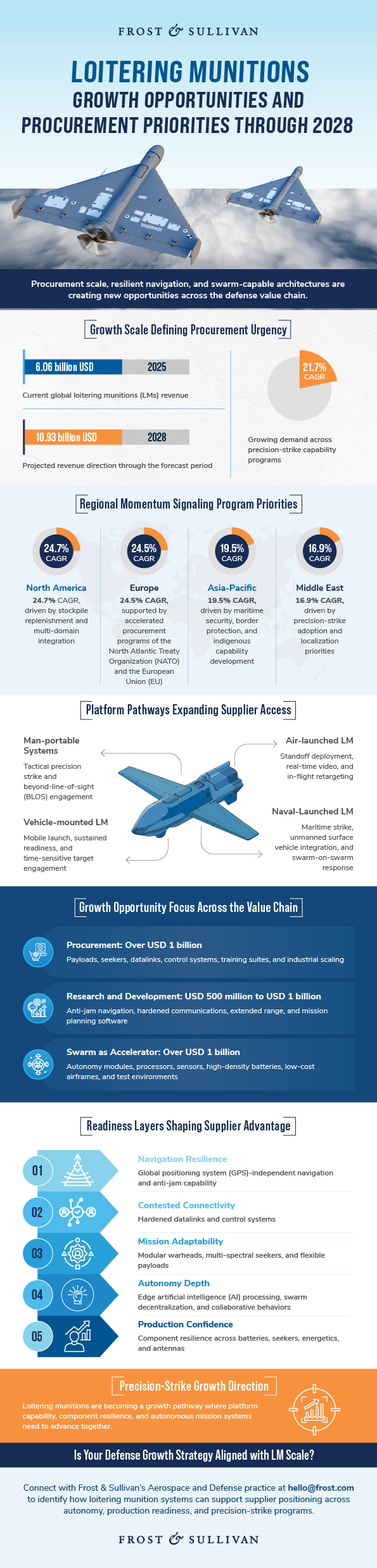
Global revenue is projected to grow from USD 6.06 billion in 2025 to USD 10.93 billion by 2028, reflecting a 21.7% CAGR. For defense original equipment manufacturers (OEMs), systems integrators, autonomy specialists, sensor providers, and component suppliers, supplier opportunity is concentrating around the systems that determine deployment scale, mission reliability, and integration readiness. Seekers, payloads, datalinks, propulsion, mission software, modular warheads, training suites, and swarm-capable architectures are becoming central to how loitering munition systems gain program relevance across land, air, and naval operations.
Precision-Strike Growth Priorities for Defense Suppliers
Frost & Sullivan’s sample analysis helps defense OEMs, systems integrators, autonomy specialists, and component suppliers assess:
- Procurement signals across land, air, and naval launch platforms
- Supplier roles across seekers, payloads, datalinks, and modular warheads
- Readiness risks tied to GPS-denied navigation and electronic warfare (EW)
- Growth Opportunities in R&D, swarm-capable architectures, and production scale
Strategic Imperatives Defining Precision-strike Advantage
Three Strategic Imperatives are influencing where loitering munitions gain procurement relevance, supplier attention, and technology depth.
- Geopolitical Chaos: High-intensity conflicts and regional instability are raising demand for accurate, longer-range strike systems that can reduce collateral damage and support faster tactical response.
- Competitive Intensity: Defense primes, start-ups, and specialist firms are competing for roles as demand rises, supply chains tighten, and collaboration becomes more important to production scale.
- Disruptive Technologies: Global positioning system (GPS)-independent navigation, swarm decentralization, hybrid propulsion, Edge artificial intelligence (AI) processing, and multi-spectral seekers are becoming key differentiators for loitering munition systems in contested environments.
How prepared is your organization to seize emerging growth opportunities in research and technology development?
Growth Forces and Readiness Pressures Shaping Adoption
Loitering munitions are gaining program relevance because they address two procurement priorities at once: precision effects at lower cost and tactical flexibility in contested environments. Their role is expanding as defense forces reassess where conventional artillery, airstrikes, and traditional guided missiles create cost, timing, or exposure constraints.
What is accelerating demand
- The Changing Nature of Warfare: Conflicts across Ukraine, the Middle East, and the Indo-Pacific are increasing demand for low-cost strike options that support precise engagement in asymmetric, urban, and contested conditions.
- Multi-role LM: Loitering munition systems combine ISR, precision strike, and battle-damage assessment in one modular platform, improving mission flexibility while reducing logistics burden.
- AI and Swarm-enabled Munitions: Autonomous target detection, collaborative behaviors, and distributed engagement are extending the value of loitering munitions across scalable precision-strike programs.
What could affect program scale
- Component availability: Specialized microelectronics, propulsion materials, seekers, batteries, energetics, and antennas can affect production timelines during demand surges.
- Mission performance limits: Smaller systems face range, endurance, and warhead capacity trade-offs.
- GPS-denied conditions: Jamming, signal denial, and adverse weather increase the need for navigation reliability.
- Autonomy risk: Human-in-the-loop requirements can influence how autonomous target acquisition and swarm-capable deployments progress.
Program confidence will depend on how tactical value aligns with production resilience, navigation reliability, and credible autonomy controls.
Growth Opportunities Across Procurement, R&D, and Swarm-capable Systems
The strongest growth pathways are forming where near-term procurement, technology development, and scalable autonomy intersect.
- Procurement: Valued at over USD 1 billion, this opportunity is tied to payloads, seekers, datalinks, control systems, virtual training, plug-and-play warheads, and industrial scaling support as loitering munitions move into larger acquisition cycles.
- Research & Development: With an opportunity size of USD 500 million to USD 1 billion, R&D priorities are centered on anti-jam navigation, hardened communications, flexible payloads, extended range, mission planning software, and sensor-to-shooter automation.
- Swarm as Accelerator: Valued at over USD 1 billion, this pathway is expanding around autonomy modules, processors, sensors, high-density batteries, low-cost airframes, simulation environments, and software-in-the-loop testing.
These opportunities point to a supplier landscape where program relevance depends on capability depth, production readiness, and integration strength across loitering munition systems.
Supplier Positioning Across Precision-strike Programs
Competitive relevance is concentrating around suppliers that can support platform integration, localized production, and industrial scaling. AeroVironment, Anduril Industries, Teledyne FLIR, MBDA, Rheinmetall, WB Group, Israel Aerospace Industries (IAI), Rafael Advanced Defense Systems, Elbit Systems, UVision, EDGE Group, and Innovaero reflect a supplier base spanning defense primes, specialist firms, and regional manufacturers.
Program activity across the United States, Europe, the Middle East, and Asia-Pacific shows a stronger focus on partnerships, sovereign production, and faster fielding. Advantage is forming where loitering munition systems connect payloads, seekers, datalinks, launch integration, and production readiness.
Charting the Next Path for Loitering Munition Growth
Loitering munitions are becoming a precision-strike growth lever where affordability, autonomy, and readiness are influencing procurement choices. The next phase will be shaped less by platform availability and more by how production scale, resilient components, platform integration, and swarm-capable architectures connect across land, air, and naval programs.
For defense leaders, the value lies in identifying where procurement demand, R&D, and supplier capabilities are likely to concentrate through 2028. The strongest growth pathways will form where capability priorities align with regional programs, technology differentiation, and execution readiness.
Ready to Lead the Transformation?
- Book a Growth Strategy Session: Align your growth roadmap with Frost & Sullivan’s visionary Growth Pipeline™ Dialog.
- Engage with Growth Experts: Co-design AI-enabled, data-driven operating models that scale industry-specific and commercial impact.
- Share Your Transformation Story: Position your organization as a transformation leader through Frost & Sullivan’s Transformational Growth Leadership platform.
- Join the Growth Council: Collaborate with industry leaders shaping the future of your ecosystem.
- Nominate for the Best Practices Recognition: Be recognized for excellence in growth strategy, execution, and customer impact.
- Demonstrate Industry Positioning on the Frost Radar™: Benchmark your growth performance and innovation strength against industry competitors.
- Activate Brand & Demand Growth: Accelerate awareness, engagement, and revenue growth through integrated brand and demand generation strategies.
FAQs
1. What are loitering munitions?
Loitering munitions are expendable weapon systems that combine intelligence, surveillance, and reconnaissance (ISR), loiter capability, and precision strike in one platform.
2. Why are loitering munition systems gaining defense priority?
Loitering munition systems support lower-cost precision effects, faster target response, and beyond-line-of-sight (BLOS) engagement across asymmetric, urban, and contested environments.
3. How does GPS denied navigation affect loitering munitions?
Global positioning system (GPS) denied navigation can reduce mission reliability when jamming, signal denial, adverse weather, or electronic disruption affects guidance performance.
4. What role do swarm munitions play in precision-strike programs?
Swarm munitions support distributed engagement, collaborative behavior, and scalable strike effects, expanding the operational value of loitering munitions in contested environments.
5. How are autonomous weapons systems influencing supplier priorities?
Autonomous weapons systems are increasing focus on target detection, resilient navigation, hardened datalinks, autonomy modules, and human-in-the-loop controls.
6. Where are growth opportunities emerging in the Loitering Munitions Market?
Growth Opportunities are emerging across procurement, R&D, and swarm-capable architectures, with value tied to seekers, payloads, datalinks, modular warheads, anti-jam navigation, Kamikaze Drone Technology, and Autonomous Precision Strike Systems.