This blog is based on Frost & Sullivan’s recent analysis, “Satellite Communication (SATCOM), Earth Observation (EO), and Position, Navigation, and Timing (PNT) Value Chain Analysis,” authored by Aarthi Kannadoss from the Aerospace and Defense Practice Area.
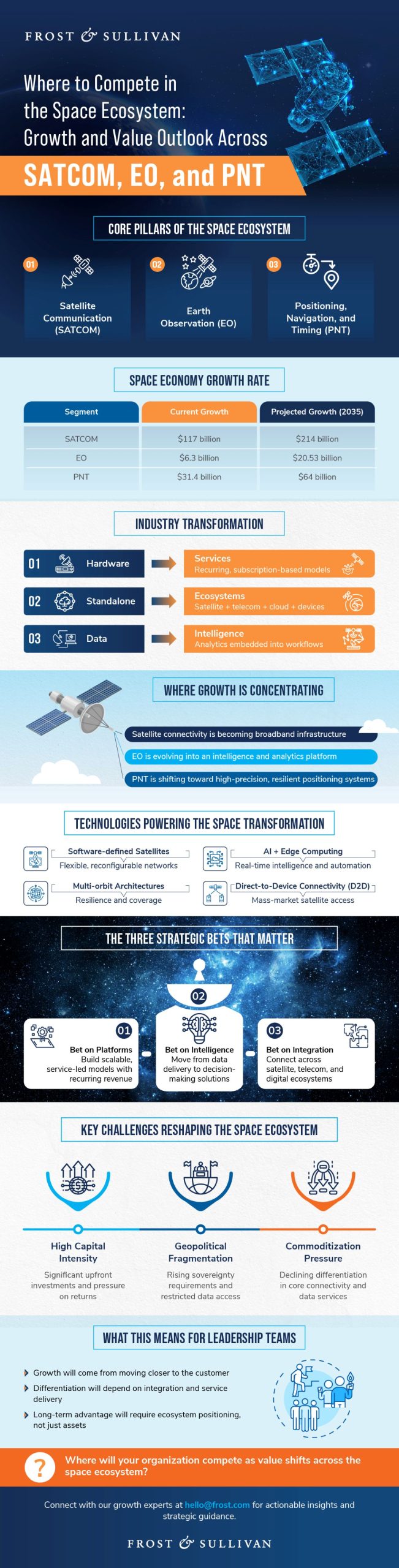
The global space economy is entering a phase of accelerated expansion, with Satellite Communications (SATCOM) projected to grow from $117 billion to over $214 billion by 2035, Earth Observation (EO) expanding at 11% CAGR to $20.5 billion, and Positioning, Navigation, and Timing (PNT) reaching $64 billion.
This growth, driven by Low Earth Orbit (LEO) constellations, software-defined architectures, and recurring service-based models, is accelerating the shift from infrastructure ownership to platform-led value creation. For leadership teams, this transformation is redefining where value pools emerge and how competitive advantage is built.
Where Is Value Shifting Across the Space Ecosystem?
- Identify Growth Opportunities
- Navigate Technology Disruption
- Align Your Strategy
Is your organization positioned to capture value as the space economy shifts toward platform-led ecosystems?
Tune into our Growth Podcast on the Future of the Space Economy to stay ahead of the ecosystem shift.
How the Space Economy Is Shifting Toward Platform-led Growth
The traditional space economy, built on asset-heavy infrastructure and long investment cycles, is evolving into a dynamic, interconnected ecosystem where value is created through integration, data, and services.
Across SATCOM, EO, and PNT, this shift is reshaping how companies compete, monetize, and differentiate. Three structural transitions are driving this transformation:
- From Hardware to Services: Revenue models are moving away from one-time, asset-based transactions toward recurring, subscription and as-a-service offerings, improving revenue predictability and customer lifetime value
- From Standalone Systems to Ecosystems: Satellite operators, telecom providers, cloud platforms, and device manufacturers are converging to deliver integrated, end-to-end solutions, redefining competitive boundaries
- From Data to Intelligence: Particularly in EO, value is shifting downstream—from raw data and imagery to analytics, insights, and decision-support solutions embedded directly into customer workflows
This transformation is compressing value chains and prompting companies to move closer to end users, where differentiation and margins are strongest.
Strategic Imperatives Shaping the Space Ecosystem
Customer Value Chain Compression
Satellite operators are moving downstream from capacity providers to end-to-end service platforms, bundling connectivity, infrastructure, and support to capture higher margins and strengthen customer ownership.
Geopolitical Chaos
Rising global conflicts and data concentration risks are accelerating sovereign EO programs and hybrid commercial models, reshaping access, competition, and regional ecosystem development.
Disruptive Technologies
Increasing reliance on critical positioning and timing systems is driving the shift toward hybrid architectures that integrate Global Navigation Satellite System (GNSS), LEO, and alternative technologies to ensure accuracy, resilience, and service continuity.
Download the full analysis to align your space growth strategy with emerging value pools.
Key Growth Drivers Across the Space Ecosystem
- Proliferation of LEO Constellations and Next-gen Satellites (SATCOM):
The expansion of LEO constellations and high-throughput satellites is significantly increasing global capacity while lowering cost per bit. This is enabling scalable, low-latency connectivity and accelerates adoption across consumer, enterprise, and mobility applications. - Rising Demand for High-frequency, High-resolution Geospatial Data (EO):
Increasing need for real-time, precise geospatial insights across sectors such as defense, agriculture, and infrastructure is driving sustained demand for advanced EO capabilities and analytics platforms. - Rising Demand for High-precision Positioning and Timing:
The growth of autonomous systems, unmanned aerial vehicles (UAVs), robotics, and 5G/6G networks is driving demand for centimeter-level positioning and sub-microsecond timing. This is expanding adoption of advanced GNSS corrections, sensor fusion, and high-performance timing solutions.
Key Technologies Driving Performance and Scalability in the Space Ecosystem
- Software-defined Satellites: Enabling dynamic reconfiguration, flexible capacity allocation, and faster innovation cycles
- Multi-orbit Architectures (LEO, MEO, GEO): Improving resilience, coverage, and service quality across applications
- AI and Edge Computing: Enhancing real-time analytics, automation, and network optimization
- Direct-to-device (D2D) Connectivity: Embedding satellite communication into smartphones and IoT devices
These advancements are reducing costs, improving service delivery, and enabling entirely new use cases across industries.
Where the Next Growth Opportunities Are Emerging in the Space Economy
- LEO-based SATCOM Networks: LEO-based networks are transforming satellite connectivity into a scalable broadband infrastructure layer by enabling low-latency, high-capacity services that compete with terrestrial systems.
- Non-terrestrial Networks (NTNs): NTNs are integrating satellites into 5G and future 6G ecosystems, extending coverage, enhancing network resilience, and enabling seamless connectivity across terrestrial and space-based networks.
- AI-driven EO Analytics Platforms: These platforms are shifting value from imagery to predictive intelligence by embedding analytics directly into decision workflows across sectors such as defense, agriculture, and infrastructure.
These opportunities reflect a broader shift toward platform-based ecosystems with recurring revenue models and stronger customer integration.
Access more growth opportunities in detail by downloading our exclusive analysis on Space Economy.
Leading Companies Navigating the Space Ecosystem Transformation
- Starlink (SpaceX): Leading the commercialization of LEO-based broadband and redefining global connectivity economics.
- Iridium: Delivering global LEO-based communication and positioning services with strong presence in defense and maritime sectors.
- Planet Labs: Leading high-revisit, small-satellite constellations and enabling continuous Earth monitoring with scalable data platforms.
- Maxar Technologies: Delivering high-resolution imagery and geospatial intelligence, with strong positioning in defense and analytics-driven applications.
- Trimble: Expanding precision positioning solutions across industries through GNSS corrections, sensor fusion, and vertical-specific platforms.
- Hexagon: Strengthening end-to-end PNT capabilities with integrated hardware, software, and geospatial intelligence solutions across industrial and infrastructure sectors.
As value shifts across the space ecosystem, the window to secure strategic advantage is narrowing. The next phase of growth will be led by organizations that can move decisively, repositioning portfolios, strengthening ecosystem partnerships, and investing in scalable, service-driven models.
Frequently Asked Questions:
- What is SATCOM?
Satellite Communications (SATCOM) refers to the use of satellites to transmit voice, data, and video signals across long distances. It enables connectivity in areas where terrestrial networks are limited or unavailable, supporting applications across consumer broadband, enterprise networks, mobility, and defense.
- How much will the space economy be worth by 2035?
The space economy is expected to grow significantly, with SATCOM alone projected to exceed $214 billion, alongside strong growth in EO and Positioning, PNT markets, collectively driving substantial expansion of the overall ecosystem.
- What does PNT mean?
PNT stands for Positioning, Navigation, and Timing. It refers to technologies and systems, such as GPS and other Global Navigation Satellite Systems (GNSS), that provide precise location, navigation data, and timing signals critical for applications like transportation, telecommunications, and defense.
- What is a low earth orbit constellation?
LEO constellation is a network of satellites operating relatively close to Earth (typically 160 to 2,000 km altitude). These constellations provide low-latency, high-speed connectivity and are increasingly used for broadband internet, Earth observation, and next-generation communication services.
Ready to Lead the Transformation?
- Book a Growth Strategy Session: Align your growth roadmap with Frost & Sullivan’s visionary Growth Pipeline™ Dialog.
- Engage with Growth Experts: Co-design AI-enabled, data-driven operating models that scale industry-specific and commercial impact.
- Share Your Transformation Story: Position your organization as a transformation leader through Frost & Sullivan’s Transformational Growth Leadership platform.
- Join the Growth Council: Collaborate with industry leaders shaping the future of your ecosystem.
- Nominate for the Best Practices Recognition: Be recognized for excellence in growth strategy, execution, and customer impact.
- Demonstrate Industry Positioning on the Frost Radar™: Benchmark your growth performance and innovation strength against industry competitors.
- Activate Brand & Demand Growth: Accelerate awareness, engagement, and revenue growth through integrated brand and demand generation strategies.