This blog is based on a recent analysis “Benchmarking of Global Charging Point Operators (CPOs)” authored by Jagadeesh Chandran, one of Frost & Sullivan’s Growth Experts from the Mobility team, specializing in the Leasing & Rental domain.
Transport electrification is well underway, and its impact is being felt across every part of the mobility ecosystem. At the heart of this transformation, charging point operators (CPOs) are evolving from simple infrastructure providers into energy and technology companies. As the industry matures, identifying the right CPO growth opportunities is key to maintaining a competitive edge.
The operators leading the pack are no longer just deploying chargers and selling electricity. They are forging cross-industry partnerships and building platform-based business models to capture growth.
The CPO Playbook Is Being Rewritten
Surging electric vehicle (EV) adoption, evolving customer expectations, and tightening regulations are rendering traditional hardware-centric models obsolete. Forward-thinking operators are integrating AI-driven asset management, vehicle-to-grid (V2G) functionalities, dynamic pricing, and energy storage to stay relevant.
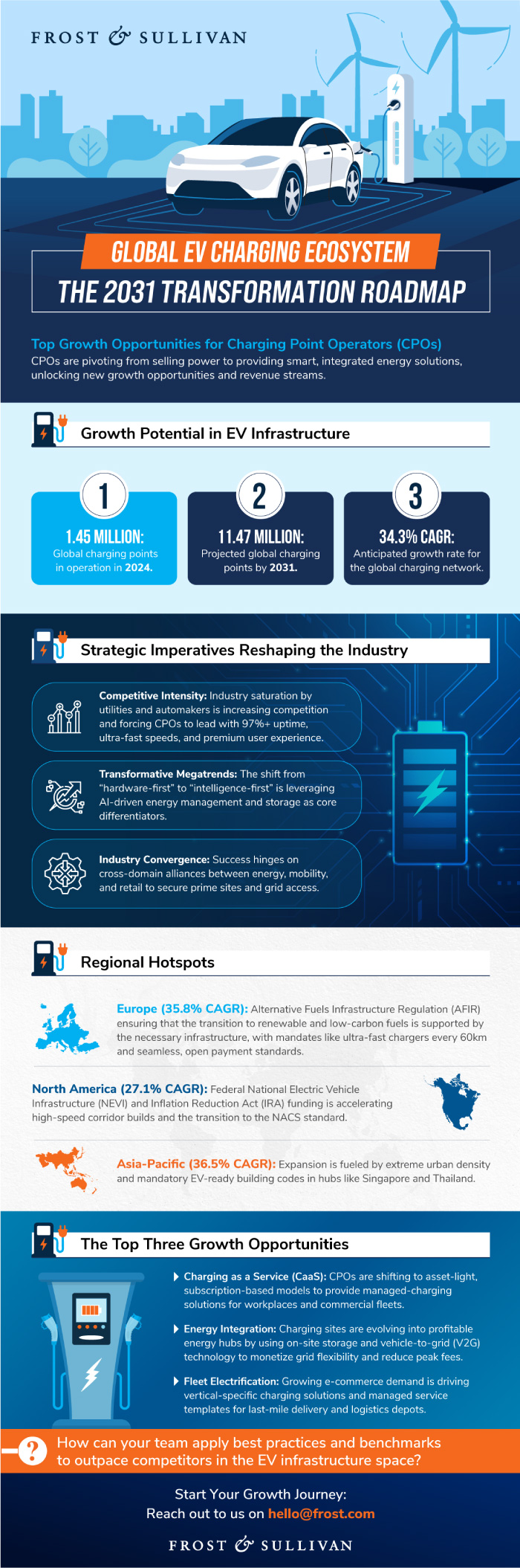
The CPO infrastructure industry is poised to grow at a CAGR of 34.3% between 2024-2031.
READ MORE
Tune into the growth podcast to unlock the latest growth opportunities for CPOs and create a robust revenue pipeline.
– Listen Here–
Key Strategic Imperatives Shaping CPO Growth
- Competitive Intensity Is Accelerating the Platform Shift
The EV charging infrastructure industry is no longer the domain of pure-play operators alone. Utilities, automakers, and energy companies are stepping in with faster charging speeds, higher uptime guarantees, and integrated energy services.
For CPOs, the implication is clear – competitive differentiation is no longer about the number of chargers deployed, but the intelligence embedded in those networks. Operators that leverage data analytics, energy intelligence, and customer experience platforms are carving out defensible positions in an increasingly crowded industry.
- Transformative Megatrends Are Demanding New Business Models
The operators thriving in this environment are those embracing transformative technologies and business model innovation. Charging-as-a-Service (CaaS), for instance, is gaining traction as fleet electrification accelerates across Europe and North America. CPOs are partnering with real estate firms, corporate fleets, and office parks to deploy scalable, subscription-based charging infrastructure. This model shifts capital expenditure from the end user to the operator.
Meanwhile, energy integration in EV charging is turning what was once a cost center into a profit engine. By integrating battery storage, AI-driven load optimization, and grid services monetization, CPOs are converting high peak-demand costs into sustainable revenue. Fast-charging sites that once faced crippling demand charges, often accounting for 40% to 80% of operating costs, are now monetizing flexibility by discharging energy back to the grid during critical periods.
- Industry Convergence Is Creating Cross-sector Growth Pathways
EV charging infrastructure is evolving and CPOs are partnering with energy companies, automakers, and real estate players to get faster access to capital, prime locations, and broader customer ecosystems.
Partnerships with energy companies are enabling optimized power procurement and demand management. Collaborations with automakers are driving higher utilization rates through bundled offerings. Real estate alliances are securing high-traffic locations with minimal friction.
Is your organization re-aligning its growth strategy with these key strategic imperatives?
Five Growth Drivers CPOs Cannot Afford to Ignore
Beyond the strategic imperatives, five fundamental growth drivers are reshaping the EV charging infrastructure landscape and creating new avenues for CPO expansion:
Unlock the latest growth opportunities across the EV landscape.
READ:
- Electric Vehicle Charging Infrastructure Industry, India
- Top Growth Opportunities for CPOs
- Meeting the EV Infrastructure Demand
Consumer interest in EVs is pushing automakers to launch EV-only lineups and phase out internal combustion engines (ICEs). This shift is creating a huge demand for accessible, reliable charging infrastructure, particularly in underserved urban and suburban regions. - Technology Advancements Are Enhancing User Experience
The development of ultra-fast charging solutions and the adoption of open standards are improving interoperability and reducing charge times. For CPOs, investing in next-generation charging architectures is crucial for customer retention and network competitiveness. - Business Diversification Is Expanding the CPO Ecosystem
Utility companies are venturing into charging point operations, offering EV charging services alongside grid integration solutions. This diversification is blurring traditional industry boundaries and creating new competitive dynamics. - Fleet Electrification Is Driving Self-operated Infrastructure Demand
As shared mobility providers and logistics companies electrify their fleets, the demand for dedicated, self-operated charging infrastructure is surging. CPOs that can deliver turnkey fleet charging solutions complete with depot charging, route optimization, and energy management, are capturing significant industry share. - Environmental, Social, and Governance (ESG) Mandates Are Accelerating Investment in On-site Charging
Corporate stakeholders are investing heavily in on-site EV charging solutions to meet ESG commitments. For CPOs, this represents a lucrative business-to-business (B2B) growth channel with long-term contract potential.
Get In-depth Knowledge About Latest CPO Growth Opportunities: Listen to our PODCAST now!
Which growth processes and best practices will help you lead the EV infrastructure transformation?
The Path Forward: From Infrastructure to Intelligence
The most compelling growth opportunities in the industry require CPOs to evolve from infrastructure providers into intelligent energy and technology platforms. This means building digital capabilities, forging strategic partnerships, and developing diversified revenue models that extend well beyond kilowatt-hour sales.
For operators still focused primarily on hardware deployment and site selection, the window for strategic repositioning is narrowing. The CPOs that will lead the next phase of EV charging infrastructure growth are those investing now in AI-driven asset management, energy integration in EV charging, and cross-industry collaboration.
Frequently Asked Questions
- How is the CPO role changing in 2026?
CPOs are evolving from hardware installers into intelligent energy partners. The focus has shifted from “total chargers deployed” to using AI for grid management and seamless digital user experiences.
- What is Charging-as-a-Service (CaaS)?
CaaS is a subscription model where the CPO handles all upfront costs and maintenance for a monthly fee. This allows businesses and fleets to scale charging infrastructure without heavy capital investment.
- How does energy integration increase CPO profits?
By using battery storage and Vehicle-to-grid (V2G) technology, CPOs can sell power back to the grid during peak times, turning electricity costs into a high-margin revenue stream.
- Why move from hardware to platform-based models?
In a crowded industry, data is the differentiator. Platforms allow for predictive maintenance and dynamic pricing, offering a more scalable and defensible business than just selling hardware.
- How are ESG mandates driving CPO growth?
Corporate sustainability targets are forcing businesses to electrify their sites. This creates a massive B2B growth channel for CPOs through long-term contracts for workplace and fleet charging.
Ready to Lead the Transformation?
- Book a Growth Strategy Session: Align your growth roadmap with Frost & Sullivan’s Visionary Growth Pipeline™ Dialog.
- Engage with Growth Experts: Co-design AI-enabled, data-driven operating models that scale industry-specific and commercial impact.
- Share Your Transformation Story: Position your organization as a transformation leader through Frost & Sullivan’s Transformational Growth Leadership platform.
- Join the Growth Council: Collaborate with industry leaders shaping the future of your ecosystem.
- Nominate for the Best Practices Recognition: Be recognized for excellence in growth strategy, execution, and customer impact.
- Demonstrate Industry Positioning on the Frost Radar™: Benchmark your growth performance and innovation strength against industry competitors.
- Activate Brand & Demand Growth: Accelerate awareness, engagement, and revenue growth through integrated brand and demand generation strategies.
Annexure: EV Infrastructure, Energy Integration, and Platform Innovation
Frost & Sullivan has curated analyses that highlight growth opportunities, strategic imperatives, and technological transformations across the EV charging infrastructure segment, offering critical insights for innovation and modernization.
Here are a few of them that you would like reading: