This blog is based on the recent Frost & Sullivan analysis, “Global Digital Health Solutions for Behavioral Health Management, forecast to 2031,” authored by Alejandra Parra, Research Analyst, Healthcare & Life Sciences Practice.
Demand for mental health services continues to rise, but traditional care models are struggling to keep pace. Persistent workforce shortages and limited access to timely support are prompting employers, payers, and health systems to reconsider how behavioral healthcare is delivered. Reflecting this change, the global digital health solutions market for behavioral health management is projected to reach $9,956.0 million by 2031, at a CAGR of 14.9%.
Explore the Future of Behavioral Healthcare
Learn how telebehavioral care, digital therapeutics, and workflow innovation are transforming care delivery.
This shift is changing the role of digital behavioral health platforms. Telebehavioral care remains an important access point, but its role is expanding. Platforms now include care navigation, digital therapeutics, workflow automation, and tools that track treatment outcomes.
Enterprise buyers are also looking beyond isolated consumer applications to integrated platforms that connect access, intervention, and analytics to address clinical and operational needs. This transition is opening opportunities for digital health companies to support more coordinated behavioral healthcare through scalable delivery models.
Listen to our latest podcast episode on behavioral health management.
Top 3 Strategic Imperatives Impacting Digital Health Solutions
- Disruptive Technologies
Clinician shortages are increasing the need for digital tools that extend support beyond scheduled sessions. Artificial intelligence (AI), digital therapeutics, and remote monitoring can help identify needs earlier and provide more personalized, ongoing care. Their growing use alongside traditional therapy is expanding how and when behavioral healthcare can be delivered.
- Innovative Business Models
Session-based therapy alone cannot meet the need for prevention, ongoing support, and relapse management. Subscription, bundled, and hybrid models address this gap by bringing different forms of care into a connected experience. This approach also helps employers and payers evaluate the impact of behavioral health programs on productivity and healthcare costs.
- Customer Value Chain Compression
Multiple steps and fragmented referrals can delay access to behavioral healthcare. Digital assessments, triage, and automated routing help connect individuals with suitable care more quickly. Integrated platforms are creating a simpler path from identifying a need to receiving support.
Behavioral Health Management Landscape at a Glance
Traditional vs. Behavioral Health Management Model
Behavioral healthcare is moving from episodic treatment toward technology-supported management. The comparison below shows how this change affects care delivery, follow-up, and outcome measurement:
| Traditional Treatment Model | Behavioral Health Management Model |
| Symptom-driven and short-term | Continuous and proactive |
| Centered on in-person visits | Digital-first and hybrid |
| Limited follow-up | Self-management, monitoring, and relapse prevention |
| Fragmented tools and data silos | Integrated platforms and data flows |
| Visit completion | Outcomes, engagement, and population impact |
Role of AI in Behavioral Health Management
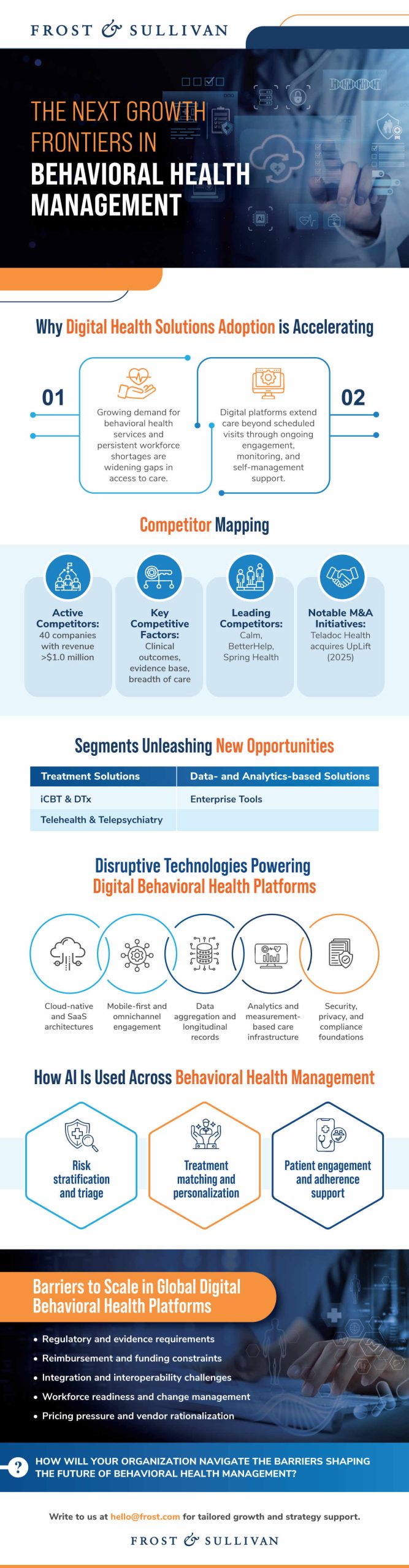
AI is helping behavioral health platforms personalize care, improve efficiency, and extend support at scale. Adoption remains gradual, because these applications involve sensitive health data, clinical oversight, and strict evidence requirements.
- Where AI is used today: Risk assessment, triage, treatment personalization, and patient engagement.
- Emerging uses: Clinical decision support, predictive analytics, and relapse detection.
- What AI is not replacing: Clinicians, therapists, psychiatric diagnosis, or human oversight in care delivery.
- Barriers to adoption: Regulatory requirements, sensitive health data, and the need to build stakeholder trust continue to limit wider use.
Barriers to Scaling Digital Health Solutions
Scaling digital behavioral health platforms requires companies to address the following challenges first:
- Regulation and evidence: Strict evidence and approval requirements can slow market expansion.
- Reimbursement and funding: Uneven coverage across regions and buyers can limit large-scale deployment.
- System integration: Connecting platforms with health records, payer systems, and employer systems can add time and cost.
- Workforce readiness: Differences in clinician adoption and workflows can limit how widely digital tools are used.
- Pricing and vendor pressure: Closer buyer scrutiny is driving consolidation and putting smaller vendors under pressure.
Companies to Action: Advancing Digital Health Solutions
Vendors compete across three main areas, each serving a different part of the behavioral health journey:
- Telebehavioral care: The most competitive segment includes Teladoc Health, Lyra Health, Spring Health, and Modern Health, which offer large therapist networks, hybrid care, and services for employers and payers.
- Digital therapeutics: Big Health and SilverCloud by Amwell offer clinically validated internet-based cognitive behavioral therapy (iCBT) programs that complement clinician-led care.
- Enterprise behavioral health management: Lyra Health, Spring Health, and NeuroFlow bring together analytics, patient monitoring, and care coordination for employer and provider programs.
Emerging Opportunities in Behavioral Health Management
Future growth is likely to come from reaching people earlier and providing support across different stages of life.
- Preventive Care and Longevity: Mental health support is beginning earlier, before a person reaches a point of crisis. The focus now includes stress, sleep, emotional resilience, and cognitive health, with screening and coaching becoming part of primary care, virtual care, and workplace benefits.
- Neurodivergence and Brain Health: Support for attention-deficit/hyperactivity disorder (ADHD), autism, and other cognitive differences is no longer limited to childhood. Digital assessments, behavioral tools, and executive-function coaching provide ongoing support across healthcare, education, and the workplace.
Future Outlook
Digital behavioral health companies need to show that their solutions remain useful beyond the first consultation or intervention. Platforms covering early screening, treatment, and long-term management can play a greater role in employer, payer, and provider strategies.
According to Frost & Sullivan, the market is moving from feature-led competition toward measurable improvements in care, engagement, and cost. Companies that deliver these results while simplifying access are more likely to secure long-term enterprise partnerships.
Frequently Asked Questions
What Is Behavioral Health Management?
Behavioral health management is the coordinated delivery of services that address mental health, substance use, and related behavioral conditions. It includes prevention, screening, diagnosis, treatment, care coordination, medication management, and ongoing patient support. Digital solutions increasingly help improve access, personalize care, monitor outcomes, and connect patients with providers across care settings.
What Are the Types of Behavioral Health?
Behavioral health encompasses mental health, substance use, and behaviors that affect overall health and well-being. Key areas include anxiety and mood disorders, serious mental illness, substance use disorders, eating disorders, trauma-related conditions, and behavioral factors related to stress, sleep, and treatment adherence.
What Are the 7 Components of Mental Health?
There is no universally accepted list of seven components of mental health. Commonly recognized dimensions include emotional well-being, psychological well-being, social connections, resilience, self-esteem, coping skills, and a sense of purpose. Together, these factors influence how people think, feel, manage stress, build relationships, and function in daily life.
What Are Some Examples of Digital Health Solutions?
Examples of digital health solutions include telehealth platforms, mobile health apps, remote patient monitoring, wearable devices, electronic health records, clinical decision support systems, AI-enabled tools, and digital therapeutics. In behavioral health, these solutions can support virtual care, symptom tracking, patient engagement, and care coordination.
What Is the Role of Digital Health?
Digital health uses technology to make healthcare more accessible, connected, efficient, and personalized. It supports virtual care, remote monitoring, digital communication, data-driven decision-making, and workflow automation. In behavioral health, digital tools can extend care beyond traditional settings and help improve continuity between patients and providers.
What Are the Advantages of Digital Health?
Digital health can improve access to care, convenience, patient engagement, care coordination, and operational efficiency. It can also support continuous monitoring, personalized interventions, and data-driven clinical decisions. However, successful adoption depends on factors such as interoperability, data security, clinical validation, and equitable access.
What Are 10 Common Applications of Artificial Intelligence in Healthcare?
Ten common applications of artificial intelligence (AI) in healthcare include:
- Medical imaging and image analysis
- Clinical decision support
- Disease prediction and risk stratification
- Drug discovery and development
- Personalized treatment recommendations
- Clinical documentation and ambient AI
- Remote patient monitoring
- Administrative and workflow automation
- Patient engagement and virtual assistants
- Population health and predictive analytics
In behavioral health, AI is increasingly used to support clinical documentation, risk identification, patient engagement, personalized care, and workflow automation.
Ready to Lead the Transformation?
- Schedule a Growth Strategy Dialog: Align your growth roadmap with Frost & Sullivan’s Visionary Growth Pipeline™ Dialog.
- Engage with Growth Experts: Co-design AI-enabled, data-driven operating models that scale industry-specific and commercial impact.
- Showcase Your Transformational Leadership: Position your organization as a transformation leader through Frost & Sullivan’s Transformational Growth Leadership platform.
- Join the Growth Council: Collaborate with industry leaders shaping the future of your ecosystem.
- Explore Best Practices Recognition: Be recognized for excellence in growth strategy, execution, and customer impact.
- Benchmark Your Industry Positioning on the Frost Radar™: Benchmark your growth performance and innovation strength against industry competitors.
- Tell Your Story: Accelerate awareness, engagement, and revenue growth through integrated brand and demand generation strategies.